
Most blackout curtains that get ruined in the wash aren’t ruined by soap or by washing too often. They’re ruined because the wrong method got applied to the wrong construction.
A blackout curtain built from a dense triple-weave fabric handles a normal cold machine wash just fine. A blackout curtain built from a foam or coated backing does not, and treating the two the same way is the single most common reason a blackout curtain loses its light-blocking ability within a year.
Check the back of the panel before washing anything. A woven or fabric-lined back tolerates a cold, gentle machine cycle with mild detergent. A foam, rubbery, or sprayed-feeling back needs hand washing or the gentlest cold cycle at most, and heat in any form, hot water, the dryer, or a direct iron, is what cracks and peels that coating permanently. Twice-yearly washing with monthly dusting in between covers most households, and the panel should always finish drying hanging on its own rod rather than in a dryer.
Identifying Which Type of Blackout Curtain You Own
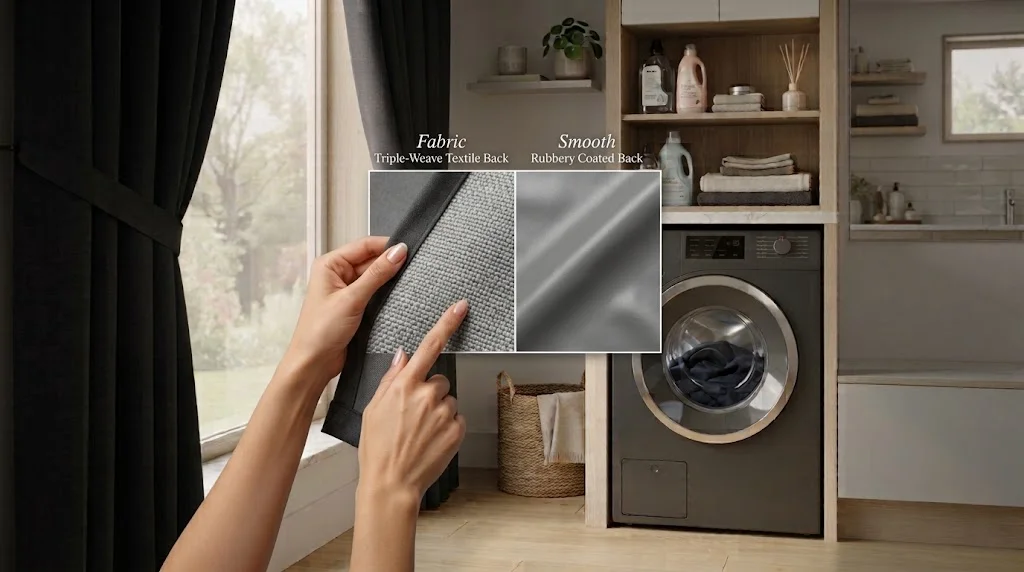
Turn the panel over and check the back. If it looks and feels like fabric, whether that’s the same weave as the front or a separate lighter liner sewn in, it’s a washable, woven panel. If the back looks smooth or shiny, or feels a bit rubbery, it’s a coated panel, and that changes how you should treat it from here on.
Check the care label first if it’s still there and readable, since it settles the question for good. If there’s no label left, the back-of-panel check works just as well and only takes about ten seconds.
Preparing Blackout Curtains Before Washing
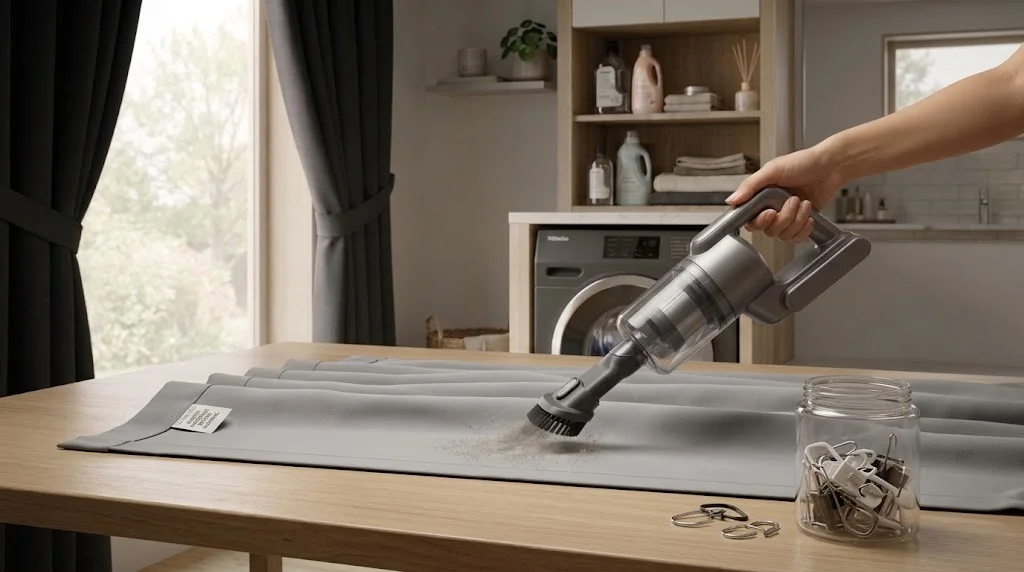
Vacuum the panel first using a brush attachment on low suction. This clears loose dust before washing, since wet dust turns into paste that’s much harder to rinse out than dry dust.
Take off any hooks or rings before washing. This stops them from snagging or marking the fabric during the cycle.
Check the care label one more time, even if you’ve already done the back-of-panel check. Some panels come with specific instructions from the manufacturer that differ from the general guidance above.
Can Blackout Curtains Be Machine Washed?
Yes, woven and fabric-lined blackout curtains can go in the machine on a cold, gentle cycle with mild detergent and nothing else added. Foam-coated panels are the ones that cause confusion, since some can handle a very gentle cold cycle in a mostly empty machine, while others need hand washing or spot cleaning only. This is why checking the construction first matters so much, rather than figuring it out partway through.
Try not to wash more than two panels together in one load, no matter the type. A crowded machine makes the fabric rub against itself instead of against the water and detergent. That’s a small issue for ordinary curtains, but a bigger one for coated panels, since the coating can rub off against another panel.
Washing Woven or Triple-Weave Blackout Curtains
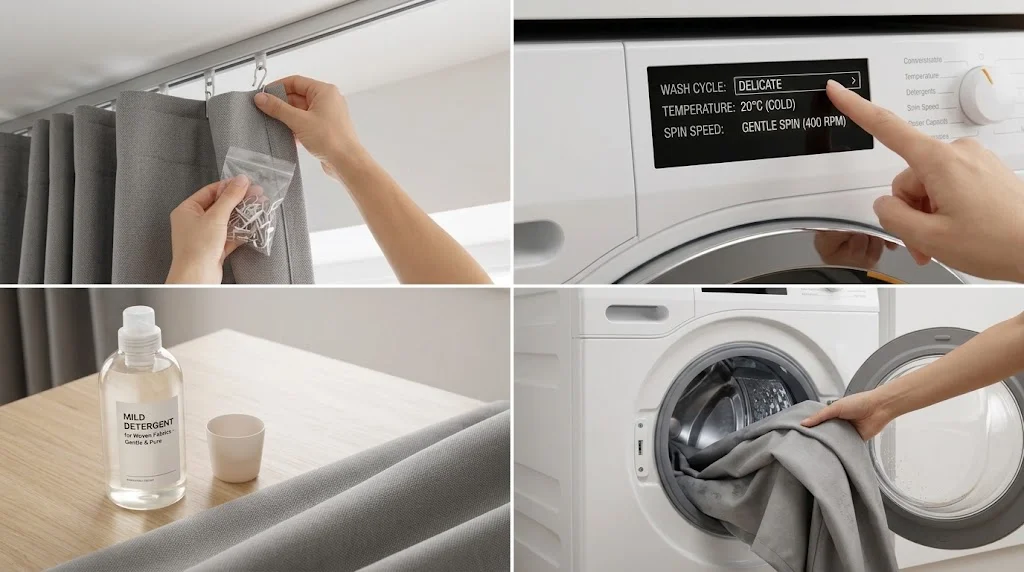
Remove the panel from the rod or track and take out any hooks or rings first, since metal hardware left in during a wash cycle can snag or mark the fabric. Wash cold, on a gentle cycle, one or two panels per load, using a mild detergent with no bleach and no fabric softener, since softener coats fibers and can dull the fabric’s weave over time. Skip a high-speed spin where the machine allows a gentler spin option, and take the panel out as soon as the cycle finishes rather than leaving it damp in the drum.
Washing Foam-Coated Blackout Curtains
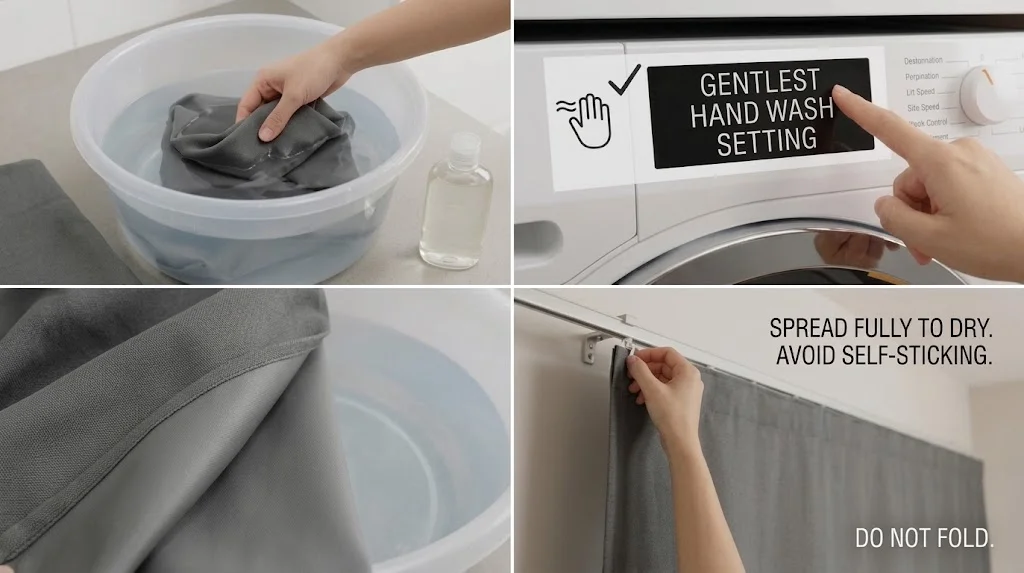
Hand washing is the safer default, and it’s worth treating any machine-wash instruction on the label as the exception rather than the rule. Fill a basin with cold water and a small amount of mild detergent, submerge the panel, and agitate gently by hand rather than scrubbing. Where the label does permit a machine cycle, use the gentlest cold setting available, a mostly empty drum, and wash one panel at a time.
The step that actually protects the coating happens after washing, not during it. Drying two coated panels, or even two folds of the same panel, against each other while still damp is what causes foam backing to stick to itself and peel away when separated. Hanging the panel fully open and spread out, rather than draped over a rail in folds, avoids this specific failure.
Removing Stains Without Bleach
Spot cleaning handles most everyday marks without needing a full wash cycle at all. Dampen a clean cloth with cold water and a small amount of mild soap, then work from the outer edge of the stain inward rather than scrubbing directly at the center, which stops the mark from spreading further into clean fabric. Blot rather than rub, particularly on a coated panel, since rubbing creates exactly the kind of friction against the coating that a full wash cycle would also risk.
Bleach is worth avoiding entirely on any blackout curtain, woven or coated. It breaks down both dye and, on coated panels, the backing chemistry itself, and the discoloration or degradation it causes doesn’t reverse.
Drying Blackout Curtains Without Damage
Hanging the panel back on its own rod while still damp is the method that works across both constructions. The fabric’s own weight pulls out wrinkles as it dries, which reduces or eliminates the need for ironing afterward, and the rod essentially functions as a full-length drying rail rather than needing separate drying space. Keep the panel spread fully open rather than bunched, particularly for a coated back, and keep two damp panels from touching each other directly.
Can Blackout Curtains Go in the Dryer?
For coated panels, no, under any circumstance. The dryer is the single most reliable way to destroy a foam backing. Combining heat and tumbling in exactly the combination that coating can’t tolerate. For woven or fabric-lined panels, a low-heat tumble setting is sometimes acceptable if the label explicitly allows it, but air drying remains the safer choice even for washable constructions, since it avoids any risk of shrinkage or heat exposure altogether.
Why Does Heat Ruin a Blackout Coating?
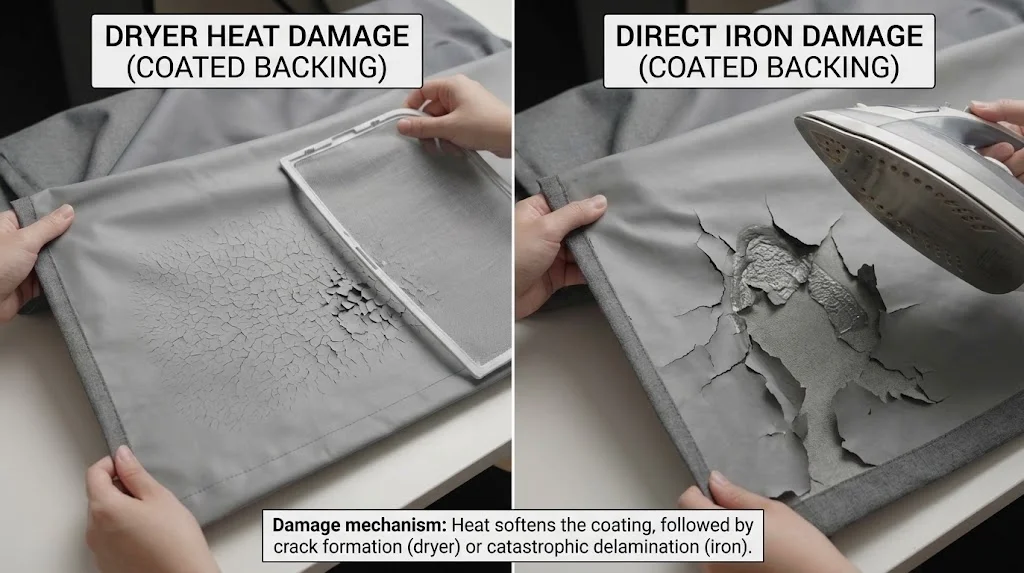
Heat softens the foam or polymer coating, and once softened, it’s far more vulnerable to cracking, stretching, or peeling under any mechanical stress, spinning, folding, or the direct pressure of an iron. A hot wash, a hot dryer cycle, or a hot iron applied straight to the coated side all do a version of the same damage, just at different stages of the process. Once a coating has visibly cracked or started peeling, it doesn’t recover, and the panel’s actual blackout performance drops permanently from that point forward. This is the mechanism behind nearly every “my blackout curtains stopped blocking light” complaint that traces back to washing rather than age.
How Often Should Blackout Curtains Actually Be Washed?
Twice a year is a reasonable baseline for most rooms, timed loosely around a seasonal changeover, paired with a monthly pass using a vacuum’s brush attachment on low suction to keep dust from settling into the weave between full washes. Kitchens, rooms with smokers, or homes near a lot of outdoor dust need this more often. Bedrooms with lower daily traffic often need it less.
| Room type | Suggested full wash frequency | Between-wash care |
|---|---|---|
| Bedroom, low traffic | Twice yearly | Monthly vacuum brush pass |
| Living room, general use | Twice to three times yearly | Monthly vacuum, spot clean as needed |
| Kitchen or high-dust room | Every 2 to 3 months | Weekly vacuum, spot clean promptly |
A useful practical check beyond any fixed schedule: if the panel smells musty or stale when it’s given a light shake, that’s a better trigger for washing than sticking rigidly to a calendar date.
Ironing and Steaming Blackout Curtains Safely
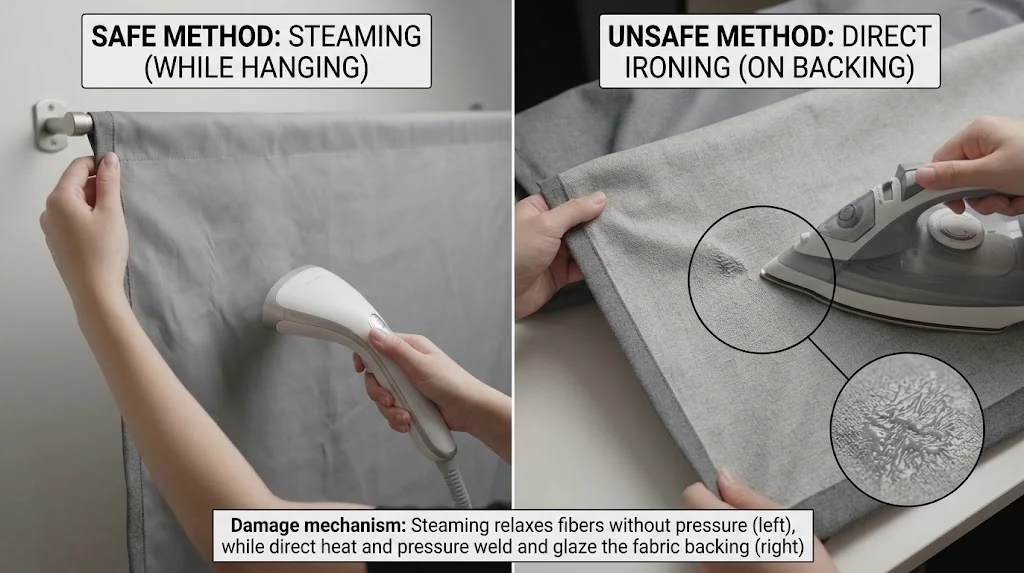
Direct ironing on a coated back is one of the fastest ways to weld and glaze that coating, so any ironing on a coated panel should stay strictly on the fabric face, on a low setting, and never touch the backing at all. Steaming is the gentler option for either construction, since a garment steamer relaxes wrinkles from a distance without direct contact or pressure, and curtains steam perfectly well while still hanging on the rod, which also saves the effort of laying them flat.
Do Blackout Curtains Ever Need Dry Cleaning Instead?
Sometimes, and it depends more on the outer fabric than the blackout construction underneath it. Natural fibers like linen and heavier decorative fabrics such as velvet, when used as the face fabric on a lined blackout curtain, often carry dry-clean-only instructions specifically because washing risks shrinkage or texture change in the outer fabric, separate from whatever the blackout layer itself could tolerate. Where a label specifies dry cleaning, that instruction overrides every washing method covered above, regardless of how the backing is constructed.
What Washing Mistakes Do to a Blackout Curtain
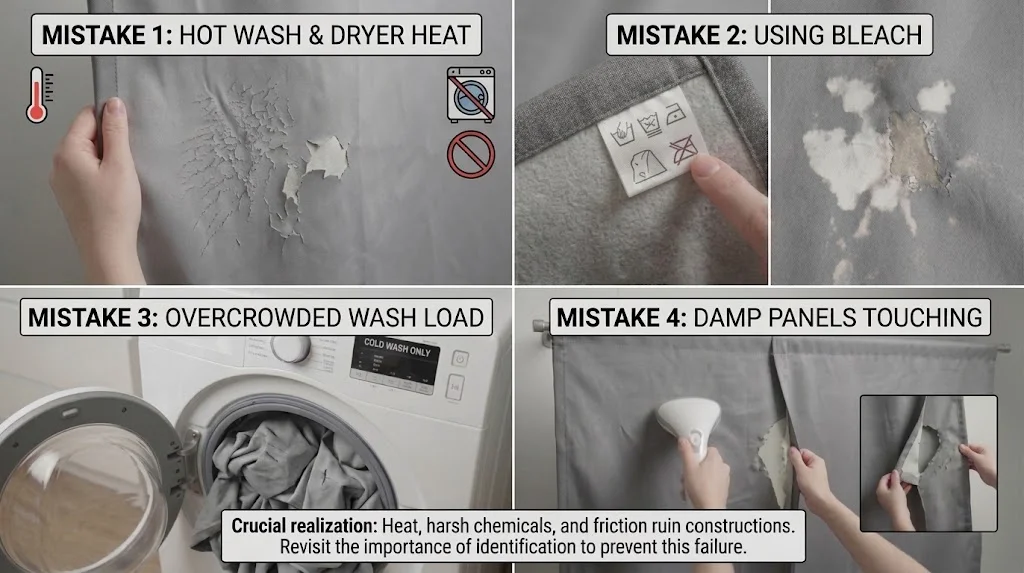
| Mistake | What it does to the curtain |
|---|---|
| Hot water wash on a coated panel | Softens and can crack the backing |
| Dryer heat on a coated panel | Peeling, permanent loss of blackout performance |
| Bleach on either construction | Breaks down dye and, on coated panels, the backing itself |
| Direct iron on the coated side | Welds and glazes the coating, ruins the surface |
| Two damp coated panels touching while drying | Foam backing sticks together and pulls apart on separation |
| Overcrowded wash load | Mechanical abrasion between panels, worse on coated fabric |
Every outcome in that table traces back to heat, harsh chemicals, or friction applied to a construction that wasn’t built to handle it, which circles back to the opening point: identifying the construction before washing anything is what actually prevents this list from happening.
What Are Blackout Curtains Made Of?
Blackout curtains reach their light-blocking effect through one of two genuinely different constructions, and this single fact is the part most washing guides skip entirely.
Woven or Triple-Weave Fabric
Woven blackout fabric, sometimes marketed as triple-weave, achieves darkness through a dense, tightly woven fabric structure, occasionally with a separate sewn-in fabric liner attached behind the main panel. The whole thing, front and back, behaves like ordinary fabric because it is ordinary fabric, just woven far more densely.
Foam-Coated or Backing-Coated Fabric
Foam-coated or backing-coated blackout fabric achieves the same darkness differently, through a layer of foam or polyurethane coating applied to the back of an otherwise normal curtain fabric. That coating is not fabric. It’s closer to a thin rubber sheet bonded to the back of the cloth, and it behaves like one under heat and agitation.
Neither construction is better than the other for daily use. They are dramatically different when it comes to what a washing machine and a dryer will do to them.
Pro Tips for a Damage-Free Wash
- Test a hidden corner before the first wash on any bold or dark colored coated panel. A small dab of cold water and detergent on an inside seam shows whether the dye holds before it’s risked on the full curtain.
- Handle a foam-coated panel at room temperature rather than straight out of a cold wash. The coating is more flexible when it isn’t cold, which lowers the chance of a crease turning into a crack while the panel is being moved or hung.
- Roll a coated panel instead of folding it for storage or a move. A fold sits in one place long enough to leave a permanent line in the coating, while a roll spreads the same bend across a wider curve.
- Keep a leftover fabric scrap from a new curtain purchase and test any stain remover on that first, rather than on a hidden part of the actual panel, since even a hidden section is still attached to the same coating.
- Skip fabric protector sprays on the coated back entirely. They’re fine on the face fabric, but a spray-on treatment can react with the coating underneath in ways a label rarely mentions.
Frequently Asked Questions
Can blackout curtains be machine washed?
Woven and fabric-lined panels generally yes, cold water, gentle cycle, mild detergent, no bleach. Foam-coated panels are the exception, and hand washing or the gentlest cold cycle at most is the safer approach, since machine agitation and heat are what damage that kind of backing specifically.
Can blackout curtains go in the dryer?
Not for foam-coated panels, ever. Dryer heat softens and cracks that backing permanently. Woven panels sometimes tolerate a low-heat tumble if the label allows it, but hanging the panel to air dry on its own rod is the safer choice regardless of construction.
How do I wash blackout curtains without ruining them?
Check the back of the panel first to identify whether it’s woven or coated, wash cold and gentle with mild detergent only, skip bleach and fabric softener entirely, and dry the panel hanging rather than tumbling it. Almost every ruined blackout curtain traces back to skipping that first identification step.
How often should blackout curtains be washed?
Roughly twice a year for most rooms, with a monthly vacuum pass using a brush attachment in between to keep dust from building up. High-dust rooms or kitchens benefit from washing more frequently than that baseline.
Do blackout curtains need dry cleaning?
Sometimes, mainly when the outer fabric is a natural fiber like linen or a heavier decorative weave like velvet, where washing risks shrinkage separate from whatever the blackout backing itself could handle. A dry-clean-only label overrides every washing method regardless of the backing construction underneath.
Why did my blackout curtains stop blocking light after washing?
This almost always points to heat damage on a coated backing, whether from hot water, a dryer cycle, or a direct iron applied to the coated side. Once that coating cracks or peels, the light-blocking performance drops permanently and doesn’t recover with further washing.
Can I iron blackout curtains?
On the fabric face only, at a low setting, never on the coated back. Steaming is the safer option for either construction, since it relaxes wrinkles without direct pressure and works perfectly well while the curtain is still hanging on the rod.