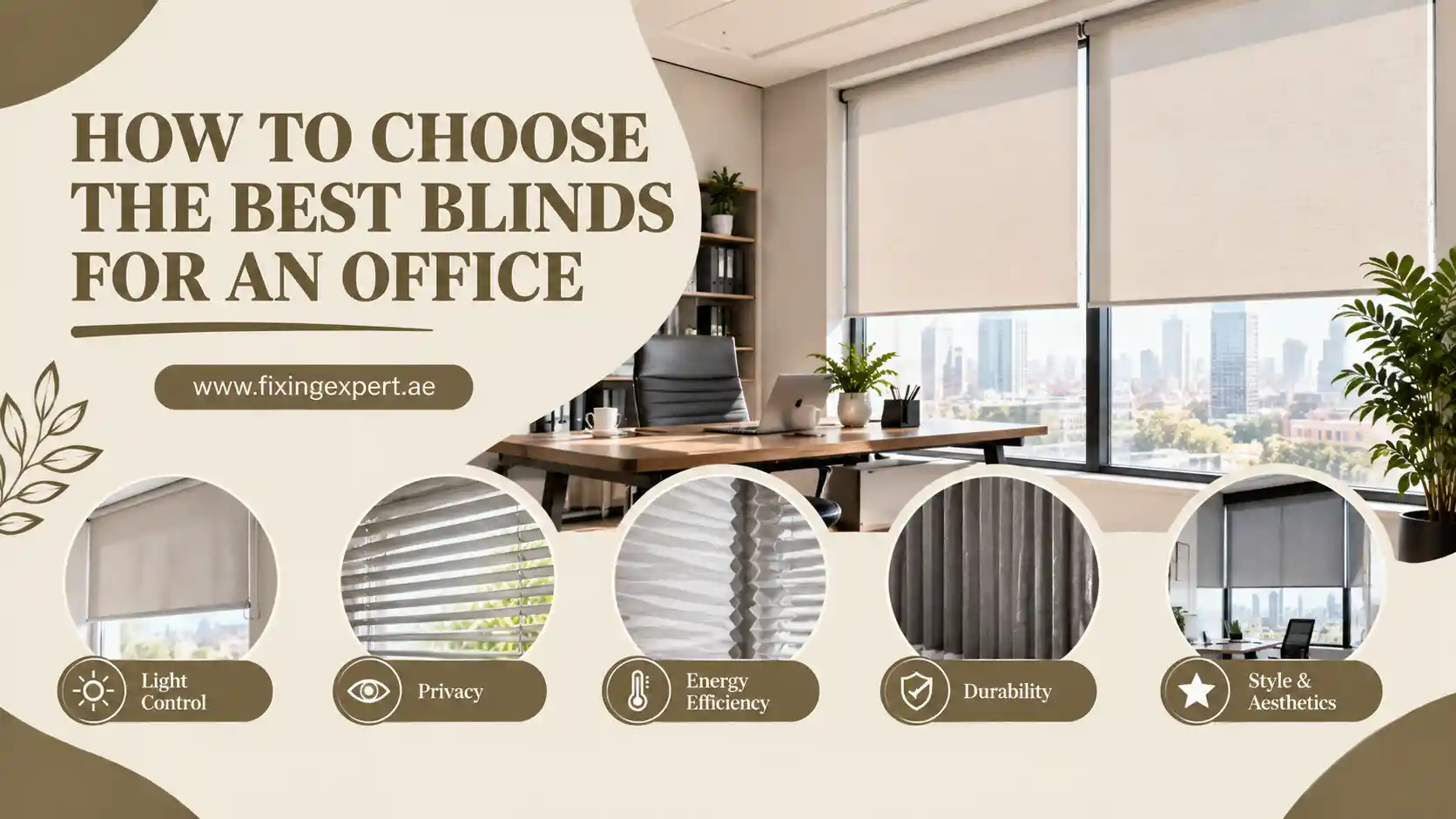
How to choose the best blinds for office comes down to five checks: how much light and glare each window gets, how much privacy each room needs, which fabric suits daily wear, how the blinds are operated and fitted, and what they cost over many years.
A good set of blinds does more than cover glass. It cuts glare on screens, keeps meetings private, softens heat and makes the room look cared for. A poor set does the opposite. Most office blinds go wrong because they are picked by color alone, before anyone checks which way the window faces or who sits next to it. The right window blinds are chosen room by room, using a short list of checks.
WHAT SHOULD YOU CHECK BEFORE YOU CHOOSE BLINDS FOR AN OFFICE?
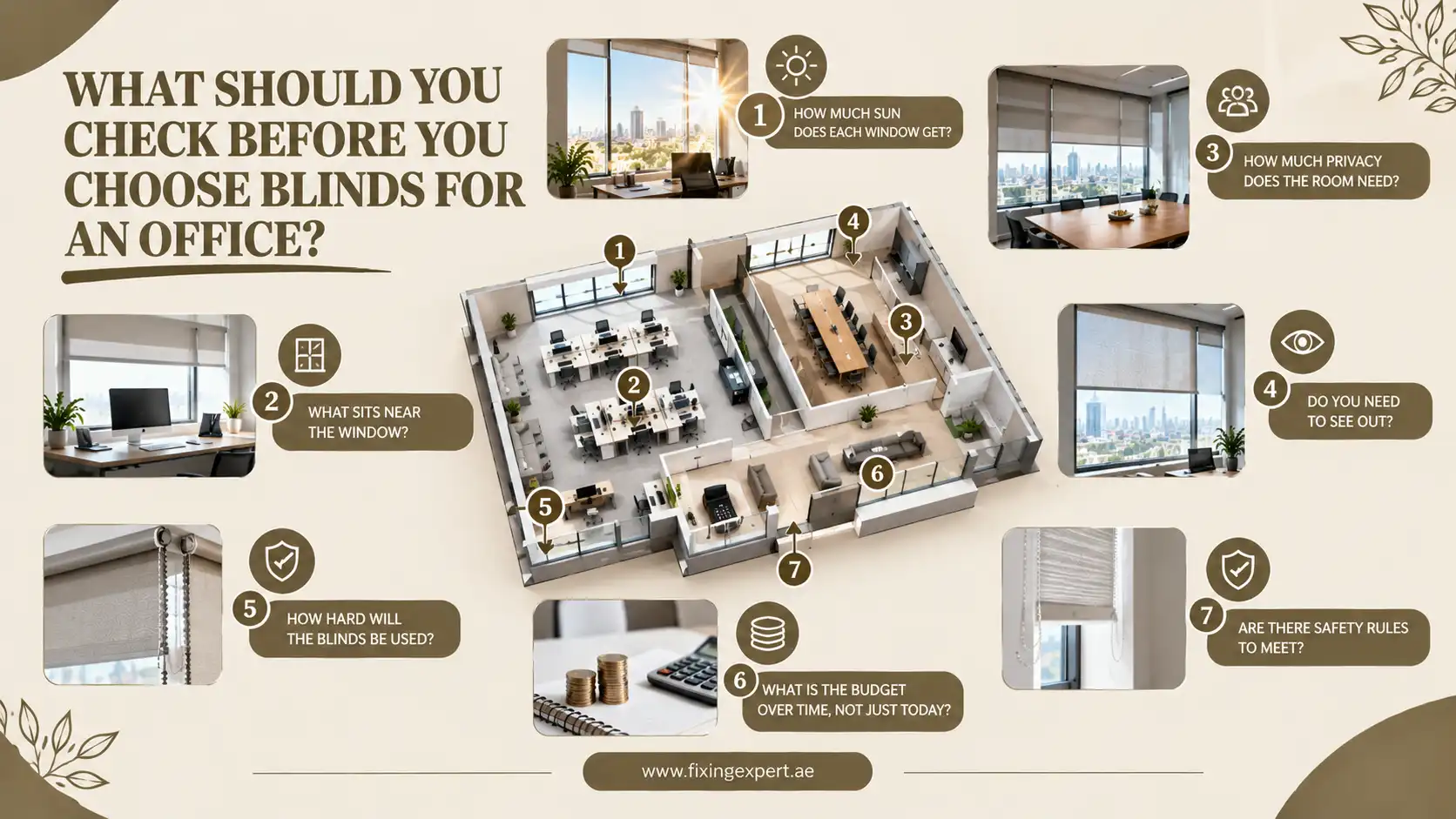
Answer these seven questions first. They save time because they remove most of the wrong options before you look at a single sample.
1. HOW MUCH SUN DOES EACH WINDOW GET?
A window that gets strong afternoon sun needs a different fabric from one that stays shaded all day. Walk the office at three times of day, morning, midday and late afternoon, and note where the sun lands on desks and screens.
2. WHAT SITS NEAR THE WINDOW?
Desks next to glass need glare control first. A meeting room needs darkness on demand. A reception area needs a calm, tidy look because visitors see it first.
3. HOW MUCH PRIVACY DOES THE ROOM NEED?
A meeting room or manager’s office needs high privacy. An open plan floor on a high level may need very little. A ground floor room facing a street needs the most.
4. DO YOU NEED TO SEE OUT?
Some people want the view kept while the glare is cut. Others want a fully closed room. This choice decides between a sunscreen fabric and a blackout fabric.
5. HOW HARD WILL THE BLINDS BE USED?
Blinds in a busy shared room get pulled many times a day. They need strong cords, sturdy headrails and fabric that wipes clean.
6. WHAT IS THE BUDGET OVER TIME, NOT JUST TODAY?
A cheap blind that needs replacing in two years costs more than a sturdier one that lasts ten. Count fitting, repairs and cleaning too.
7. ARE THERE SAFETY RULES TO MEET?
Offices often have rules on cords, fire resistant fabric and child safety if visitors bring children. Check these before ordering, because they limit your choices.
Write the seven answers next to each window on a floor plan. This becomes your shopping brief.
WHICH BLINDS ARE BEST FOR EACH PART OF AN OFFICE?
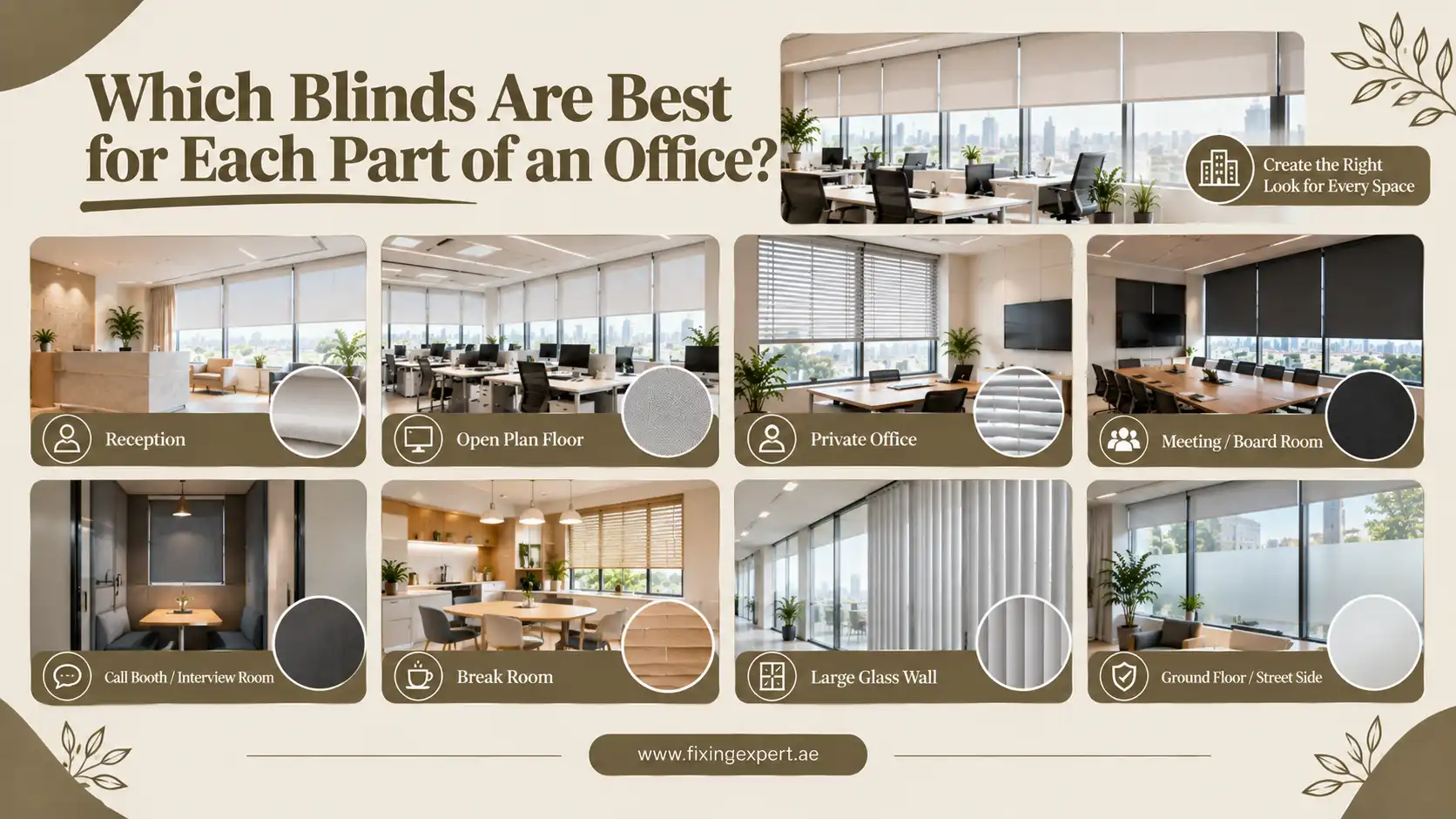
Different areas have different jobs. One blind type rarely suits the whole building, and mixing types is normal in a well planned office.
| Office area | Best blind choice | Why it works |
| Reception | Light filtering roller or Roman style | Soft, tidy look with gentle daylight |
| Open plan floor | Sunscreen roller with low openness | Cuts glare on screens and keeps the view |
| Private office | Venetian or roller | Light angle and privacy are easy to adjust |
| Meeting or board room | Blackout roller, ideally with a sheer layer | Full darkness for screens and presentations |
| Call booth or interview room | Blackout or thick fabric | Privacy and a calm feel |
| Break room | Faux wood or wipeable roller | Handles steam, spills and grease |
| Large glass wall | Vertical or wide roller | Covers a long span with one clean line |
| Ground floor, street side | Higher coverage fabric or frosted option | Stops people seeing in without losing all light |
RECEPTION AND ENTRANCE AREAS
Visitors form an opinion in the first minute. Pick a clean fabric in a neutral color such as white, grey or sand. Keep the blinds even and aligned across all windows, because crooked or half raised blinds look careless.
OPEN PLAN OFFICES
Glare on screens is the main complaint here. A sunscreen roller blind in a low openness fabric keeps the view and cuts the harsh light. Use the same fabric across a whole row of windows so the floor looks consistent.
PRIVATE OFFICES AND MANAGER ROOMS
These rooms need flexible privacy. Venetian blinds tilt the slats to let light in while blocking the view from outside. Roller blinds give clean full coverage when closed.
MEETING AND BOARD ROOMS
Presentation screens need a dark room. Use a blackout fabric, and if you want softer light between meetings, layer a sheer blind or curtain in front. This gives you two settings in one window.
BREAK ROOMS AND KITCHENS
Choose materials that wipe clean. Faux wood and PVC coated fabrics handle steam and splashes better than natural fabrics.
Treat each area as its own project. Fix the job first, then pick the blind that does it.
WHAT ARE THE MAIN TYPES OF OFFICE BLINDS?
Most offices use five main blind types. Each has strengths and limits.
| Blind type | Light control | Privacy | Best for | Watch out for |
| Roller | Good to excellent, by fabric | Good | Almost any office window | Cannot tilt to angle light |
| Vertical | Very good | Very good | Wide glass walls, doors | Vanes can sway or swing |
| Venetian (horizontal slats) | Excellent | Good, adjustable | Private offices, small windows | Slats collect dust |
| Zebra (day and night) | Very good | Good | Modern, bright offices | Needs clean handling of layers |
| Pleated or cellular | Good | Good | Skylights, heat control | Harder to wipe clean |
| Wooden or faux wood | Excellent | Good | Executive rooms, warm style | Heavier, costs more |
ROLLER BLINDS
Roller blinds are the most common office choice. They have a simple, flat design and few moving parts, which keeps repairs low. They come in blackout, light filtering and sunscreen fabrics, so one style covers many jobs. If you want to see the range, roller blinds are available in many fabrics and sizes.
VERTICAL BLINDS
Vertical blinds hang as separate vanes and suit wide glass walls and sliding doors. They draw sideways to open the full width. In a busy office, check that the vanes are sturdy, because thin ones bend and look tired.
VENETIAN BLINDS
Venetian blinds use horizontal slats that tilt. You can angle the slats to bounce light onto the ceiling instead of onto a screen, which gives bright rooms without glare. They suit private offices where one person controls the window.
ZEBRA BLINDS
Zebra blinds alternate solid and sheer stripes on one rolling fabric. Slide the stripes apart and you have a light setting. Align them and you have privacy. Many modern offices like the clean look, and the choice of zebra blinds suits bright rooms where staff want quick control.
PLEATED AND CELLULAR BLINDS
Pleated blinds fold neatly and suit odd shapes and skylights. Cellular versions trap air in small pockets, which adds a layer of insulation. They are harder to clean, so they suit low traffic rooms better than a kitchen.
WOODEN AND FAUX WOOD BLINDS
Wooden blinds give a warm, high end look for executive rooms. Faux wood copies the look and handles moisture and wear better, which makes it easier to keep tidy in busy rooms.
ROMAN BLINDS
Roman blinds fold into soft layers. They look more like fabric than a shade, so they suit reception and meeting areas where appearance matters more than precise light control.
Pick a main type for most windows, then use a second type only where a room needs something special.
HOW MUCH LIGHT SHOULD YOUR OFFICE BLINDS LET THROUGH?
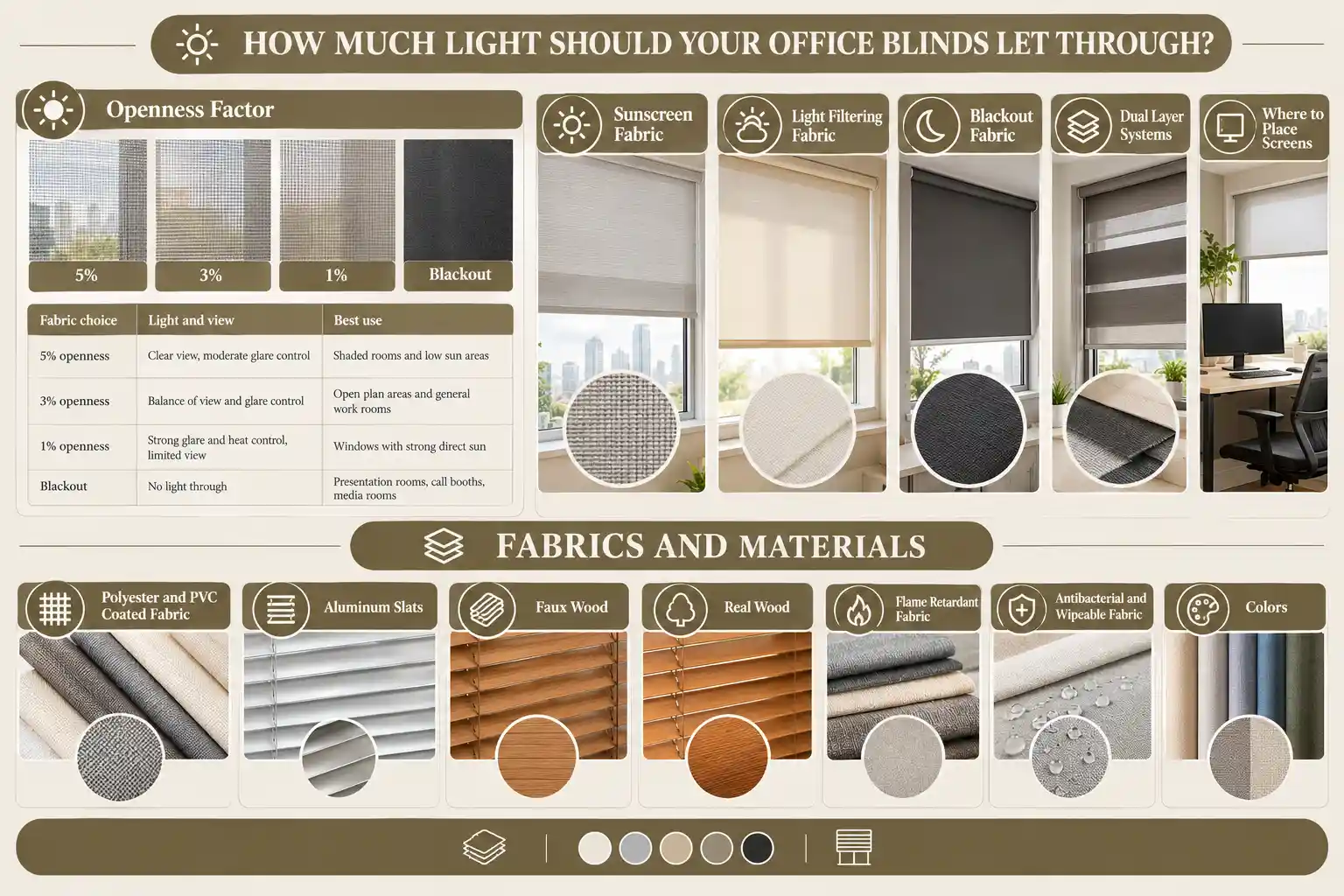
This is the most important choice, and it comes down to one number called openness. The openness factor is the percentage of the fabric that is open weave. A lower number blocks more light and heat but shows less of the view.
| Fabric choice | Light and view | Best use |
| 5% openness | Clear view, moderate glare control | Shaded rooms and low sun areas |
| 3% openness | Balance of view and glare control | Open plan areas and general work rooms |
| 1% openness | Strong glare and heat control, limited view | Windows with strong direct sun |
| Blackout | No light through | Presentation rooms, call booths, media rooms |
SUNSCREEN FABRIC
Sunscreen fabric has a fine woven structure. It filters sun and cuts glare, and many types also block a large share of UV rays. People can still see the outside, so the room feels open. This is the usual pick for desks that face screens.
LIGHT FILTERING FABRIC
Light filtering fabric is solid but thin, so light glows through while the view is blocked. It suits rooms that need privacy and soft daylight, such as private offices and reception.
BLACKOUT FABRIC
Blackout fabric blocks nearly all light. It is best for meeting rooms that use screens and projectors. A fabric with a coated backing keeps the room dark even at midday. Therange of blackout blinds includes many colors, so a dark room does not have to look dull.
DUAL LAYER SYSTEMS
Some offices fit two layers on one window, a sunscreen layer and a blackout layer. Staff use the first for daily work and the second for presentations. This costs more but gives full control.
WHERE TO PLACE SCREENS
Place monitors at right angles to the window, not facing it or with the window behind them. Even good blinds work better when the screen is not aimed straight at the light.
For most desks, a 3% or 5% sunscreen fabric works well. Reserve blackout for rooms with screens or a need for full darkness.
FABRICS AND MATERIALS
The blind fabric decides how long the blind lasts and how easy it is to look after.
POLYESTER AND PVC COATED FABRIC
Polyester blends are the most common office fabric. They resist fading and wipe clean. PVC coating adds moisture resistance, which helps in kitchens and near windows that get condensation.
ALUMINUM SLATS
Aluminum is light, strong and easy to wipe. It suits venetian blinds in busy rooms. Thin slats can bend if handled roughly, so choose a thicker gauge in shared spaces.
FAUX WOOD
Faux wood handles humidity and temperature changes better than real wood. It is a safe choice for break rooms and rooms near a kitchen.
REAL WOOD
Real wood gives a rich look for senior offices and boardrooms. It needs gentler cleaning and does not like moisture.
FLAME RETARDANT FABRIC
Many offices need fabric that resists fire or slows its spread. Ask the supplier for the fabric certificate before you buy, and keep a copy for your records.
ANTIBACTERIAL AND WIPEABLE FABRIC
Hygiene matters in shared offices. Antibacterial coatings and wipeable surfaces help in reception areas, break rooms and any space many people touch.
COLORS
Neutral colors such as white, grey, beige and black are safe and look professional. Light colors reflect heat and keep a room bright. Dark colors cut glare more but can make a small room feel closed in. If your company has brand colors, you can echo them in one room or in an accent area. For a deeper look at fabrics and styles, this overview of types of window blinds and their materials explains how each one behaves.
Pick fabric by use. Wipeable for busy rooms, flame rated where rules require it, and neutral colors where you want a calm look.
WHICH WINDOW DIRECTION MATTERS FOR OFFICE BLINDS?
The direction a window faces changes how much sun it gets and when. In the northern hemisphere the pattern looks like this.
| Window faces | Sun pattern | Blind approach |
| North | Soft, steady light, little direct sun | Lighter fabric, higher openness such as 5% |
| East | Strong low sun in the morning | Adjustable blinds, easy to angle or lower |
| South | Bright sun at midday, high in the sky | Low openness fabric, 3% or 1% |
| West | Hot, low sun in the afternoon | Low openness fabric or blackout in key rooms |
INSIDE OR OUTSIDE SHADING
Shading on the outside of the glass stops heat before it enters the room. Blinds on the inside cool the room less, because the sun has already warmed the glass. If outside shading is possible, it reduces heat the most. Where it is not possible, choose a reflective backed fabric on the inside, and use air conditioning for the hottest days.
CORNER OFFICES AND GLASS WALLS
Floor to ceiling glass on two sides gets sun at several times of day. Use matching blinds on both sides so the room looks balanced, and consider motors so one control moves all of them together.
Walk the building and note which windows face west and south. Those need the strongest glare control.
HOW DO BLINDS HELP WITH HEAT AND ENERGY COSTS?
Blinds change how much heat comes in and how much light you need to switch on.
LESS HEAT IN SUMMER
Reflective or light colored fabric bounces some sun back out through the glass. A tight weave with low openness keeps more heat out. Closing blinds during the hottest hours lowers the load on the air conditioning.
LESS LIGHTING NEEDED
Good daylight control means staff can work with the lights off for more of the day. Sunscreen fabric keeps the room bright without the harsh patches.
A STEADY ROOM TEMPERATURE
Most people work best in a room that stays around 21 to 23 degrees Celsius. Blinds cannot hold that alone, but they make it far easier for the cooling system to keep it steady.
CELLULAR BLINDS
Cellular blinds trap air in honeycomb pockets, which adds a thin layer of insulation. They help in rooms that lose heat in cold months and gain it in warm ones.
Choose lighter, reflective, tighter weave fabrics on sunny sides, and add motors or timers if the blinds are hard to manage by hand.
DO OFFICE BLINDS HELP WITH PRIVACY AND NOISE?
Yes for privacy, and a little for sound.
PRIVACY
Privacy depends on the fabric and the time of day. In daytime, a light filtering fabric hides people inside. After dark, with the lights on, almost any light fabric shows silhouettes, so a thicker or blackout fabric is better for rooms used at night. Frosted or opaque options suit ground floor rooms that face a street.
MEETING ROOM PRIVACY
Meetings often cover private topics. A closed blind plus a thicker fabric stops outsiders from seeing screens or papers through the glass.
NOISE
Blinds do not make a room soundproof. Thicker fabrics and a lining can reduce echo, which makes a room feel calmer and easier to talk in. If noise is a real problem, read how soundproofing with curtains or blinds works to see what each can and cannot do.
Match the fabric to the privacy level of the room, and do not expect blinds alone to fix a noisy space.
SHOULD YOU CHOOSE MANUAL OR MOTORIZED BLINDS FOR AN OFFICE?
Both work well. The best choice depends on the size of the windows and how often the blinds change position.
| Option | Strengths | Limits |
| Chain operated | Low cost, simple, easy to repair | Cords need safety fittings, slower on large windows |
| Cordless spring | Clean look, no loose cords | Heavy or wide blinds are harder to lift |
| Motorized with remote | Smooth, quiet, very easy for large or high windows | Higher cost, needs power or battery |
| Motorized with timer or sensor | Moves blinds on a schedule or with sunlight | Needs setup and testing |
WHEN MOTORS MAKE SENSE
Motors suit wide windows, high windows and large floors where dozens of blinds must move together. One button or one timer keeps them all level, which makes the whole building look neat. A wide range of motorized blinds can be controlled by remote, wall switch or app.
SMART CONTROLS
Some systems link blinds to a timer, a light sensor or a building system. They lower in the afternoon sun and rise in the evening without anyone touching them. This reduces glare, saves cooling energy and takes a job off the office manager.
MANUAL
For a small office with a few windows, chain operated or cordless blinds are simple and cheap. Fit a cord tensioner or choose a cordless style to keep loose loops away from children and pets.
Use manual blinds for small, low traffic rooms and motorized blinds for large, high or heavily used windows.
WHAT SAFETY RULES SHOULD OFFICE BLINDS MEET?
Safety is easy to fix when you plan for it early and expensive to fix later.
CORDS AND CHAINS
Loose cords can be a danger, especially where children visit. Choose cordless blinds, or fix chain loops to the wall with a tensioner or safety clip.
FIRE RESISTANCE
Many offices need blinds made from fabric with a fire rating. Ask for certificates and keep them with building records.
CHILD SAFETY
Even in an office, visitors bring children, and some offices include play areas or waiting rooms. Keep furniture away from windows so a child cannot climb up to the cords.
STRONG FIXINGS
Heavy or wide blinds need strong brackets and plugs that suit the wall. A blind that falls is a safety problem as well as a repair bill.
Plan cord safety, fabric certificates and strong brackets at the start, and write them into the order.
HOW DO YOU PLAN THE BUDGET FOR OFFICE BLINDS?
Price is made of several parts. Look at all of them, not just the headline number.
| Cost factor | What changes the price |
| Size | Wider and taller blinds use more fabric and bigger mechanisms |
| Fabric | Blackout, flame rated and coated fabrics usually cost more |
| Mechanism | Chain, cordless spring or motor |
| Motors and controls | Remote, app, timer, sensor and building links |
| Custom shapes | Angled, curved or oversized windows |
| Fitting | Number of windows, height and wall type |
| Repairs and cleaning | Ongoing cost over the years |
COST OVER TIME
A blind that lasts ten years at a moderate price beats a cheap one replaced every two or three years. Ask about warranty length and the parts covered.
BUY IN MATCHING SETS
Ordering all blinds for a floor from one batch keeps fabric color and size consistent. Reordering later can lead to small color differences between dye batches.
ASK FOR SAMPLES
Request fabric samples and hold them against the window at different times of day. Colors look different on a screen and in sunlight.
Compare total cost across the life of the blinds, and buy matching batches for rooms that share a view.
HOW DO YOU MEASURE AND FIT OFFICE BLINDS?
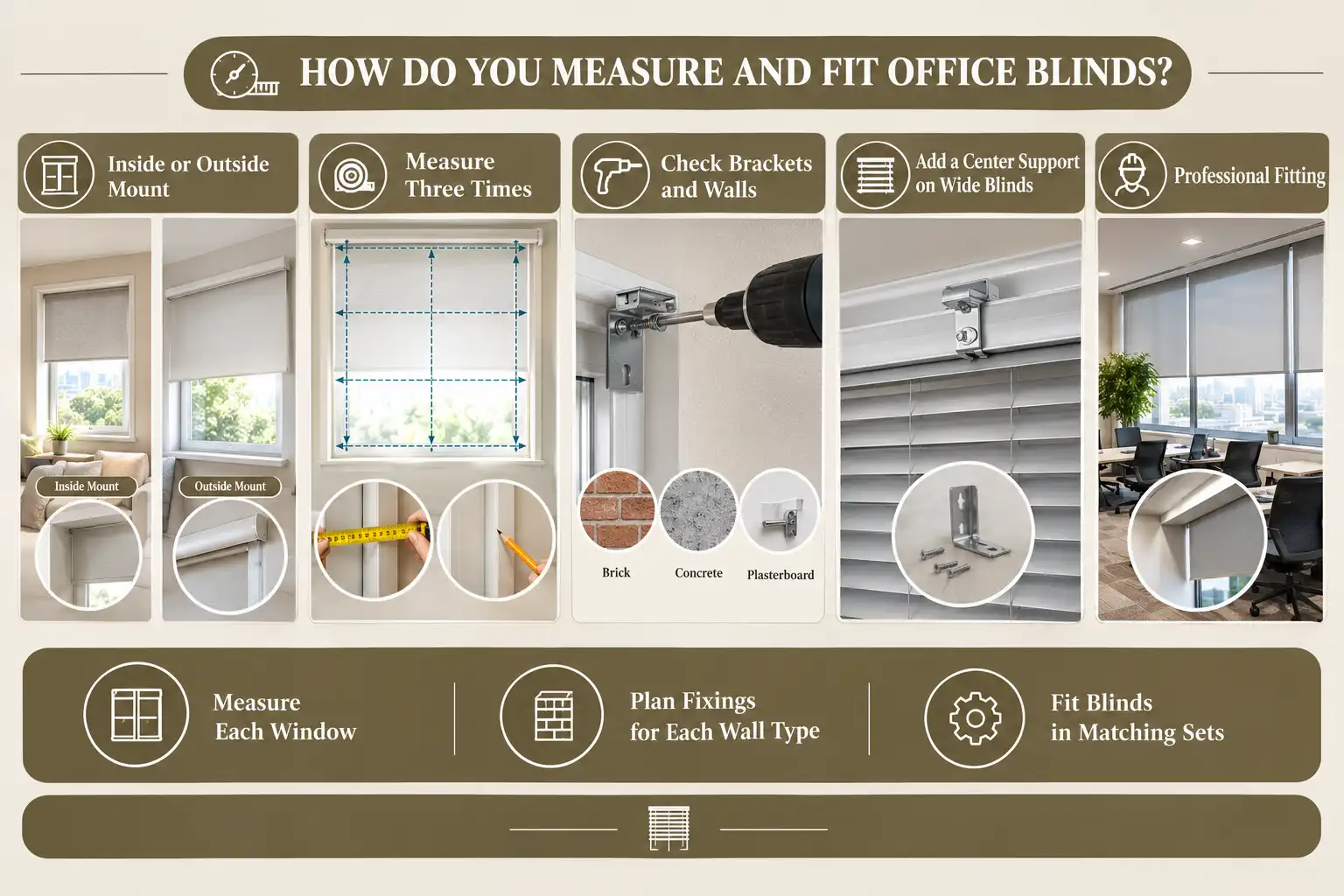
Correct measuring avoids most fitting problems. A few rules cover nearly every window.
INSIDE OR OUTSIDE MOUNT
An inside mount sits within the window recess and gives a tidy look, but the recess must be deep enough. An outside mount sits on the wall or frame above the window. It works with any recess andblocks more light at the edges.
MEASURE THREE TIMES
Measure width at the top, middle and bottom, and drop on the left, center and right. For an inside mount, use the smallest number in each case. Window recesses are rarely perfectly square.
CHECK BRACKETS AND WALLS
Check what the wall is made of before ordering. Brick and concrete need plugs and the right bit. Plasterboard needs fixings made for it, and heavy blinds need to find a stud or solid support.
ADD A CENTER SUPPORT ON WIDE BLINDS
A wide blind tube can sag in the middle. A third bracket keeps it level.
PROFESSIONAL FITTING
Large offices, high windows and motorized systems are quicker and safer with trained fitters. Professional blinds installation also keeps all the blinds aligned across a floor, which makes the whole building look neat.
Measure each window on its own, plan the fixings for each wall type, and fit blinds in matching sets.
HOW DO YOU CARE FOR OFFICE BLINDS?
A few small habits keep blinds working and looking good.
- Dust them every one to two weeks with a soft cloth or a vacuum brush.
- Wipe them with a damp cloth once a month in busy rooms.
- Check chains, cords and clips every few months.
- Raise and lower every blind regularly so the mechanism does not stiffen.
- Fix small faults early, such as a sticking chain or a crooked blind.
BRACKETS AND REPAIRS
Brackets can loosen with daily use. If one bends or pulls out,replacing a blind bracket costs far less than replacing the blind.
CLEANING BY MATERIAL
Fabric blinds like a soft vacuum and a barely damp cloth. Faux wood and aluminum can take a gentle wipe with mild soap. Real wood needs a dry or barely damp cloth.
Weekly dusting and a quick check of the mechanisms prevent most repair calls.
CAN CURTAINS AND BLINDS WORK TOGETHER IN AN OFFICE?
Yes, and many offices benefit from the mix. Blinds do the daily light control, and curtains add softness, sound absorption and a finished look.
WHERE THE MIX WORKS
- Boardrooms, where blackout blinds do the work and a curtain frames the window.
- Reception areas, where a roller blind controls glare and a sheer curtain adds warmth.
- Executive offices, where a venetian blind sits behind drapes for a layered look.
For rooms that need a softer, quieter feel, office curtains can sit in front of the blinds. Some ideas on using blinds together with curtains show how to space the two layers so they do not catch each other.
HARDWARE DEPTH
Mount the blind close to the glass and the curtain rod further forward. If both sit at the same depth, the fabric brushes the blind and wears quickly.
WHAT MISTAKES SHOULD YOU AVOID WHEN CHOOSING OFFICE BLINDS?
These mistakes appear again and again in office projects.
- Choosing by color alone, without checking light and glare.
- Using one blind type for every room.
- Ignoring window direction.
- Picking blackout fabric for desks that need a view.
- Buying cheap mechanisms for windows that open and close many times a day.
- Forgetting cord safety and fire certificates.
- Measuring each window once, or using the largest number for an inside mount.
- Ordering in small batches, leading to color differences.
- Skipping samples.
- Leaving cleaning and repairs out of the plan.
HOW DO YOU MAKE THE FINAL DECISION?
Use this short routine to turn your notes into an order.
STEP BY STEP
- Make a floor plan list of every window, with its direction, size and room use.
- Write the light, privacy and view needs next to each window.
- Pick a blind type for each room using the tables above.
- Pick an openness level or blackout fabric for each window.
- Choose the material, such as polyester, aluminum or faux wood.
- Decide manual, cordless or motorized for each group of windows.
- Request samples of the top two fabrics.
- Hang the samples for a full day and check them in morning, noon and late light.
- Confirm safety needs, fire certificates and warranty terms.
- Measure carefully or ask the supplier to measure.
- Order in one batch and plan one fitting day.
A SIMPLE SCORECARD
Give each blind option a score from 1 to 5 on each point, then add up the totals.
| Point | What to rate |
| Glare control | How well it cuts screen glare |
| Privacy | How well it hides people and papers |
| View | How much of the outside stays visible |
| Heat control | How well it reduces heat in the room |
| Durability | How well it handles daily use |
| Cleaning | How easy it is to keep tidy |
| Looks | How well it suits the room and brand |
| Cost over time | Price, fitting and upkeep together |
The option with the highest total for that room is the one to order.
FREQUENTLY ASKED QUESTIONS
HOW DO YOU CHOOSE THE BEST BLINDS FOR AN OFFICE?
Start with light, privacy and use, then pick the blind type and fabric to match. Check how much sun each window gets, how private the room needs to be and how often the blinds will move. A common case is an open plan floor with west facing windows. A low openness sunscreen roller blind keeps the view and cuts the afternoon glare, while a meeting room on the same floor gets blackout blinds for presentations.
WHICH BLINDS ARE BEST FOR AN OFFICE?
Roller blinds suit most offices, vertical blinds suit wide glass walls, and venetian blinds suit private rooms. Roller blinds have few parts and many fabric choices. Vertical blinds cover long spans. Venetian blinds tilt to steer light away from screens. Many offices use two or three types across the building, matched to each room.
WHAT ARE THE BEST BLINDS FOR COMPUTER SCREEN GLARE?
Sunscreen roller blinds with 3% or 5% openness work best. They filter the light but keep the view. A desk that faces a sunny window often sees glare on the screen by mid morning, and swapping a plain blind for a sunscreen fabric usually fixes it. Turning the monitor sideways to the window helps too.
ARE VERTICAL BLINDS GOOD FOR OFFICES?
Yes, for wide windows and glass walls. Vertical blinds draw sideways, so one set can cover a long wall. They are a good fit for meeting rooms with floor to ceiling glass. Choose sturdy vanes, because thin ones bend and sway in air conditioning.
WHICH IS BETTER FOR AN OFFICE, ROLLER OR VENETIAN BLINDS?
Roller blinds are simpler and tidier, and venetian blinds give finer control of light angle. A reception area looks cleaner with matching roller blinds. A manager’s office that wants bright light without glare often works better with venetian slats that can tilt. If you want to compare fabrics before you decide, ask for samples of both.
WHAT COLOR BLINDS ARE BEST FOR AN OFFICE?
White, grey, beige and black are safe, professional choices. Light colors reflect heat and keep a room bright. Dark colors cut glare more but can feel heavy in small rooms. A company with a strong brand color often uses that color in one meeting room as an accent and keeps the rest neutral.
SHOULD BLINDS MATCH IN EVERY OFFICE ROOM?
They do not need to match, but they should look planned. Using the same fabric family and color across the building looks tidy from outside. Rooms can use different blind types where the job differs. A boardroom with blackout blinds and a work floor with sunscreen blinds can still share the same color.
ARE MOTORIZED BLINDS WORTH IT FOR AN OFFICE?
Yes, for large, high or heavily used windows. Motors keep many blinds level with one button, which makes the floor look neat. Timers or sensors lower the blinds in the afternoon sun without anyone having to remember. For a small office with three windows, manual blinds are usually enough.
DO BLINDS REDUCE HEAT IN AN OFFICE?
Yes, mostly when they are closed during the hottest part of the day. Reflective, light colored and tight weave fabrics keep more heat out. Blinds on the inside cool less than shading on the outside, so use air conditioning on the hottest days. A west facing room that gets hot in the afternoon often feels much more comfortable once a low openness fabric is fitted.
DO OFFICE BLINDS NEED TO BE FLAME RETARDANT?
Many offices need them to be. Rules vary by building type and use, so ask the supplier for a fabric certificate and keep a copy. A shared building with fire inspections often asks to see these papers, and having them ready saves delays.
HOW OFTEN SHOULD YOU CLEAN OFFICE BLINDS?
Dust them every one to two weeks and wipe them monthly in busy rooms. Break rooms and reception areas pick up more dirt and need more frequent attention. Check chains and brackets every few months so small faults do not turn into repairs.
CAN YOU USE BLACKOUT BLINDS IN AN OFFICE?
Yes, in rooms that need darkness, such as meeting rooms and call booths. Blackout blinds suit presentations and calls where screens must be clear. They are not ideal on open desks, where staff want daylight and a view. A good approach is blackout in the boardroom and sunscreen on the work floor.