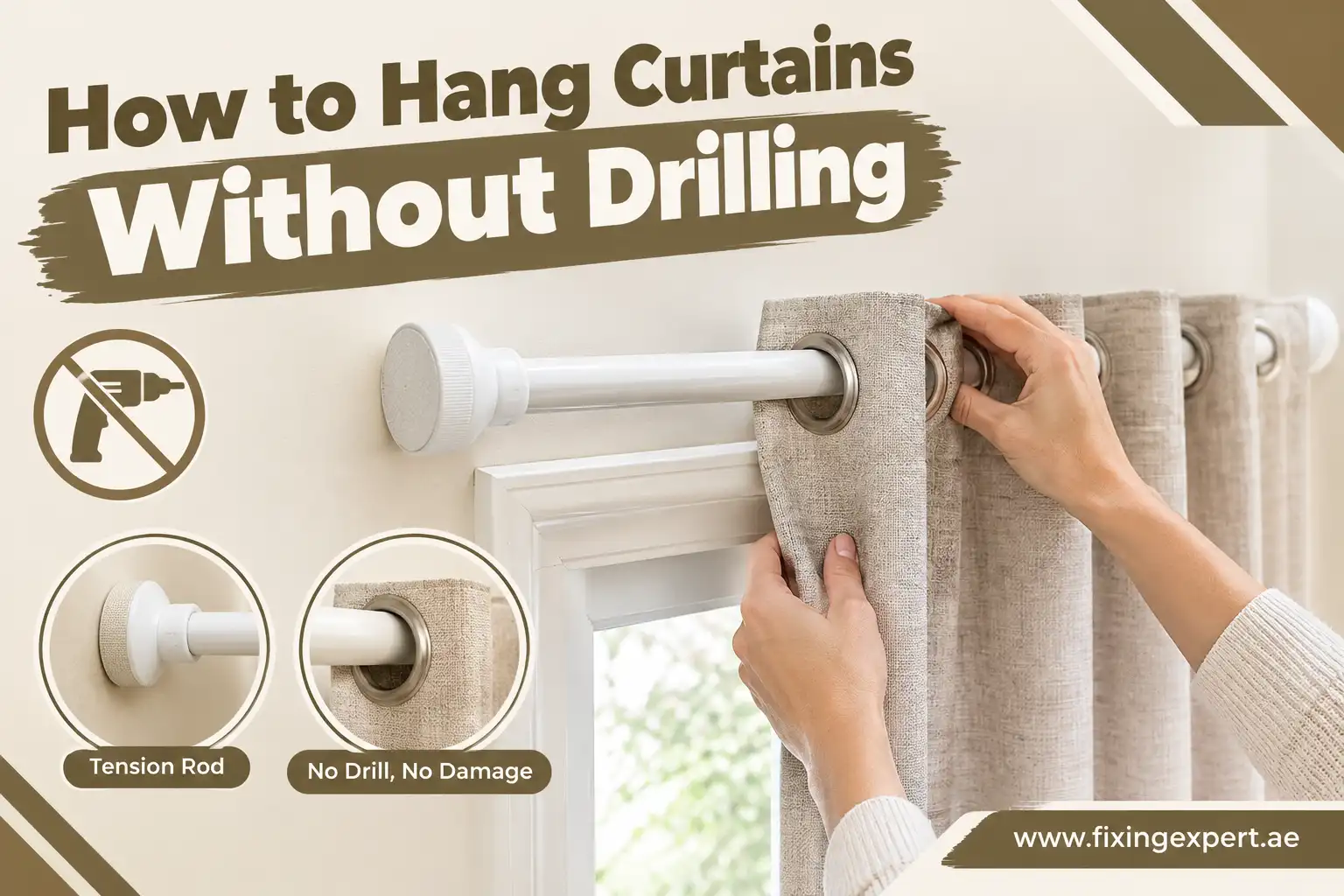
Renters aren’t the only ones avoiding drilling. Villa owners with marble window surrounds, tenants whose contracts flat-out ban wall damage, and anyone tired of patching holes every time they redecorate all land on this same search.
Eight methods genuinely work, and they’re not interchangeable. Pick based on your curtain’s weight, your frame material, and whether it’s going indoors or somewhere windy, and it holds. Pick based on whatever’s first in a listicle, and you’ll be reinstalling it in two weeks.
Light sheers do fine on adhesive rods or Velcro. Medium curtains between two solid surfaces work well on a tension rod. Moderate weight holds on Command-style hooks. Tap brackets are the strongest all-around option and leave the least trace. Outdoor curtains need different hardware entirely, covered near the bottom.
What Are the Best No-Drill Methods?
Adhesive rods, tension rods, Command-style hooks, magnetic rods, a wire-and-cable system, Velcro strips, over-the-door rods, and ceiling-mounted adhesive tracks. Tap brackets are the ninth. They use a tiny tapped pin instead of adhesive or tension, so we’ve kept them separate below rather than lumping them in with the sticky ones.
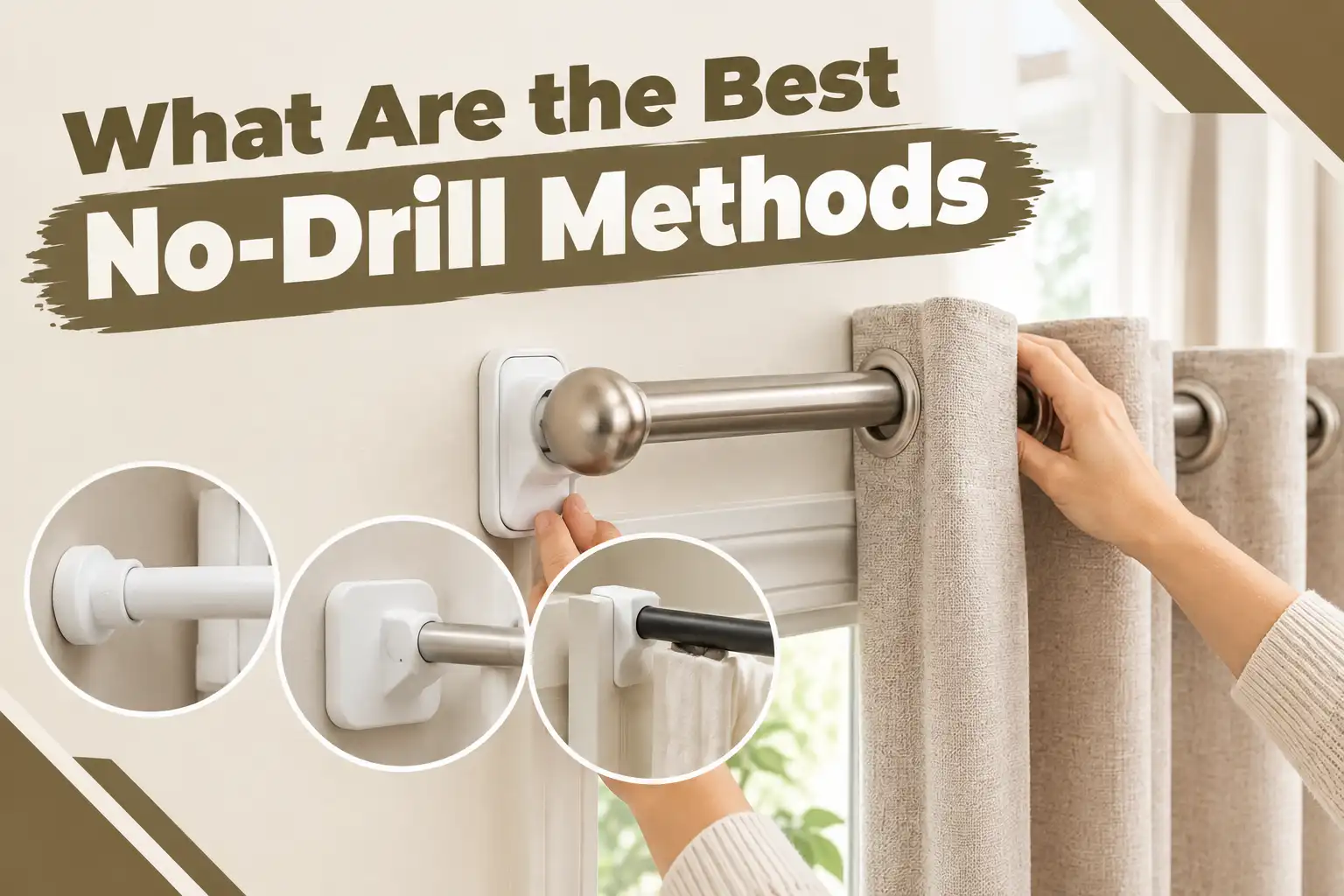
Nothing on this list is universally best. Each solves one specific combination of curtain weight and surface type. The mistake most guides make is ranking these by ease of installation alone, which is how someone ends up with the easiest option on a curtain it was never rated to hold.
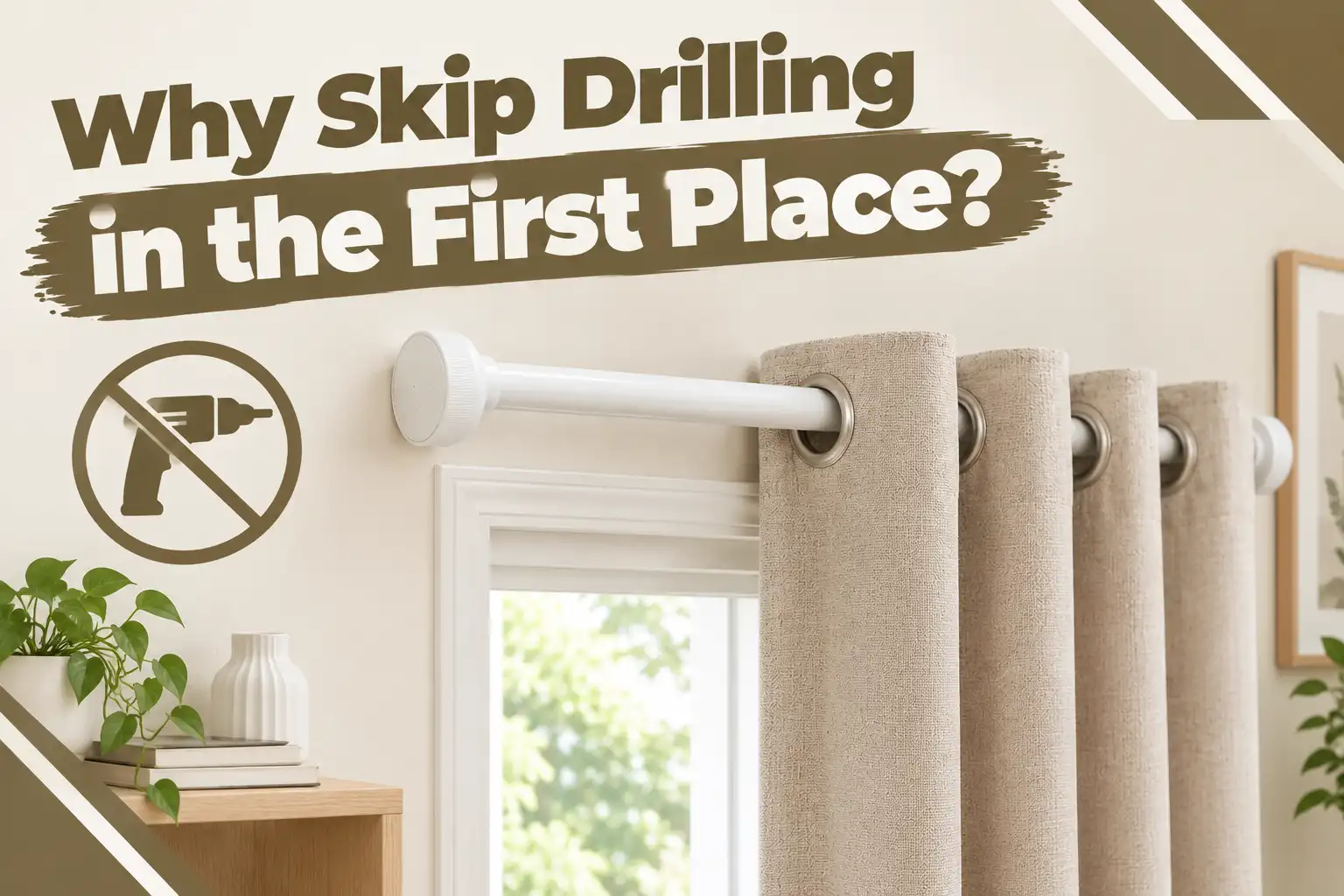
Why Skip Drilling in the First Place?
Rental contracts, mostly. A lot of Dubai tenancy agreements say no permanent alterations, full stop, and a security deposit gets docked for holes found at move-out. Marble and polished stone surrounds are the second reason. Drill into those without the right bit, and you’ve cracked something a lot more expensive to fix than a small hole in drywall.
Frame material here throws off a lot of guides written for the US or UK market. Dubai windows are commonly uPVC or aluminum, set into gypsum board, not the painted wood trim most American rental guides assume. That matters for which methods actually grip. Tap brackets need real wood underneath, so they’re out on a bare aluminum frame. Magnetic rods, on the other hand, work surprisingly well here because a lot of older buildings still use steel window frames.
If you’re in a rental specifically, our guide on hanging curtains in a rental apartment goes deeper on that situation.
Tools and Prep:
A tape measure, a level, and a clean, dry cloth cover most of it. Whichever mounting method you pick adds its own hardware on top: adhesive brackets, a tension rod, Command-style hooks, a tap bracket kit.
The step people skip is drying the wall fully before sticking anything to it. Dust or leftover moisture is the reason an adhesive bond that should last a year gives out in a week instead.
Temperature matters too, more than most people think. Adhesive backing cures slower in a cold room and can bond weaker if the wall itself is warm from direct sun, which is worth knowing if you’re mounting anything on a west-facing wall in a Dubai apartment during the afternoon. Give it the full cure window regardless, and check the bond with a gentle tug before loading the curtain, not after.
Matching the Method to Your Curtain Type
Curtain weight decides more of this than the wall does. Here’s the breakdown we actually use when a client asks which method fits their fabric.
| Curtain type | Approximate weight | Methods that hold |
| Sheer, voile, unlined linen | Light | Adhesive rod, Velcro, tension rod, magnetic rod |
| Standard cotton, unlined polyester | Medium | Command hooks, tension rod (short span), wire and cable |
| Lined curtains, blackout | Medium to heavy | Tap bracket, Command hooks (rated for the weight), clamp-on outdoors |
| Velvet, double-lined drapes | Heavy | Tap bracket only, or a properly anchored rod if drilling is an option |
If your curtain sits at the boundary between two rows, size up rather than down. A method rated for medium weight holding a curtain right at that weight limit has almost no margin left if the fabric absorbs any humidity, which adds weight over time in Dubai’s climate more than people expect.
Methods To Hang Curtains Without Drilling
Follow these methods to hang curtains without drilling:
Method 1: Adhesive Curtain Rods
- Stick directly to the wall, no screws.
- Clean the surface
- Mark your spot
- Peel the backing
- Press for the full 30 seconds most brands recommend
- Leave it to cure for an hour or more before loading any curtain onto it
Best for light sheer or linen. We’ve had clients try to hang lined blackout panels on these and call us back a week later once the bracket started peeling under the weight.
Removal is the real catch. On painted drywall, pulling these off sometimes takes a thin layer of paint with them. Test a hidden patch of wall first, and if the paint lifts even slightly on that small test area, that’s your answer before you commit to the whole window.
Method 2: Tension Rods
Extends between two solid, parallel surfaces using spring pressure. Twist to lengthen, wedge it into the window jamb, slide the curtain on.
Fastest method here, full stop. It’s the standard pick for eyelet curtains mounted inside a recess. Overtighten it, though, and it bows in the middle before eventually popping loose. And it won’t work if the window already has blinds installed, since the rod usually needs the same flush space the blinds sit in.
Method 3: Magnetic Rods
Only work on a metal frame. No adhesive, no tension, just magnetic contact. Position at height, and it holds.
Narrow use case. Won’t work on wood, uPVC, or painted drywall. Where it does apply, usually older buildings with steel frames, it’s one of the easiest options on this list. Zero damage risk since there’s nothing stuck to the wall at all.
Method 4: Wire and Cable Systems
A cable strung between two anchor points, usually adhesive hooks at either end, with the curtain clipped on rather than threaded through a rod. Measure the span, mount the hooks level, run the cable, tension it.
Cleaner look than a rod, and it handles wider spans than a rigid rod would without sagging. Works well for velvet or other moderate-weight fabric spread across a wide window. Needs occasional retensioning as the cable settles, which a solid rod never asks for.
Method 5: Velcro Strips
Simplest method here. One side on the frame, one side on the curtain fabric, pressed together. No rod at all.
Light fabric only. Sheer, voile, unlined cotton. Anything heavier pulls it apart. The adhesive also weakens faster in humid conditions than in a drier climate, so treat this as something you refresh occasionally rather than a permanent fix.
Method 6: Over-the-Door Rods
Hook straight over a door frame. No hardware, no adhesive. Good for glass or French doors where you want privacy without drilling into the frame.
Only works on doors. It can also slightly affect how freely the door swings depending on the rod’s profile. Narrow use, fast install.
Method 7: Ceiling-Mounted Tracks
Mounts to the ceiling instead of the wall, so curtains run genuinely floor to ceiling. Clean the ceiling, apply the adhesive track, press, and wait the full cure time.
This changes a room’s proportions more than any other method on this list. A curtain that actually reaches the ceiling reads as far taller than the window underneath it. The same removal caveat as adhesive rod brackets applies here too.
Method 8: Tap Brackets
A small soldered pin, tapped into the top window trim with a few light hammer strikes. Not a nail exactly, more a permanent part of the bracket itself, and it comes back out just as easily, so the bracket gets reused on a different window later.
This is the strongest hold of anything on this list for medium to heavy curtains, and the mark it leaves sits right at the top of the frame where the curtain already covers it. The tradeoff is narrow: you need solid wood trim to tap into, and you can’t choose your own height, since it has to sit on top of the trim.
We reach for these more than any other method on installation callouts where drilling isn’t allowed, mainly because the failure rate we’ve seen on them is close to zero once the trim material is confirmed solid. The only jobs where we’d steer away from a tap bracket are the ones with composite or MDF trim rather than real wood, since the pin doesn’t hold the same way in a softer material and can work loose over time.
Rating Every Method, Honestly
| Method | Best for | Rating | Why |
| Tap bracket | Medium to heavy, wood trim | 5/5 | Strongest hold, tiny mark, reusable |
| Magnetic rod | Steel frames only | 4/5 | Zero damage, but narrow use case |
| Ceiling track | Floor-to-ceiling look | 3/5 | Dramatic effect, adhesive removal risk |
| Tension rod | Light to medium, recessed | 3/5 | Fast, but can bow if overtightened |
| Wire and cable | Wide windows | 3/5 | Good span, needs retensioning |
| Over-the-door rod | Doors only | 3/5 | Fast, but a narrow use case |
| Adhesive rod bracket | Light curtains only | 2/5 | Easy up, risky on removal |
| Velcro strips | Very light sheers | 2/5 | Cheapest, weakest, humidity-sensitive |
These ratings assume correct installation. A tap bracket driven into painted composite trim instead of solid wood behaves more like a 2. An adhesive bracket on a clean, dry wall holding a genuinely light curtain can last a year without complaint.
How Strong Are Command-Style Hooks, Really?
Genuinely stronger than people expect, fore-eyelet hooks hold 5 to 10 pounds each depending on the product, which covers most standard rods with medium fabric. Clean the wall, press firmly, then walk away for a full hour before hanging anything.
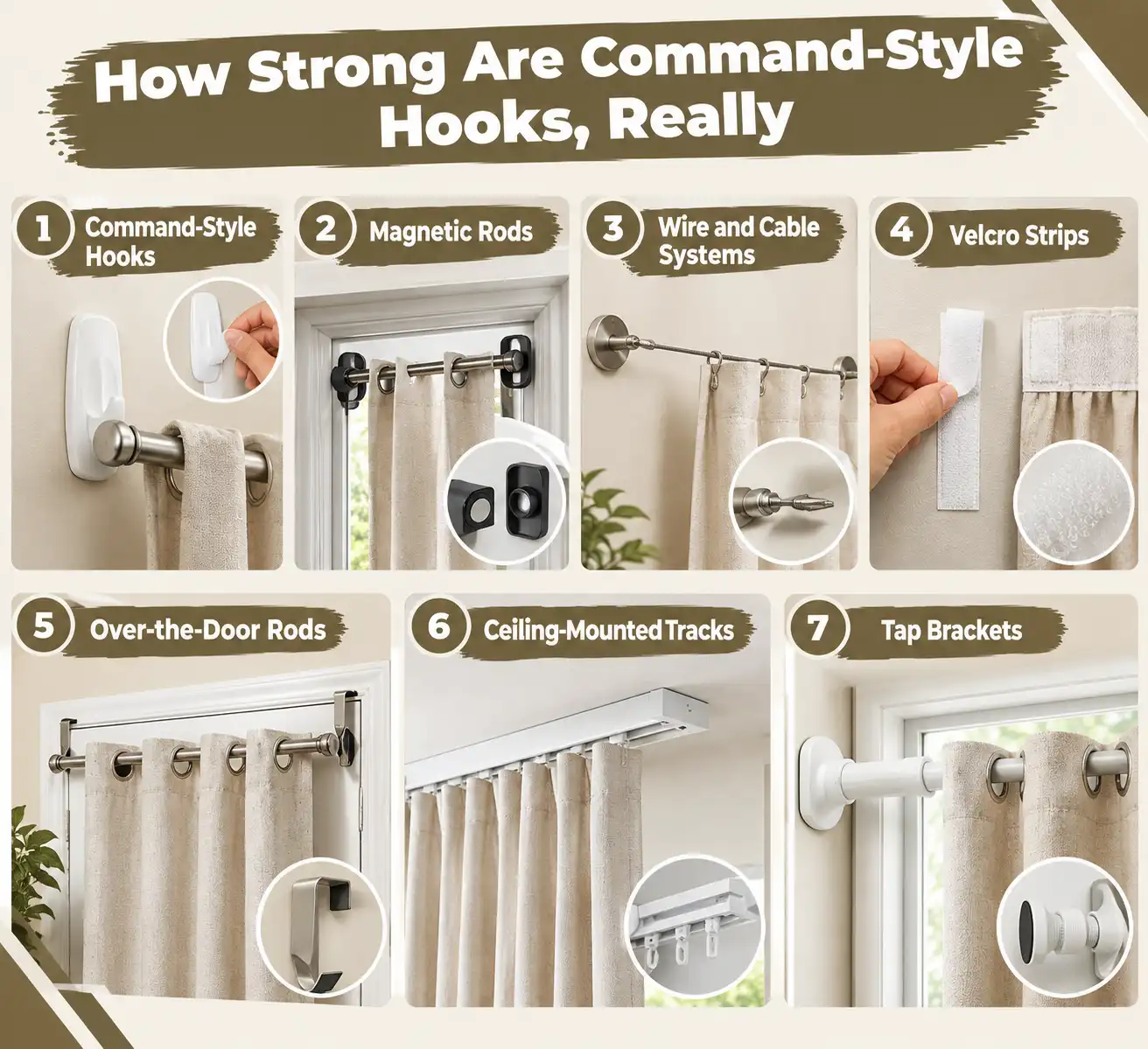
The other possible reason could be that the hook body is often bulkier than expected and can peek out from behind the curtain rather than disappearing. Removal is clean, though, thanks to the pull-tab design, which is more than you can say for most adhesive brackets.
Hanging Outdoor Curtains
Wind changes everything here. Adhesive hooks aren’t safe outdoors. A curtain panel catching wind puts far more pull on a sticky bond than anything indoors ever does, and it tends to fail suddenly, mid-gust, not gradually.
What Actually holds Outdoor Curtains
Solid walls on two sides, use a heavy-duty tension rod, rated for outdoor use so it doesn’t rust. Open beams, like a pergola, use clamp-on brackets instead, since they grip the beam mechanically rather than relying on glue. Wide spans where a rod would sag, run an aircraft cable between two anchors and clip the curtain on. No sag, and it disappears when the curtains are open.
Weighted hems matter as much as the hardware. An unweighted curtain acts like a sail. That force lands on the bracket, and the bracket is usually what gives out first.
Check the setup again after the first real storm, not just on install day. Hardware that held fine in a calm test can still shift once it’s taken an actual gust.
What We’d Actually Recommend, by Situation
These are the calls we actually make on real jobs, since most people asking about this have a specific room in mind rather than an abstract question.

Rental apartment bedroom, standard blackout curtain
Tap bracket if there’s wood trim on the window. It’s the only method on this list rated for blackout-weight fabric without babying it, and the mark is invisible once the curtain’s hanging. No wood trim, usually the case on newer aluminum-framed buildings; then Command hooks rated for the curtain’s actual weight, checked after the first week..
Villa with marble window surrounds
Skip adhesive entirely. Marble doesn’t hold a bond as reliably as painted drywall does, and we’ve seen brackets slide within days on polished stone. A tension rod works if the window’s recessed enough for two solid opposing edges. If it isn’t, that’s genuinely a case where we’d recommend proper drilling with the right masonry bit rather than forcing a no-drill method onto a surface that doesn’t suit it.
Sheer curtains in a living room
Adhesive rod or Velcro, whichever’s on hand. Light fabric, low stakes if it needs redoing in six months, and neither leaves meaningful damage even in the rare case it fails.
Balcony or JBR-style terrace with open railings
Heavy-duty tension rod if there are solid side walls. Clamp-on beam brackets if it’s an open pergola structure instead. Skip adhesive outright here regardless of curtain weight, since coastal wind exposure is worse than most inland balconies deal with.
Office glass partition
Magnetic rod if the partition frame is metal, which most commercial glass partitions are. It’s the cleanest-looking option here and comes down without a trace when the layout changes again.
Taking It Down and Reusing the Hardware
Renters especially end up doing this more than once, so it’s worth knowing what survives a move and what doesn’t. Tap brackets and magnetic rods are fully reusable since neither leaves adhesive residue behind. Tension rods obviously travel with you too. Adhesive brackets, Command hooks, and Velcro strips are generally single-use once removed, since the backing rarely re-adheres with the same strength a second time, even if the bracket itself still looks fine.
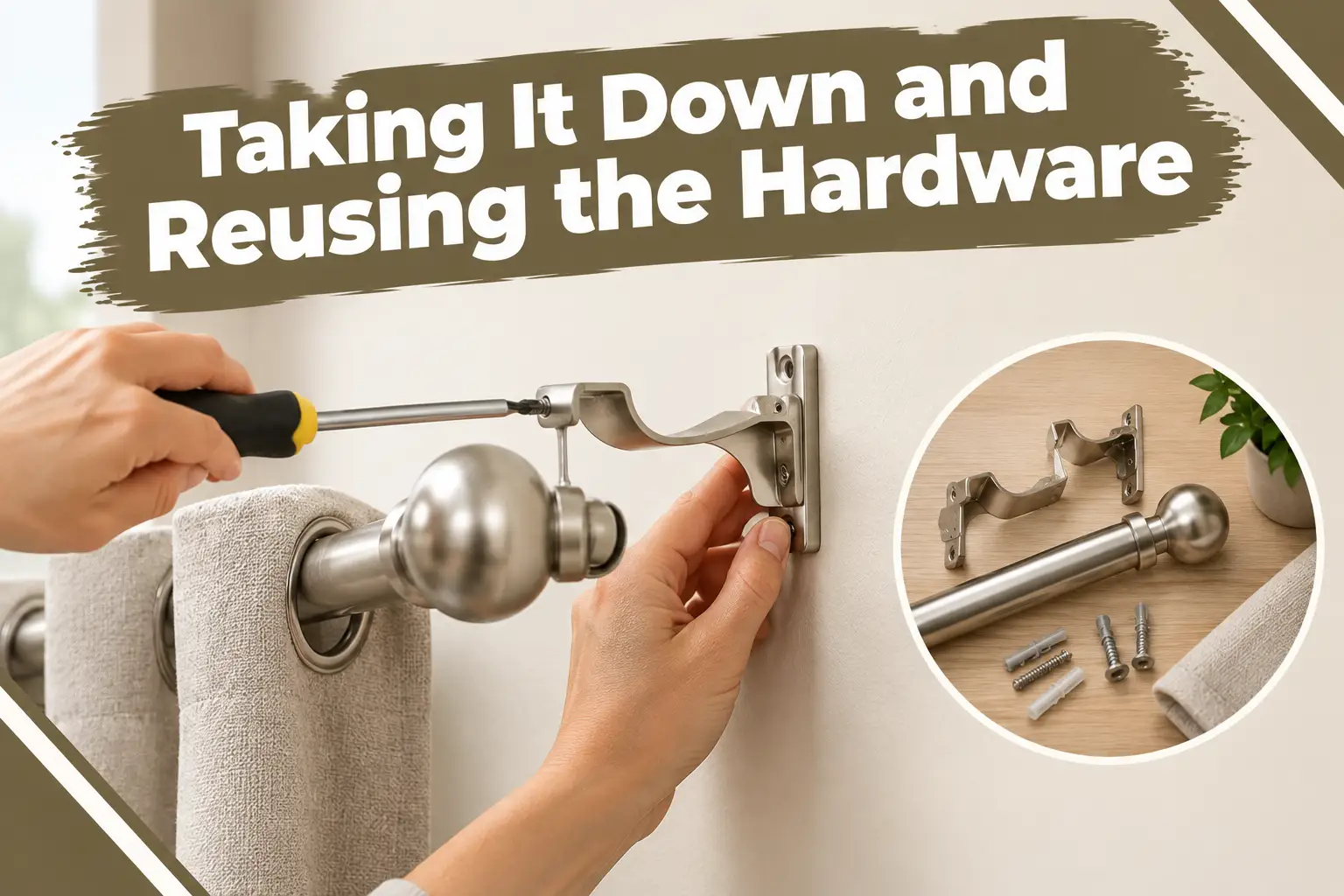
If you know you’ll be moving again within a year or two, that reusability difference is worth factoring into which method you pick now, not just how well it holds today. We’ve had clients buy a full set of adhesive brackets twice in eighteen months simply because the first set didn’t survive the move-out cleanup.
Common Mistakes Made
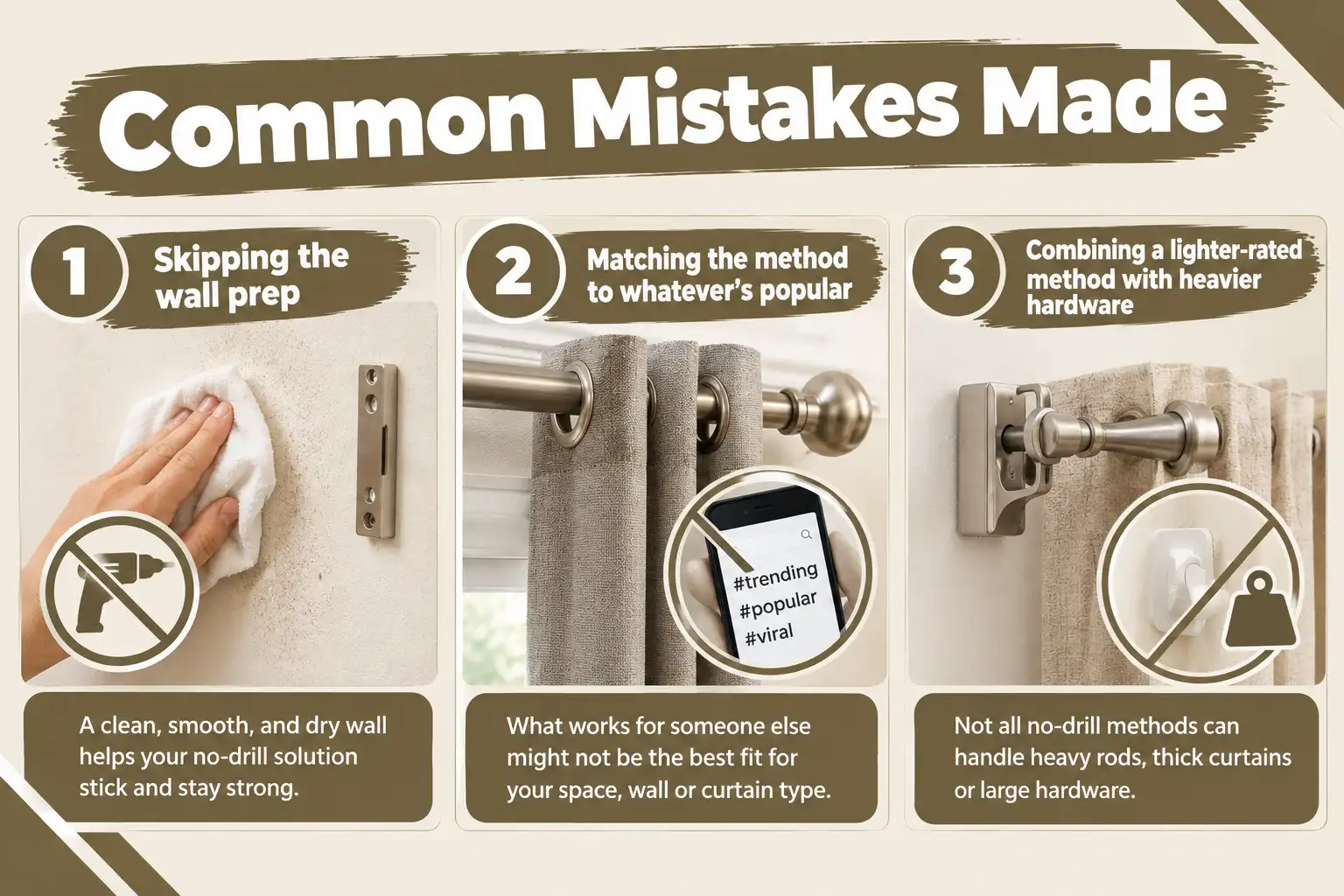
Skipping the wall prep
Dusty or damp surfaces guarantee an early failure no matter which product you bought. Rushing the cure time is close behind. Most adhesive methods need a full hour undisturbed, and hanging a curtain five minutes after pressing the bracket on is asking for it to fail within the week.
Matching the method to whatever’s popular
Velcro was never going to hold a lined drape. And outdoors, treating the install like an indoor job and ignoring wind entirely is the single biggest reason these setups fail in the first real storm.
Combining a lighter-rated method with heavier hardware
A tension rod paired with heavy metal rings adds weight and swing the rod was never tested against. When that combination fails, it’s rarely either part on its own.
When to Just Get It Installed Properly
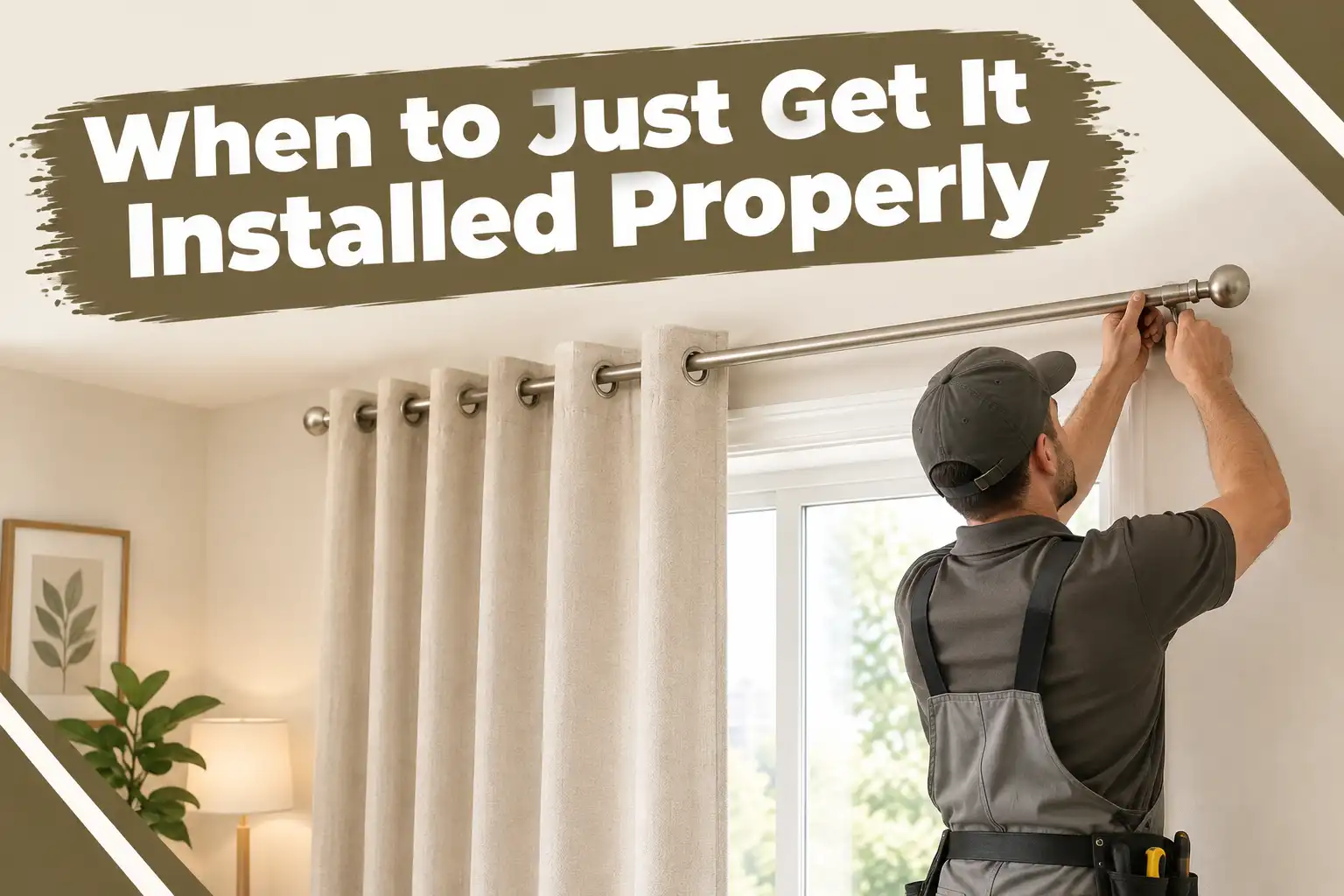
If the no-drill route isn’t holding, or the property actually does allow drilling and you’d rather have it done once, that’s a different job. A correctly anchored rod, matched to whether the wall is concrete, gypsum, or tile- the standard three across Dubai homes- outlasts every method above without the ongoing maintenance.
Frequently Asked Questions
What’s the strongest way to hang curtains without drilling?
Tap brackets. No bowing under weight, no paint coming off on removal, and they hold up real curtain weight better than anything adhesive-based.
Will adhesive hooks damage my paint when I remove them?
Sometimes. Following the pull-tab removal instructions, rather than yanking the hook off, determines whether the paint comes off clean.
Can tension rods hold heavy curtains?
Not reliably. They’re built for light to medium fabric. Overtightening to compensate for something heavier is exactly what makes the rod bow and eventually pop loose.
Is it safe to hang outdoor curtains without drilling?
Yes, with the right hardware. Heavy-duty tension rods between solid columns, clamp-on beam brackets on exposed pergola framing. What’s not safe is standard adhesive hooks outdoors, since wind puts far more strain on the bond than anything indoors.
Do adhesive curtain rod brackets actually work?
For light curtains on a clean, dry wall, yes, reliably. The failure cases we see are almost always heavier fabric than the bracket was rated for, or removal done too roughly. Used within their actual limits, they’re a legitimate option, not just a temporary stopgap.
Does hanging curtains without drilling work on marble or tiled window surrounds?
Adhesive doesn’t bond as reliably to marble or polished tile as it does to painted drywall. Tension rods or a tap bracket into any adjacent wood trim tend to hold better on these surfaces.
How do I hang extremely heavy curtains without drilling?
Realistically, only a tap bracket handles genuinely heavy fabric, like double-lined velvet, without strain. If tap brackets aren’t an option because there’s no wood trim, the honest advice is that no-drill hardware isn’t built for that weight class, and a properly anchored rod is the safer call even in a rental, worth raising with the landlord directly rather than forcing a light-duty method to hold something it was never rated for.
Is it worth switching to a properly drilled rod eventually?
If the property allows it, yes, particularly for heavy or permanent curtains. A properly anchored rod carries more weight with essentially no upkeep. For a rental where drilling’s off the table, the methods above remain the practical option.
Can I use two different no-drill methods on the same window?
Sometimes, though it’s not usually necessary. A tension rod for the sheer layer and Command hooks for a heavier outer curtain can work if you’re doing a layered setup, since each rod carries only its own fabric weight rather than both together. Just install and test each independently before trusting the full combination.