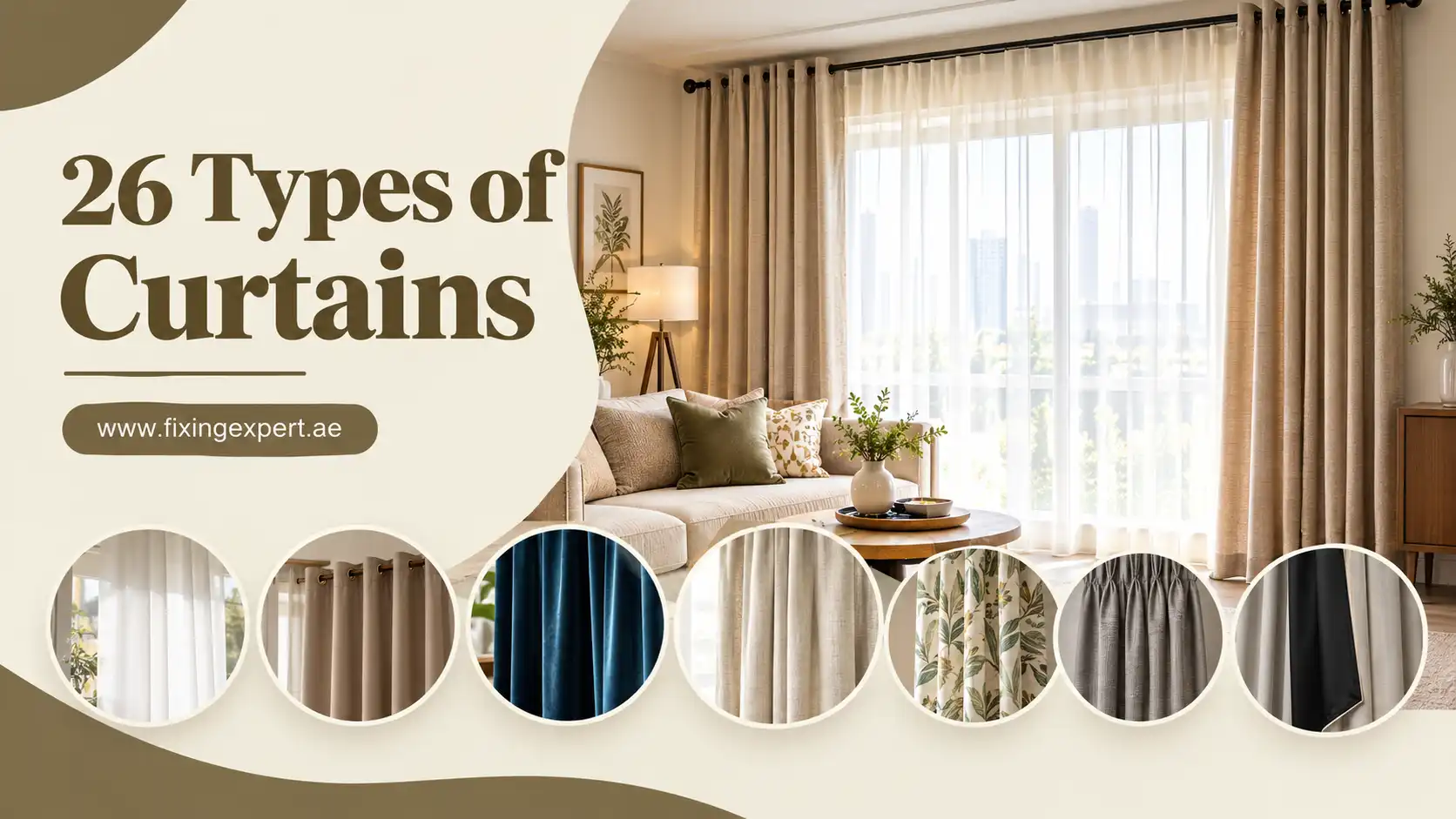
There are far more types of curtains than most people realize, and the right one depends on three things: how the top of the curtain hangs, how long the panel falls, and what fabric it is made from. Get those three choices right and almost any curtain style will look intentional in almost any room.
Curtains are grouped by heading style (how they attach to the rod), length (where they fall), and fabric function (light, heat, or sound control). We are going to cover 26 distinct curtain types, more than any single comparison most people will find, organized so it is easy to skim. Heading style affects how a curtain looks and how easily it slides open and closed. Length should match the room’s furniture and function, not just the window size. Fabric and lining decide whether a curtain controls light, heat, noise, or all three at once.
How Are Curtains Classified?
Curtains are not one single product. They split into three separate categories, and a finished curtain is really a combination of choices across all three.
- Heading style – how the fabric attaches to the rod (eyelet, pleat, rod pocket, and so on)
- Length – where the panel ends (sill length, apron length, floor length)
- Fabric and function – what the material does (block light, insulate, absorb sound, or simply decorate)
Most buying confusion comes from mixing these categories up. A “blackout curtain” describes fabric function, not heading style, so a blackout curtain can still come in an eyelet, pleat, or rod pocket heading. Once these three layers are separated, choosing curtains gets a lot simpler.
How Many Types of Curtains Are There?
There are at least 26 recognized curtain types once heading style, length, and function are all counted separately. Here is the full breakdown, grouped so related styles sit together.
Types of Curtains by Heading Style
1. Eyelet Curtains
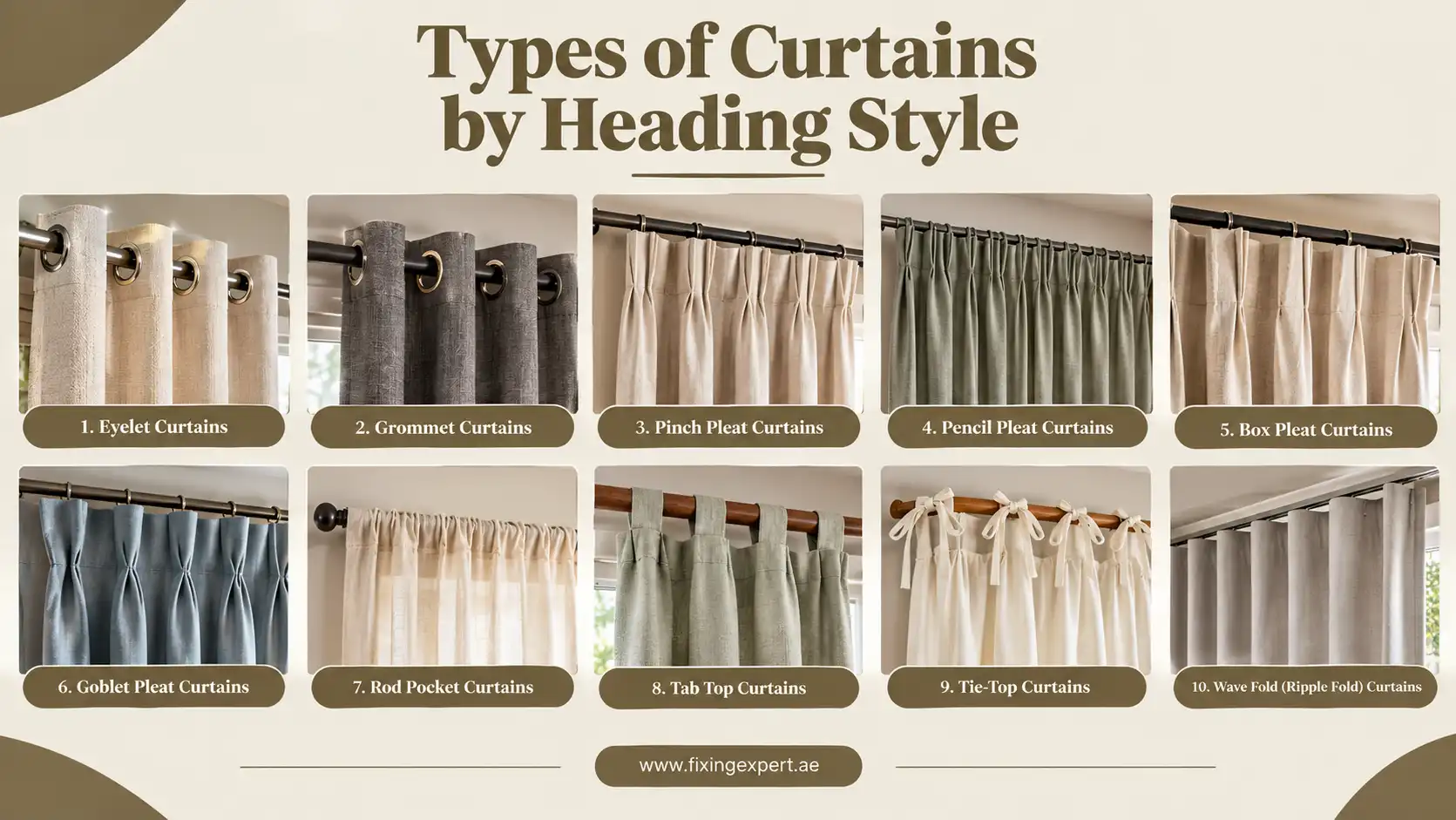
Metal rings are punched directly into the fabric at the top, and the rod threads straight through them. This gives a neat, uniform wave and makes the curtain easy to slide open daily.Ready-made eyelet designs built for smooth, everyday use are a common starting point for anyone who wants low-effort curtains without sacrificing a tidy look.
2. Grommet Curtains
Very close to eyelet curtains, but the rings are reinforced and often available in different finishes or larger sizes. The reinforced ring holds up better under frequent use.
3. Pinch Pleat Curtains
Small clusters of fabric are stitched together at the top, usually in groups of two to five folds, creating a tailored, formal look that holds its shape whether open or closed. For anyone drawn to that structured fold,pleated styles built around this exact tailored look tend to be the most requested formal option.
4. Pencil Pleat Curtains
Thin, tightly packed folds line up like a row of pencils across the header tape. This style is more casual than pinch pleat and works with most curtain hooks or tracks.
5. Box Pleat Curtains
Deep, flat-fronted folds run the length of the header, giving a crisp, architectural line rather than a soft gather. They suit formal or symmetrical rooms.
6. Goblet Pleat Curtains
Rounded pleats that flare out at the top and taper in below, shaped like the bowl of a wine glass. These are decorative rather than functional, since the shape does not hold up well to frequent opening and closing.
7. Rod Pocket Curtains
A stitched channel at the top lets the rod slide directly through the fabric, creating a soft, gathered look. It is simple to assemble but does not glide smoothly, so it works best for curtains that stay mostly closed.
8. Tab Top Curtains
Fabric loops are sewn along the top edge, and the rod threads through each loop, leaving the rod visible as part of the design. It gives a relaxed, handmade feel.
9. Tie-Top Curtains:
Similar to tab top, but fabric ties replace the sewn loops, creating a softer, looser gather. The rod stays fully visible, so it works best with a decorative pole.
10. Wave Fold (Ripple Fold) Curtains
A special track and fixed spacing create smooth, even waves across the entire width of the curtain, with no visible pleats. It has become one of the most requested styles for a clean, modern look on wide openings, and a heading style built specifically around soft, even waves has become a common upgrade for anyone replacing an older pleated set.
Types of Curtains by Length
1. Cafe Curtains
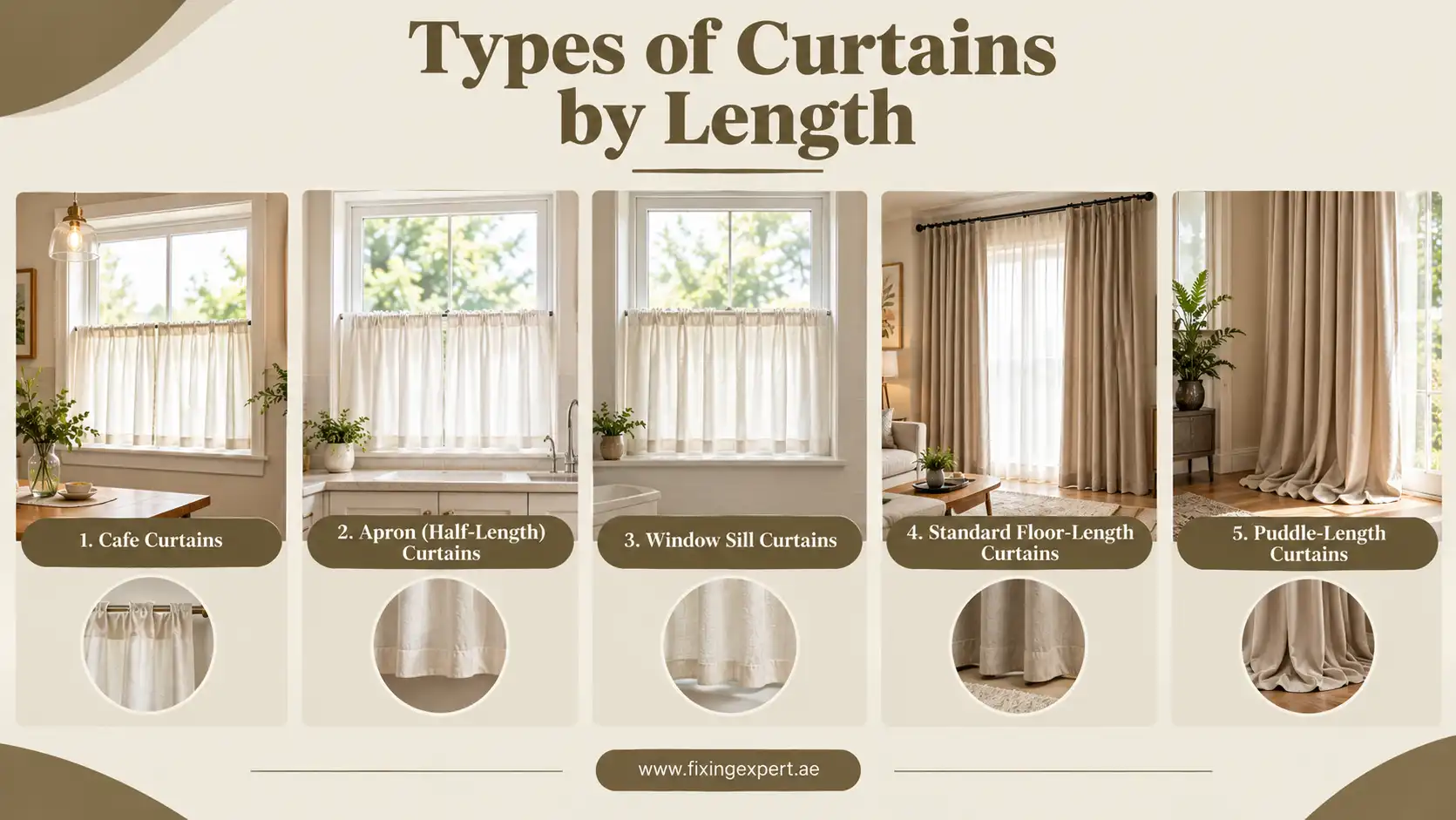
These cover only the lower half of a window, leaving the top open for light. Originally used in European coffee houses, they now show up most often in kitchens and small dining nooks.
2. Apron (Half-Length) Curtains
Falling just below the window sill, apron curtains suit windows with a radiator, desk, or counter directly underneath, where a full-length panel would get in the way.
3. Window Sill Curtains
These stop exactly at the sill, slightly shorter than apron length. They are common in kitchens and bathrooms where floor space below the window needs to stay clear.
4. Standard Floor-Length Curtains
The most common length, ending anywhere from just above the floor to just brushing it. This length works in almost any room and is the safest default when unsure.
5. Puddle-Length Curtains
Extra fabric is added so the curtain pools on the floor by a few inches. It reads as formal and luxurious but needs more frequent cleaning since the fabric touches the ground.
Types of Curtains by Fabric and Function
1. Blackout Curtains
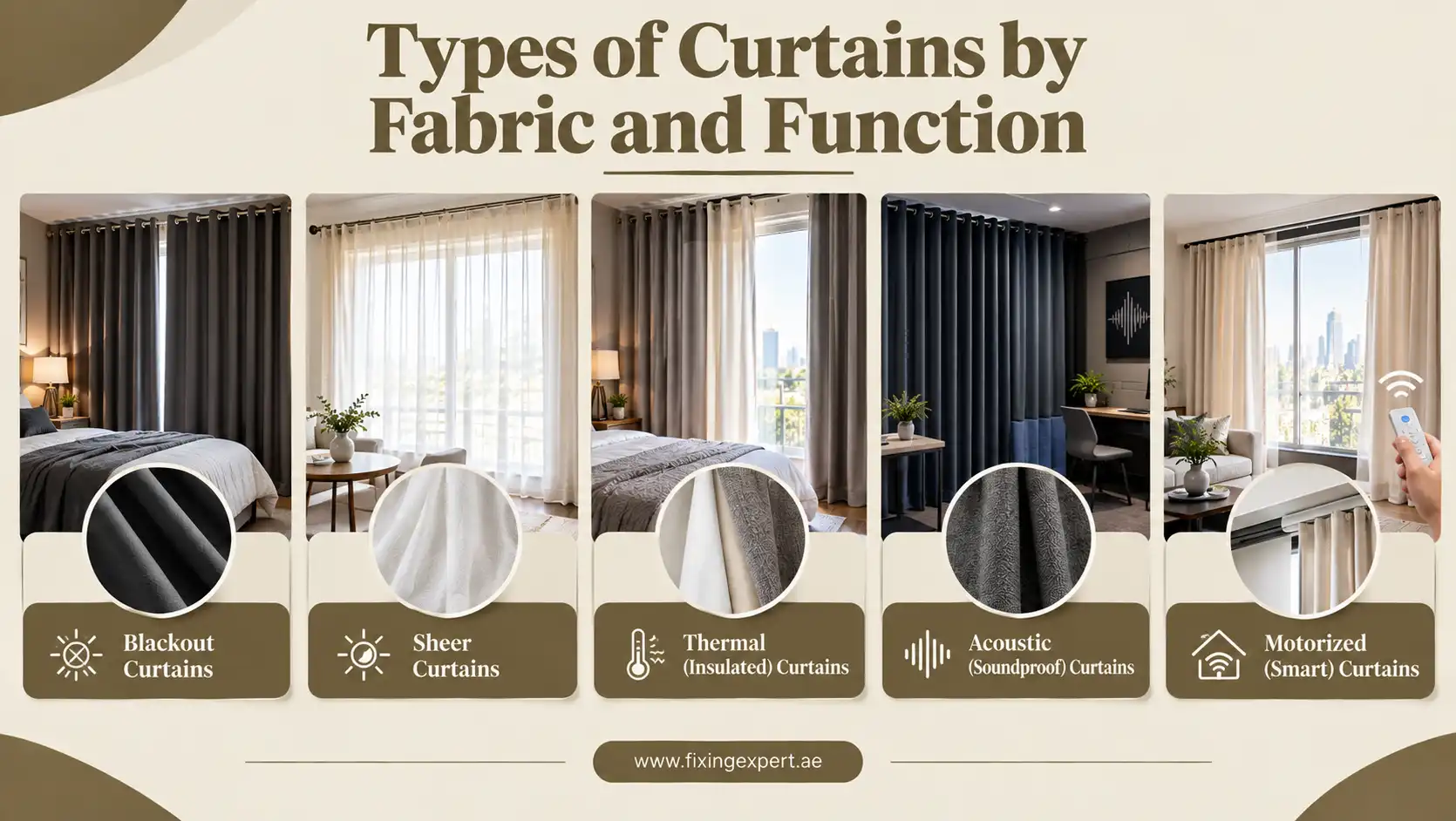
Made with a tightly woven or coated fabric that blocks nearly all outside light. These are the standard choice for bedrooms, nurseries, and media rooms.
2. Sheer Curtains
A lightweight, semi-transparent fabric that softens light without blocking it. Sheers are often layered with a heavier curtain or a blind for daytime privacy without losing brightness, and sheer fabric options built for exactly that daytime balance are worth a look before assuming any thin fabric will do the same job.
3. Thermal (Insulated) Curtains
Built with an extra lining or a denser weave that reduces heat transfer through the window. According to the U.S. Department of Energy, about 30% of a home’s heating energy is lost through windows, which is exactly the gap this curtain type is designed to close.
4. Acoustic (Soundproof) Curtains
Made from dense, heavyweight material that absorbs sound rather than reflecting it, cutting down outside noise in bedrooms and home offices. A heavier curtain option built specifically for sound control is worth a look for any room facing a busy street.
5. Motorized (Smart) Curtains
Fitted with a small motor and remote or app control so the curtain opens and closes without manual pulling. Many now connect to a wider smart home setup, opening on a schedule or through a voice assistant rather than just a handheld remote. These pair with any heading style, most often wave fold or eyelet, since both glide smoothly on a track.
Types of Curtains by Panel and Decorative Style

1. Single Panel Curtains
One wide piece of fabric covers the whole window and pulls to one side. This works well for smaller windows or a minimal, uncluttered look.
2. Double Panel Curtains
Two matching panels meet in the middle and open to either side. This is the most familiar setup for living rooms and larger windows, and it makes layering with a sheer underneath easier.
3. Decorative (Statement) Curtains
Lace, embroidered fabric, or sheer overlays used purely for visual impact rather than light or privacy control. These often sit as a top layer over a functional panel or blind.
4. Swag and Jabot Curtains
A draped valance (the swag) crosses the top of the window with tails of fabric (the jabots) hanging at each side. This traditional style adds a decorative frame without necessarily covering the full window.
5. Holdback-Style Curtains
The curtain itself can be any heading or fabric, but a decorative hook or clasp pulls the panel back and secures it against the wall. This is more a styling technique than a fixed type, though it changes how open the window feels enough that it is usually treated as its own category, and it works particularly well on wider panels that would otherwise look bulky when left hanging loose.
6. Door-string (Lace String) Curtains
Made from hanging strands or fine lace strings rather than a solid fabric panel, these are lightweight and let air move through freely while still marking a doorway or window as covered. They suit French doors, room dividers, or decorative entrances where full privacy is not the goal, and they weigh far less than any woven fabric on this list, which is why they hang so differently from every other type here.
This adds up to 26 genuinely distinct curtain types once heading, length, and fabric function are counted on their own. Knowing which category a style falls into makes it much easier to combine choices, for example, picking a wave fold heading in a blackout fabric at floor length, rather than treating “curtain type” as a single decision.
Which Curtain Heading Style Should You Choose?
Heading style affects daily use more than any other choice, since it decides how the curtain moves.
| Heading Style | Best For | Watch Out For |
| Eyelet / Grommet | Daily opening and closing, modern rooms | Rod becomes part of the visible design |
| Pinch Pleat | Formal rooms, heavier fabric | Needs professional stitching for a clean result |
| Pencil Pleat | Casual and traditional rooms alike | Header tape can look plain on its own |
| Box Pleat | Symmetrical, formal spaces | Less flexible for irregular window widths |
| Goblet Pleat | Decorative, rarely-moved curtains | Not suited to frequent opening and closing |
| Rod Pocket | Simple, mostly-closed windows | Rod does not glide smoothly |
| Tab Top / Tie-Top | Casual, farmhouse-style rooms | Exposes the rod fully, so hardware matters |
| Wave Fold | Wide openings, sliding doors | Needs a specific track system |
A quick rule of thumb: if the curtain will be touched every day, pick eyelet, grommet, or wave fold. If it stays mostly closed for decoration, pleated or rod pocket styles hold their shape better over time.
Quick Verdict: Rating the Most-Requested Curtain Types
Some styles get asked for far more often than others, so here is an honest rating out of 5 for the ones that come up most, judged on ease of daily use, how formal they look, and how much upkeep they need.
| Curtain Type | Ease of Use | Formality | Upkeep | Overall |
| Eyelet / Grommet | 5/5 | 3/5 | 4/5 | 4.5/5 |
| Pinch Pleat | 3/5 | 5/5 | 3/5 | 4/5 |
| Wave Fold | 5/5 | 4/5 | 4/5 | 4.5/5 |
| Rod Pocket | 2/5 | 3/5 | 4/5 | 3/5 |
| Blackout (any heading) | 4/5 | 3/5 | 4/5 | 4/5 |
| Sheer (any heading) | 4/5 | 3/5 | 3/5 | 3.5/5 |
| Cafe | 4/5 | 2/5 | 5/5 | 3.5/5 |
| Goblet Pleat | 1/5 | 5/5 | 2/5 | 3/5 |
Eyelet and wave fold headings come out on top overall because they combine easy daily movement with a clean, modern look that suits most rooms. Goblet pleat scores lowest on practicality since it is built for display rather than daily handling, though nothing beats it for a formal, high-ceiling room that rarely needs the curtain touched. Rod pocket sits in the middle: simple to assemble, but not the best choice if the curtain gets opened and closed often, since the fabric bunches around the rod rather than gliding.
What’s the Difference Between Eyelet and Grommet Curtains?
This is one of the most common points of confusion, and the honest answer is that the two overlap heavily. Both use metal rings punched into the fabric that the rod slides through directly. The difference comes down to the ring itself: grommet rings are usually reinforced, available in a wider range of finishes, and sometimes larger in diameter, which is why some suppliers use the terms interchangeably while others treat grommet as a sturdier subtype of eyelet.
In practice, either term describes the same basic mechanism and the same smooth, wave-like fold when hung. If a product description does not specify which, it is safe to assume they behave the same way on a standard curtain rod.
Which Curtain Length Is Right for Each Room?
Length is decided by what sits below the window, not personal preference alone.
- Kitchen and bathroom windows
Usually work best with window sill or apron length, since counters, sinks, or radiators sit directly underneath.
- Bedrooms
Suit floor-length or slightly longer, giving a calmer, more finished look around the bed area.
- Living rooms
Often look best with floor-length or puddle-length curtains, especially when the goal is a more formal, layered room.
- Home offices
Work well with apron or floor-length curtains that don’t drag on the floor near a desk chair.
- Sliding doors and balcony openings
Need floor-length or slightly longer panels so they clear the door track when opened, which is why curtain lengths sized specifically for wider glass doors and balcony openings usually differ from a standard window panel.
A simple test: stand at the window and picture the curtain fully open. If it will bunch into furniture, a shorter length works better. If there is open wall space on either side, floor length or longer almost always looks more finished.
How Do You Choose Curtains Based on Fabric and Function?
Fabric decides what the curtain actually does once it’s hanging, separate from how it looks.
For Light Control
Blackout fabric blocks the most light and suits bedrooms and media rooms. Sheer fabric lets in the most light while softening direct sun, and works well layered with a heavier curtain or a blind for flexible control through the day.
For Temperature Control
Thermal or insulated curtains reduce heat loss in winter and heat gain in summer. Since roughly a third of a home’s heating energy escapes through windows, a well-lined curtain in the coldest or sunniest rooms of a home can noticeably change how those rooms feel without needing to touch the thermostat.
For Noise Control
Dense, heavyweight fabric absorbs sound rather than letting it bounce around a room. This matters most in bedrooms and home offices near a busy street, or apartments with shared walls.
For Style Only
Decorative fabrics, lace, and sheer overlays exist purely to add texture and visual interest, usually layered over a functional curtain or blind that does the actual light and privacy work.
Mixing categories usually gives the best result. A room rarely needs just one property, so many finished setups combine a functional layer, like blackout or thermal fabric, with a decorative or sheer layer on top.
Which Type of Curtain Works Best in Each Room of the House?
Room function narrows the choice faster than browsing every style at once.
Living Room
Double panel curtains in a medium to heavy fabric suit most living rooms, especially paired with a sheer layer underneath for daytime softness. A curtain style chosen specifically to soften a main seating area tends to hold up well here since living rooms see the most daily use.
Bedroom
Blackout or thermal fabric in a floor-length panel is the standard combination, since darkness and temperature both affect sleep quality directly. For a child’s room, softer heading styles and curtain designs made with younger occupants and lighter, washable fabrics in mind tend to work better than heavy pleated styles.
Home Office
Light-filtering or sheer fabric reduces screen glare without darkening the room completely. Wave fold or eyelet headings suit a workspace well because they open and close smoothly during video calls without pulling on heavy fabric, which is why curtain designs suited to a busy workspace tend to prioritize glare control over pure darkness.
Kitchen
Cafe or window sill length curtains in an easy-wash cotton or polyester blend keep the space practical near a stove or sink, where grease and moisture are a daily concern.
Balcony or Sliding Door
Wide panels in a durable fabric that can handle sun exposure work best here, especially with a wave fold or eyelet heading that glides easily on a wider track.
How to Choose the Right Curtain Type for Your Home
- Start with the room’s main problem. Is it too bright, too cold, too noisy, or just unfinished-looking? This decides the fabric category before anything else.
- Check what’s below the window. Furniture, radiators, or counters decide the length category.
- Think about how often the curtain will move. Daily use points toward eyelet, grommet, or wave fold. Decorative, rarely-touched curtains can use pleated or rod pocket styles.
- Pick the fabric weight last. Once the function and length are set, choose a fabric weight that matches the heading style, since heavier fabric needs a sturdier heading like pinch pleat or wave fold.
- Consider layering. A functional layer plus a decorative or sheer layer solves more problems than a single curtain usually can.
- Measure before ordering anything. Even the right style will look off if the width and drop are wrong, so confirm exact measurements before buying or having a curtain made.
Anyone unsure where their window falls outside a standard size often gets better results from a made-to-measure service built around exact window dimensions than from resizing an off-the-shelf panel after the fact.
Current Curtain Style Trends
A handful of style patterns have stayed consistent across recent years and are worth knowing before making a final decision.
- Wave fold headings on wider openings.
As more homes have sliding doors and larger glass walls, wave fold has become the default choice for a clean, gliding look.
- Layering functional and decorative fabrics.
Pairing blackout or thermal curtains with a sheer or decorative overlay gives both function and texture without needing to choose just one.
- Neutral tones with one textured layer.
Many rooms now keep one layer plain and let the second layer carry pattern or texture, rather than mixing patterns across both.
- Motorized control in bedrooms and living rooms.
Motorized curtains have become far more affordable and are increasingly added to wave fold or eyelet setups rather than being a separate luxury category.
- Acoustic fabric outside of just home theaters.
Sound-absorbing curtains are increasingly chosen for regular bedrooms and offices, not only dedicated media rooms, especially in busier neighborhoods.
Common Mistakes to Avoid When Choosing Curtain Types
- Choosing heading style based on looks alone. A goblet pleat looks elegant in photos but will not hold up to daily opening and closing.
- Ignoring what sits below the window. A floor-length curtain over a radiator or desk usually looks and functions worse than a shorter one.
- Assuming one fabric does everything. A single thin curtain will not block light, insulate, and absorb sound all at once. Layering solves this; one panel alone rarely does.
- Skipping fullness ratio. A curtain that is only as wide as the window looks flat and thin once hung. Extra fabric width, usually 1.5 to 2.5 times the track width, gives a fuller, richer fold.
- Buying before measuring the wall space, not just the window. Extending the track beyond the window frame almost always looks more finished than mounting it exactly at the frame edges.
- Sticking with one fabric weight all year. Swapping to lighter panels for warmer months and heavier ones for cooler months keeps a room feeling current without buying an entirely new curtain style.
Avoiding these five mistakes solves most of the regret that shows up after a curtain is already hung.
Frequently Asked Questions
What are the main types of curtains?
Curtains fall into three categories that combine together: heading style (eyelet, pleat, rod pocket, and similar), length (sill, apron, floor, or puddle), and fabric function (blackout, sheer, thermal, or acoustic). A single curtain is really a combination of one choice from each category, not just one style.
What is the most popular type of curtain?
Eyelet and grommet headings are generally the most widely used because they move smoothly and suit almost any fabric. In terms of fabric function, blackout curtains remain the most requested for bedrooms specifically, since sleep quality is such a common concern.
What is the difference between drapes and curtains?
The terms are often used interchangeably today, though drapes traditionally refer to lined, heavier fabric panels meant to stay mostly closed, while curtains refer to lighter, more frequently opened panels. In everyday use, most people no longer distinguish between the two.
Can different curtain types be combined on one window?
Yes, and it is one of the most effective ways to solve more than one problem at once. A common setup pairs a sheer curtain for daytime softness with a blackout or thermal curtain behind it for nighttime privacy and insulation.
What type of curtain is best for blocking noise?
Acoustic or soundproof curtains, made from dense, heavyweight fabric, are specifically designed to absorb sound rather than let it pass through or bounce around the room. They work best in bedrooms and home offices facing busy streets, and layering them with a sheer curtain keeps the room from feeling too heavy.
Are pleated curtains out of style?
No, pleated styles have not gone out of style, though their popularity shifts by room. Pinch pleat and box pleat remain common choices for formal living rooms and dining areas, while pencil pleat continues to work well in more casual bedrooms. What has changed is that wave fold has taken over a share of the market that pleated styles used to hold, mainly because it offers a similarly structured look with easier daily movement.
Do curtains need lining to work well?
Not always, but lining changes what a curtain can do. An unlined curtain mainly adds softness and light filtering, while a lined curtain adds real light blocking, insulation, or a fuller, heavier drape depending on the lining type used. Thin sheers are almost never lined, since lining would remove the entire point of the fabric, but blackout, thermal, and formal pleated curtains usually perform far better with a proper lining behind them.