
Choosing between roller blinds and curtains is not really about picking a winner. It is about matching the right window treatment to the right room, light level, and budget. In many homes, the smartest answer is not roller blinds or curtains at all. It is roller blinds and curtains, layered together for better light control, privacy, and a finished look.
Roller blinds give precise light control and a clean, minimal look. Curtains add softness, warmth, and better sound and heat insulation.Layering both on one window is a growing trend and works in almost any room.Fabric weight and weave matter more than brand name when it comes to light control, privacy, and energy performance.Cordless options are the safer choice in any room used by children or pets.Budget, maintenance time, and room function should guide the final decision, not just looks.
What Are Roller Blinds and Curtains, and How Are They Different?
A roller blind is a single piece of fabric that rolls up and down around a tube fitted at the top of a window. It sits flat against the glass and takes up very little space, which is why it works well in tight rooms and small windows.
Curtains are panels of fabric that hang from a rod or track and fall in loose folds on either side of the window. They cover a wider area than the window itself, which softens the room and adds a sense of height when hung close to the ceiling.
The core difference comes down to how each one behaves in a space. A roller blind is compact, tidy, and functional first. A curtain is expressive, textured, and built to add character to a room. Neither one is automatically better. The right pick depends on the room, the light, and the mood a person wants to create.
Roller Blinds vs Curtains: A Side-by-Side Comparison
Reading a feature list is faster than reading five paragraphs, so here is a quick comparison across the factors that matter most when choosing window treatments.
| Factor | Roller Blinds | Curtains |
| Light control | Precise, adjustable in small increments | Softer, more gradual light diffusion |
| Privacy | Full coverage when fully lowered | Depends on fabric weight and lining |
| Insulation | Moderate, better with thermal fabric | Strong, especially with lined or heavy fabric |
| Sound dampening | Minimal | Noticeably better with thick fabric |
| Style flexibility | Clean, minimal, modern | Wide range from casual to formal |
| Space required | Sits flat against the window | Needs wall space on either side |
| Maintenance | Wipe clean, low effort | Needs regular washing or dry cleaning |
| Lifespan | Long, if the mechanism is well made | Long, if fabric is good quality |
Neither column wins across every row. A roller blind wins on precision and space. A curtain wins on warmth, sound, and softness. This is exactly why many homeowners end up choosing both instead of picking one.
Can You Use Roller Blinds and Curtains Together?
Yes, and this is one of the most practical setups for most homes. The roller blind handles daily light and privacy control, while the curtain adds texture, insulation, and a finished look to the room.
A simple layered setup looks like this: mount the roller blind close to the glass, then hang the curtain on a rod or track slightly further out and wider than the window frame. During the day, the blind can stay lowered for glare control while the curtains stay open for style. At night, both can close for full privacy and better insulation.
This combination also solves a common problem: rooms that get strong afternoon sun. The blind blocks the glare directly, while the curtain softens the overall feel of the room so it does not look bare when the blind is down. For rooms like a home office or a workspace that needs steady, glare-free light throughout the day, this pairing is worth considering from the start rather than adding it later.
How Do Roller Blinds and Curtains Affect Light and Privacy?

Light control comes down to fabric type more than anything else.
Roller Blind Light Control
Roller blinds come in three general fabric categories:
- Blackout – blocks nearly all outside light, best for bedrooms and media rooms
- Light-filtering – lets in a soft, diffused glow while blocking direct glare
- Sheer or sunscreen – keeps a view of the outside while cutting UV and heat
Curtain Light Control
Curtains work in layers rather than a single sheet, so light control depends on:
- Fabric weight (heavier fabric blocks more light)
- Lining (blackout lining vs unlined)
- How wide the panels are relative to the window (a fuller curtain blocks more light at the edges)
Privacy follows the same logic. A blackout roller blind or a heavily lined curtain gives full privacy after dark. A sheer curtain or a light-filtering blind gives privacy from direct sightlines during the day but will show silhouettes once the lights are on at night. Anyone who wants daytime privacy without losing natural light should look at sheer fabric options built specifically for that balance rather than assuming any thin fabric will do the job well.
Which Rooms Work Best With Roller Blinds, Curtains, or Both?

Room function changes the priority list. A bedroom cares about darkness and quiet. A kitchen cares about easy cleaning. Here is how the choice usually plays out room by room.
Living Room
This is the room where both options shine, and layering is common. A curtain that softens the main seating area adds warmth, while a roller blind underneath handles glare on bright afternoons without anyone needing to adjust heavy fabric every time the sun moves.
Bedroom
Darkness and quiet matter most here. Blackout roller blinds paired with a heavy curtain give the best combination of sleep-friendly darkness and sound reduction. For a child’s room, cordless blinds paired with soft, simple curtain designs made with younger occupants in mind are the safer and more practical route.
Home Office or Study
Screen glare is the enemy in any workspace. A light-filtering or sunscreen roller blind reduces glare on monitors without making the room feel dark, and a curtain on either side softens the acoustics during calls.
Kitchen and Bathroom
Moisture and grease mean easy-clean materials matter more than style here. Roller blinds in a wipeable fabric are usually the more practical choice, since fabric curtains near a stove or a shower need more frequent washing.
How Do Roller Blinds and Curtains Compare on Energy Efficiency?
Windows are one of the biggest sources of energy loss in any home. According to the U.S. Department of Energy, about 30% of a home’s heating energy is lost through windows, and in cooling seasons roughly 76% of the sunlight that falls on standard double-pane windows enters and becomes heat. That heat gain or loss happens whether the window has a treatment or not, which is why the right fabric choice actually affects a utility bill.
Thick, tightly woven curtains generally outperform thin roller blinds for pure insulation, since fabric traps a layer of air between itself and the glass. Layering a roller blind and a curtain together performs even better, because it creates two barriers instead of one.
A few practical habits also matter more than most people expect:
- Close curtains and blinds on the sunny side of the house during hot afternoons
- Open them on cold, sunny winter mornings to let in free heat
- Keep them closed at night in winter to hold heat inside
Small daily habits like these often save more energy than the fabric choice itself, so it is worth building them into a routine rather than treating window coverings as “set and forget.”
Are Roller Blinds or Curtains Easier to Clean and Maintain?
Roller blinds generally win on convenience. Most can be wiped down with a damp cloth or a duster every few weeks, and stains can usually be spot-cleaned without removing the blind.
Curtains need more attention. Fabric collects dust and, in kitchens, can absorb cooking odors over time. Most curtains need washing or dry cleaning every few months depending on the room and fabric type. Lined and pleated styles usually require professional cleaning to keep the pleats sitting correctly, while simpler eyelet styles can often go through a home wash cycle.
A simple rule of thumb: rooms with heavy daily use, pets, or young children benefit from wipeable roller blinds as the base layer, with curtains added mainly for style rather than heavy daily handling.
What Fabrics and Materials Should You Choose?

Fabric choice shapes light control, insulation, sound dampening, and how long a window treatment lasts.
For Roller Blinds
-
Polyester blends
Durable, affordable, and resist fading
-
Natural fiber weaves
Better texture but need more care
-
PVC-coated fabric
Best for kitchens and bathrooms due to moisture resistance
For Curtains
-
Cotton and linen
Breathable, casual, good for living rooms
-
Velvet
Heavy, insulating, and blocks the most light and sound
-
Sheer polyester or voile
Lets light through while softening the view
Anyone choosing a heading style should also think about pattern preference. Pleated styles give a structured, formal fold, while a flatter, more contemporary fold suits a minimal room better. Those who want more structure without a fussy look often prefer pleated styles with a clean, tailored fold, while those who want a smoother, more modern drape tend to lean towarda heading style with soft, even waves instead of sharp pleats.
How Much Do Roller Blinds and Curtains Cost?
Pricing depends heavily on fabric, size, and whether the product is custom-made or off-the-shelf. As a general guide:
| Item | Typical Cost Driver | Relative Price |
| Basic roller blind | Standard polyester, standard size | Lowest |
| Blackout roller blind | Coated fabric, larger windows | Low to mid |
| Off-the-shelf curtains | Standard sizes, lighter fabric | Low to mid |
| Made-to-measure curtains | Custom size, lining, heading style | Mid to high |
| Motorized roller blinds | Motor, remote or smart control | High |
| Heavy lined curtains (velvet, blackout lining) | Fabric weight, lining, tailoring | High |
Custom sizing usually costs more upfront but avoids the common problem of ill-fitting off-the-shelf pieces that let light leak in around the edges. For anyone who has struggled to find a standard size that actually fits their window properly, amade-to-measure service built around exact window dimensions is usually worth the difference in price over time, since it solves the fit problem permanently rather than needing a replacement later.
How To Measure a Window for Roller Blinds and Curtains?

Getting the measurements right is the single biggest factor in whether a finished window treatment looks professional or slightly off. The process is different for each type, so it helps to treat them as two separate jobs.
Measuring for Roller Blinds
- Measure the width of the window recess at the top, middle, and bottom, since frames are rarely perfectly even. Use the smallest of the three numbers for an inside-mount blind.
- Measure the height from the top of the recess to the sill.
- Check the depth of the recess to confirm there is enough room for the bracket without the blind touching the glass.
- For an outside-mount blind, add extra width on each side, usually around 5 to 10 centimeters, so the fabric fully covers the frame and blocks light from leaking around the edges.
Measuring for Curtains
- Decide where the track or rod will sit. Mounting it higher than the frame, closer to the ceiling, makes the room feel taller.
- Measure the total width the track needs to cover, including any extension beyond the frame on each side.
- Measure the drop from the top of the track to where the curtain should end, whether that is sill length, below the sill, or pooling on the floor.
- Multiply the track width by a fullness ratio, usually between 1.5 and 2.5 times the track width, to get the total fabric width needed. A fuller curtain blocks more light and looks noticeably richer when closed.
A tape measure and a second pair of hands make this far easier than working alone, especially for taller windows or wider tracks. Getting these numbers wrong is the most common reason a finished curtain or blind ends up looking cheap even when the fabric itself is high quality.
Current Trends in Layered Window Treatments

Window treatment styles shift slowly compared to other parts of interior design, but a few trends have held steady over the past few years and are worth knowing before making a final decision.
- Mixed textures on one window. Pairing a smooth roller blind with a textured or linen-look curtain adds depth without adding pattern.
- Taller, floor-length curtains. Mounting tracks close to the ceiling and letting fabric fall to the floor, even on shorter windows, has become the default for a more elevated look.
- Quiet, neutral tones with one accent layer. Many homes now keep the blind in a neutral shade and use the curtain as the color statement, or the reverse.
- Acoustic-focused fabric choices. Thicker, denser weaves are being chosen specifically for sound reduction in apartments and homes near busy roads, not just for looks. Aheavier fabric option designed with sound absorption in mind is worth considering for any bedroom or home office that backs onto a noisy street.
- Simplified hanging systems. Homeowners increasingly prefer heading styles that are quick to hang and easy to clean.An eyelet heading that slides directly onto the rod without extra hooks has become popular for exactly this reason.
- Treating outdoor-facing glass like indoor windows. Sliding doors and balcony glass used to be left bare or fitted with basic blinds only. Now they are increasingly treated the same way as any other window, withcurtain solutions sized specifically for wider glass doors and balcony openings rather than a generic panel stretched to fit.
None of these trends require starting from scratch. Most can be added to an existing setup one layer at a time, which keeps both the cost and the disruption low.
Safety Considerations for Homes With Children and Pets
This part is easy to overlook, but it matters more than style or price in homes with young children. According to theU.S. Consumer Product Safety Commission, accessible window covering cords are a strangulation hazard, and cordless window blinds and curtains, or those with inaccessible cords, are the only safe option in homes with infants and children.
A few practical steps reduce risk in any home:
- Choose cordless roller blinds wherever children or pets are present
- If a corded option is already installed, keep cords wound up and out of reach
- Move cribs, beds, and furniture away from windows and any hanging cords
- For curtains, use a track or rod system that does not rely on a long pull cord
Cordless roller blinds have become widely available and rarely cost more than corded versions, so there is very little reason to choose a corded option in a child’s bedroom or play area today.
How to Pair Roller Blinds and Curtains for a Layered Look

Layering is not complicated, but doing it in the right order makes the difference between a polished result and a cluttered one.
- Measure the window first, not the fabric. Get the exact width and height, then measure the wall space on either side to see how far the curtain track can extend.
- Install the roller blind first. Mount it inside or just above the window frame so it sits flat against the glass.
- Add the curtain track or rod above and outside the blind. Extending the track beyond the window frame on each side lets the curtains stack fully open without blocking any light.
- Choose a curtain fabric that contrasts in weight, not just color. If the blind is a light-filtering fabric, a heavier curtain balances it. If the blind is blackout, a lighter curtain avoids making the room feel too heavy.
- Test both fully open and fully closed. Check that the blind does not catch on the curtain and that both can move freely.
- Finish with the details. Tiebacks, trims, or a contrast lining can tie the two layers together so they look intentional rather than mismatched.
This approach works whether the goal is better insulation, better light control, or simply a room that feels more finished. Rooms with tricky natural light, like those facing direct afternoon sun, tend to benefit the most from this layered setup.
Choosing Between Roller Blinds and Curtains: A Simple Decision Guide
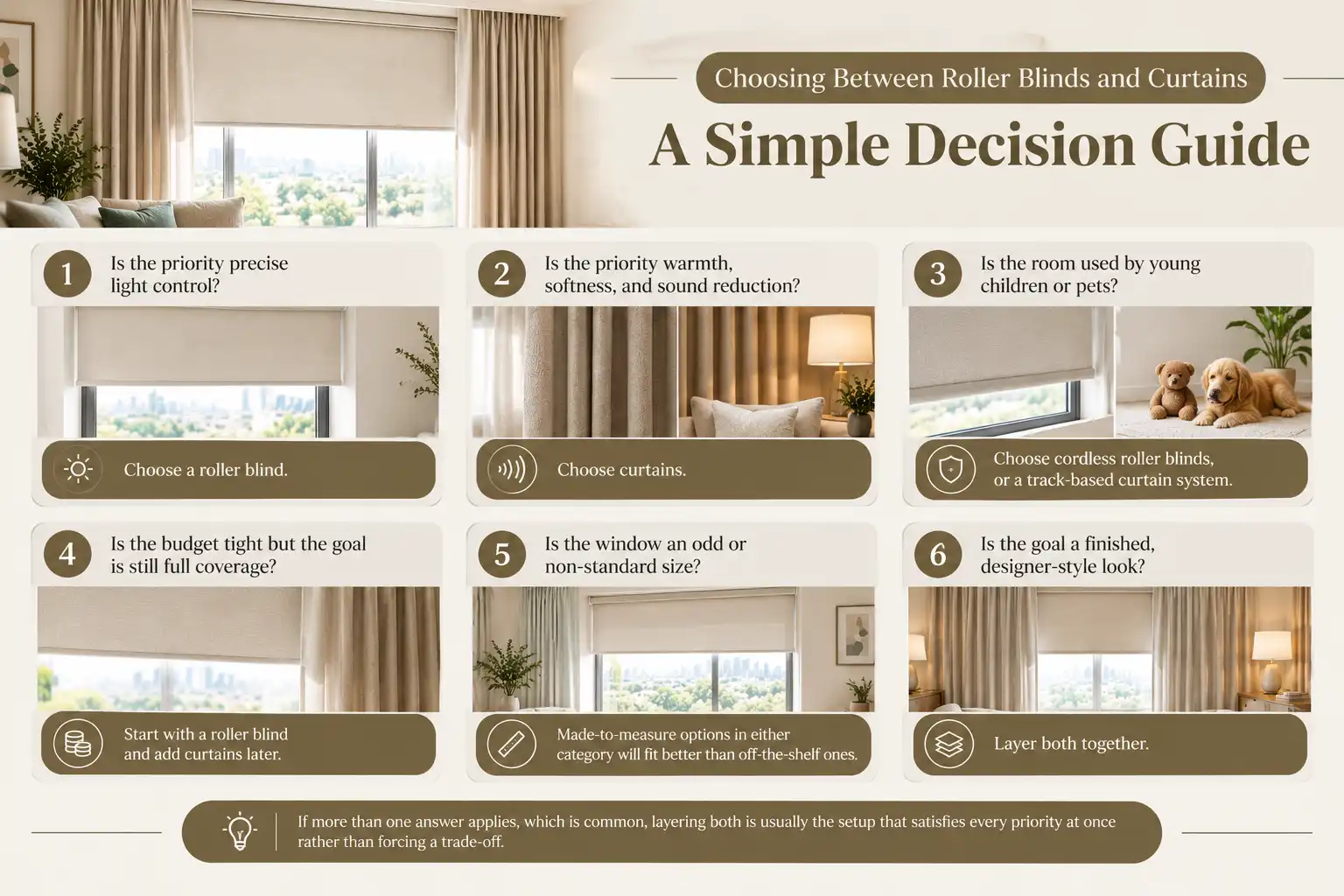
A few quick questions can narrow the decision faster than comparing every feature side by side.
- Is the priority precise light control?
Choose a roller blind.
- Is the priority warmth, softness, and sound reduction?
Choose curtains.
- Is the room used by young children or pets?
Choose cordless roller blinds, or a track-based curtain system.
- Is the budget tight but the goal is still full coverage?
Start with a roller blind and add curtains later.
- Is the window an odd or non-standard size?
Made-to-measure options in either category will fit better than off-the-shelf ones.
- Is the goal a finished, designer-style look?
Layer both together.
If more than one answer applies, which is common, layering both is usually the setup that satisfies every priority at once rather than forcing a trade-off.
Common Mistakes to Avoid When Choosing Window Treatments
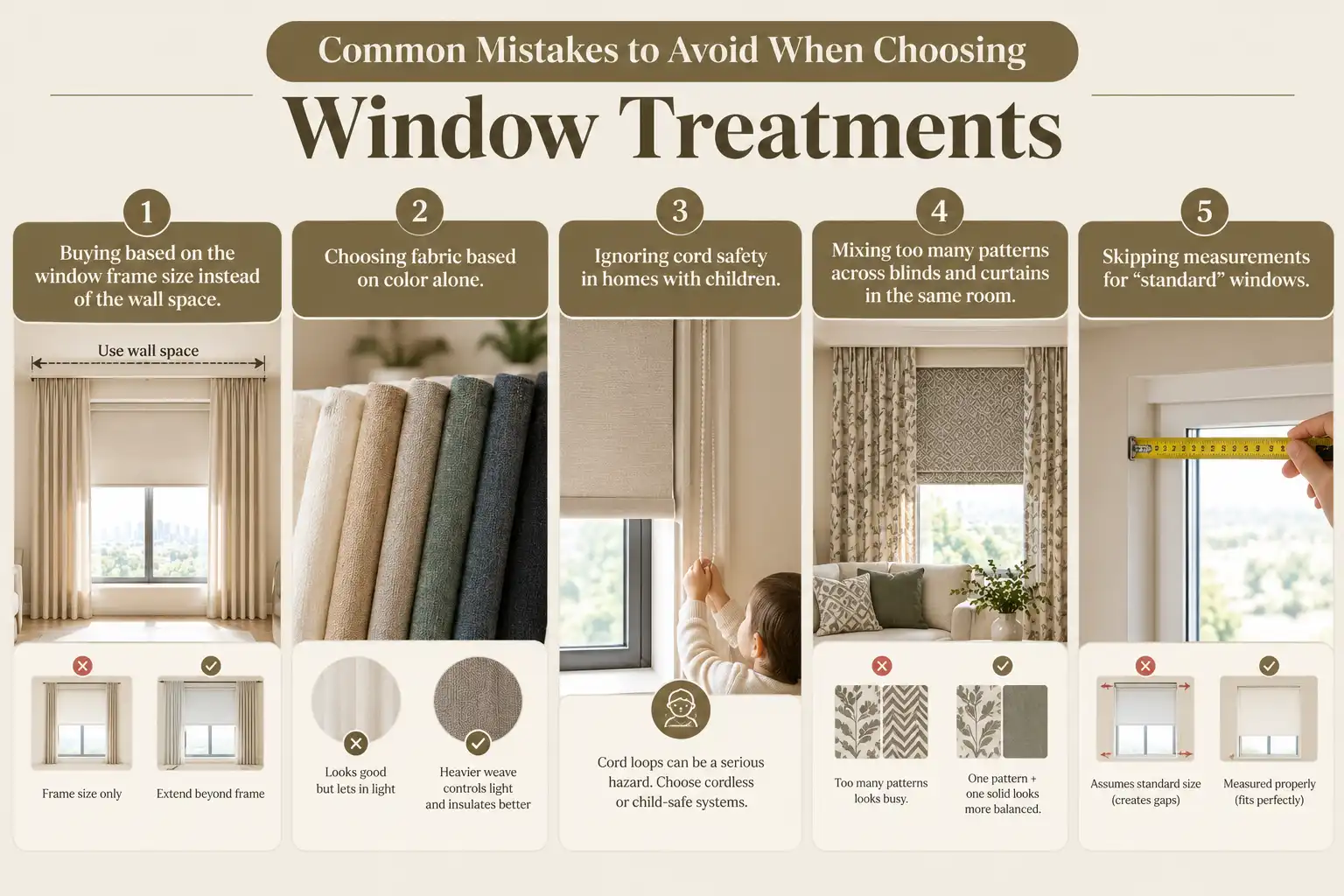
A few mistakes come up again and again, and most are easy to avoid once they are known in advance.
- Buying based on the window frame size instead of the wall space. Curtains almost always look better when the track extends beyond the frame.
- Choosing fabric based on color alone. Weight and weave affect light control and insulation far more than color does.
- Ignoring cord safety in homes with children. This is a real, documented hazard and not just a style preference.
- Mixing too many patterns across blinds and curtains in the same room. One patterned layer and one solid layer usually looks more balanced than two competing patterns.
- Skipping measurements for “standard” windows. Very few windows are perfectly standard, and even a small gap lets in light and reduces insulation.
Avoiding these five issues solves most of the regret that comes up after a window treatment is already installed.
Frequently Asked Questions
Are roller blinds better than curtains?
Neither is universally better. Roller blinds are better for precise light control, cleaning ease, and tight spaces. Curtains are better for warmth, sound dampening, and softening a room’s overall look. For example, a home office usually benefits more from a roller blind’s glare control, while a living room usually benefits more from a curtain’s texture and insulation.
Can roller blinds and curtains be used on the same window?
Yes. This layered setup is one of the most common approaches in modern interiors. The blind handles daily light adjustments while the curtain adds style and extra insulation. We regularly see this combination requested for rooms with strong afternoon sun, since it solves the glare problem without sacrificing how the room looks with the blind raised.
Do curtains block more heat than blinds?
Generally, yes, especially with heavier or lined fabric, since curtains trap a layer of air between the fabric and the glass. That said, a layered setup with both a blind and a curtain performs better than either one alone, because it creates two insulating barriers instead of one.
Are roller blinds safe for children’s rooms?
Cordless roller blinds are the safer option and are widely recommended for any room used by young children. Corded versions carry a documented strangulation risk, so cordless models or ones with fully inaccessible cords are the better default choice in a child’s bedroom or playroom.
Which is cheaper, roller blinds or curtains?
Basic roller blinds are usually the lower-cost entry point, especially in standard sizes. Curtains can range widely depending on fabric and whether they are made-to-measure, so a simple off-the-shelf curtain can sometimes cost less than a motorized or blackout roller blind. Cost really depends more on fabric and features than on the category itself.
Can curtains be added over existing roller blinds without removing them?
Yes, in most cases. A curtain track or rod can be mounted above and outside the existing roller blind without needing to take the blind down. This is one of the easiest upgrades for anyone who already has blinds installed and wants to add warmth or extra insulation without a full window treatment replacement.