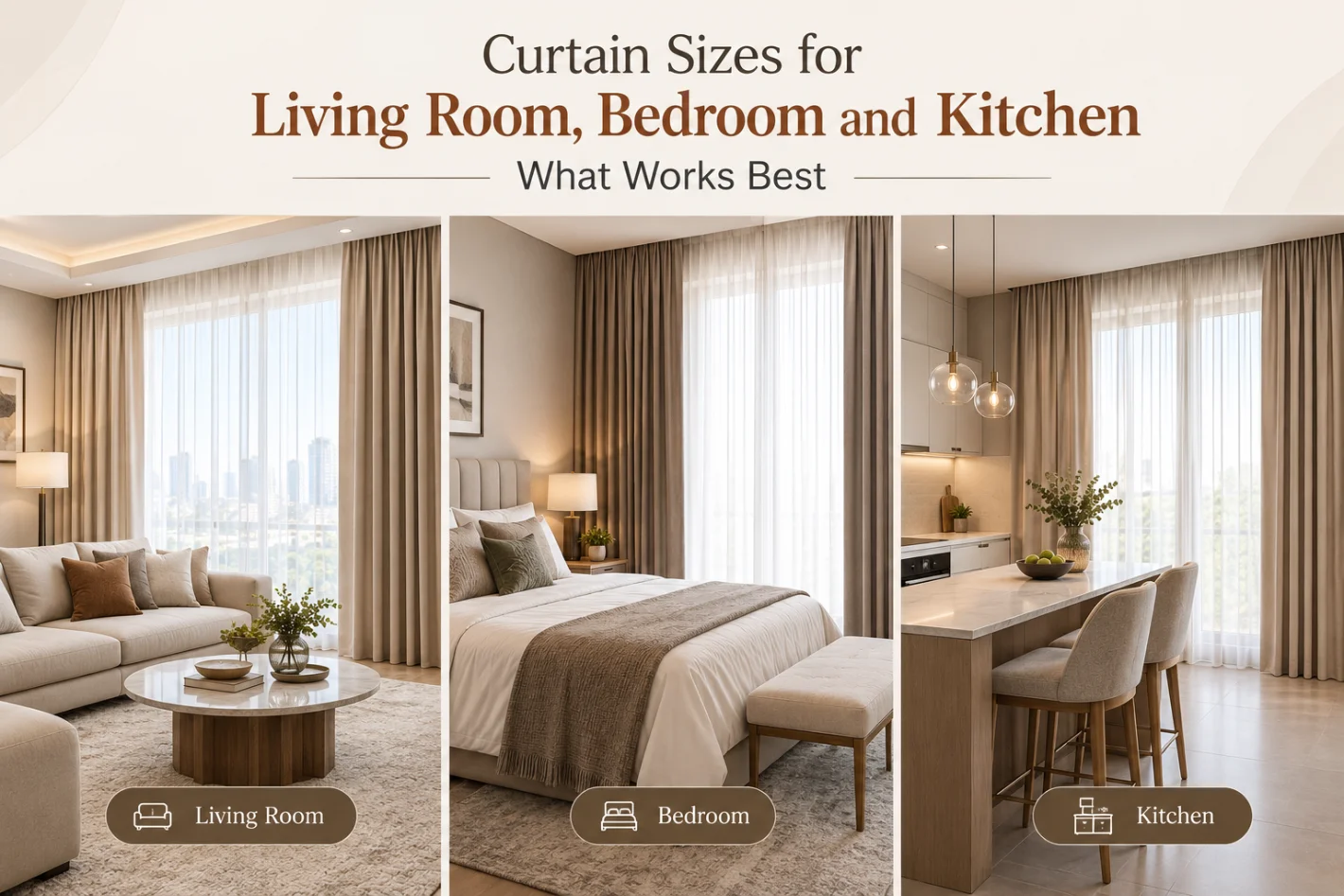
Curtain sizes are not one rule for every room. A kitchen window a living room window and a bedroom window need different lengths, widths, and even fullness, and using the same size for all three is one of the most common reasons a curtain looks off, even when the fabric itself is beautiful.
Getting curtain size right comes down to three numbers working together:
- right width for fullness,
- right length for the room
- right rod height above the window
Get all three matched to the actual room, and the curtain reads as intentional, almost tailored. Get one wrong, and no amount of expensive fabric fixes it.
Width should run 1.5 to 2.5 times the width of the window or rod, depending on the fabric and how full the finished look should be. Length depends on the room. Bedrooms and living rooms mostly use floor-length curtains, kitchens mostly use sill-length or short cafe curtains. Rod height sits 4 to 6 inches (10 to 15 cm) above the window frame as standard, and higher for a taller, more architectural look. The rod itself should extend 6 to 12 inches (15 to 30 cm) beyond the window on each side so the curtain has somewhere to stack when open, since a curtain with nowhere to go still blocks part of the glass even when fully drawn.
Why Does Curtain Size Actually Matter?
A curtain that is too narrow looks thin and pulled tight, and it will not fully close no matter how good the fabric is. A curtain that is too short looks like a measuring mistake rather than a style choice. A curtain hung too close to the window frame makes the whole window, and by extension the wall around it, look smaller than it actually is. None of these problems come from fabric quality. They come from the numbers decided before the curtain was ever ordered, which is exactly why a modest fabric sized correctly consistently outperforms an expensive fabric sized carelessly.
What Is the Right Width for Curtains?
The Basic Width Formula
Start by measuring the window width, then add extra width on both the rod and the fabric before deciding fullness. As a simple starting rule, add roughly 12 inches (30 cm) total to the window width, 6 inches (15 cm) on each side, for the rod itself. This gives the curtain somewhere to stack when fully open, so the glass is not partly covered even when the curtain is drawn back. Some retailers extend this further, recommending 6 to 12 inches (15 to 30 cm) of rod extension per side on wider or heavier curtains, since a rod that barely clears the frame still crowds the stacked fabric against the edge of the window.
Fullness: Why Total Fabric Width Should Be More Than the Rod
Fullness describes how much extra fabric is used compared to the flat rod width, and it is the real difference between a curtain that looks gathered and rich and one that looks stretched flat like a bedsheet pinned to a pole.
| Fullness Level | Total Fabric Width vs. Rod | Look |
|---|---|---|
| 1.5x | Rod width × 1.5 | Minimal fullness, tailored, flatter look |
| 2x | Rod width × 2 | Standard fullness, the most common choice |
| 2.5x | Rod width × 2.5 | Fuller, richer, best for sheers and light fabric |
A Worked Example
Take a window measuring 48 inches (122 cm) wide. Add 12 inches for stacking room, giving 60 inches (152 cm) as the rod width. For standard 2x fullness, multiply 60 inches by 2, giving 120 inches (305 cm) of total fabric width needed across however many panels are used. Split across two panels, each panel needs to measure 60 inches (152 cm) wide.
How High Should Curtain Rods Be Mounted?
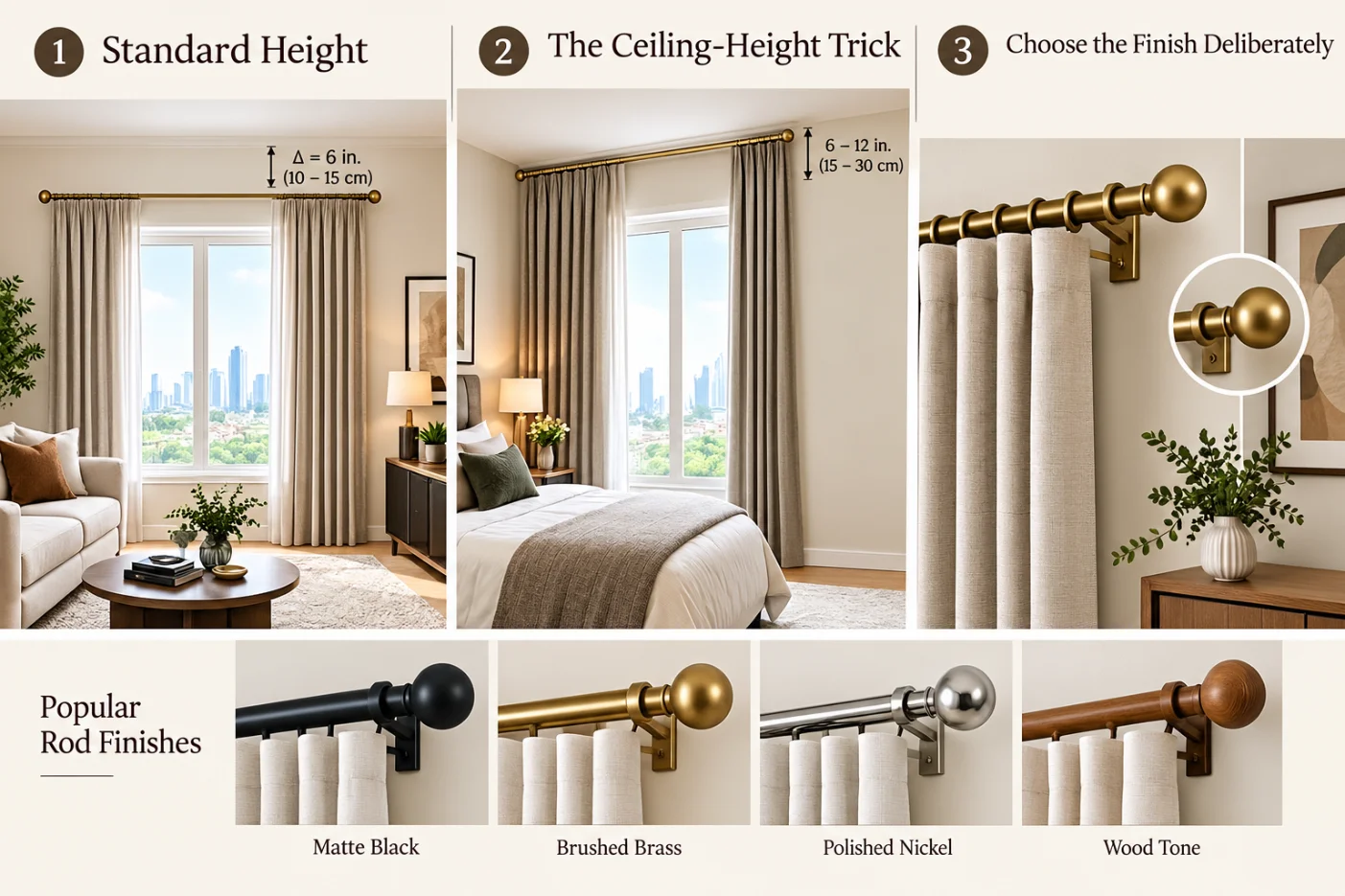
Rod height changes how tall a window, and by extension the whole wall, appears, and it is a decision made before length is even measured, since length counts downward from wherever the rod sits.
- Standard height. Mount the rod 4 to 6 inches (10 to 15 cm) above the top of the window frame. This is the safest, most common choice for most rooms and works well with a fixed panel length bought off the shelf.
- The ceiling-height trick. Mount the rod 6 to 12 inches (15 to 30 cm) above the frame, or as close to the ceiling as the wall allows. This draws the eye upward and makes the window and room look taller than they actually are. It costs nothing beyond choosing a slightly longer curtain to match the new drop, and it is one of the most reliable tricks a room can borrow from professional interior styling.
- Choose the finish deliberately, not as an afterthought. A rod and its brackets sit in full view all day, so the finish (matte black, brushed brass, polished nickel, or a natural wood tone) is part of the room’s overall look, not just hardware. A room built around warm metals reads as considered when the curtain rod matches, and slightly mismatched when it does not. Matching the rod style to the room’s existing metals is a small decision that changes how finished the whole window looks.
What Are the Different Curtain Length Types?
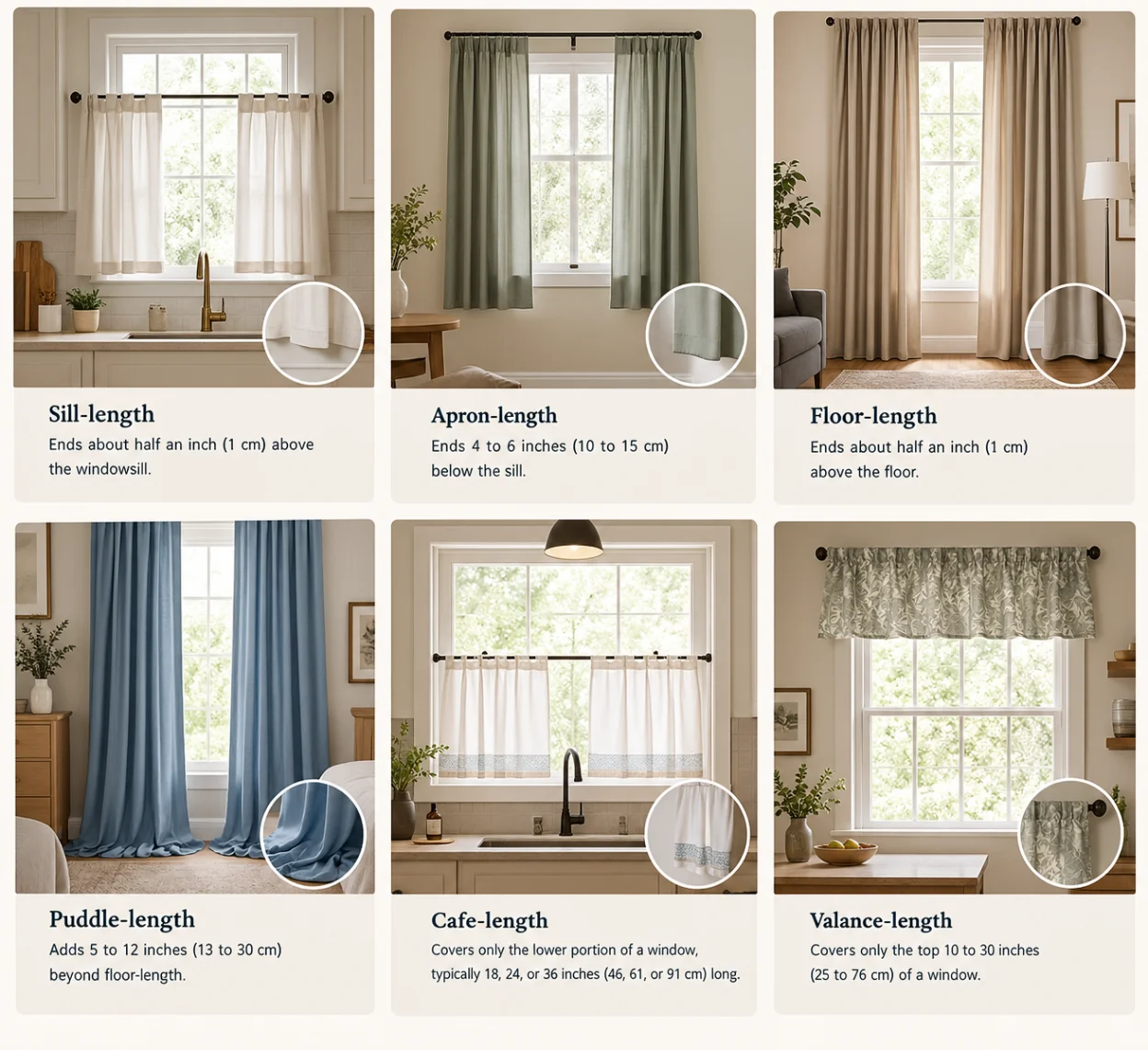
1. Sill-length.
Ends about half an inch (1 cm) above the windowsill. Informal and practical, and works well over counters, above furniture, or on small windows.
2. Apron-length.
Ends 4 to 6 inches (10 to 15 cm) below the sill, covering the apron of the window frame. A middle ground between sill-length and floor-length, useful when floor-length would be blocked by furniture underneath, or where the window gets opened often and a shorter drop is more practical day to day.
3. Floor-length.
Ends about half an inch (1 cm) above the floor. The most common choice for bedrooms and living rooms, since it elongates the whole wall.
4. Puddle-length.
Adds 5 to 12 inches (13 to 30 cm) beyond floor-length, so the extra fabric pools softly on the floor. This is a formal, romantic look best suited to low-traffic rooms without pets or small children underfoot, since a curtain opened and closed daily at this length will drag and pick up dust quickly.
5. Cafe-length.
Covers only the lower portion of a window, typically 18, 24, or 36 inches (46, 61, or 91 cm) long, leaving the top of the window open for light. Common in kitchens above a sink.
6. Valance-length.
Covers only the top 10 to 30 inches (25 to 76 cm) of a window. Decorative rather than functional, often layered over full curtains or used alone above a kitchen sink.
Which Curtain Size Works Best for a Living Room?
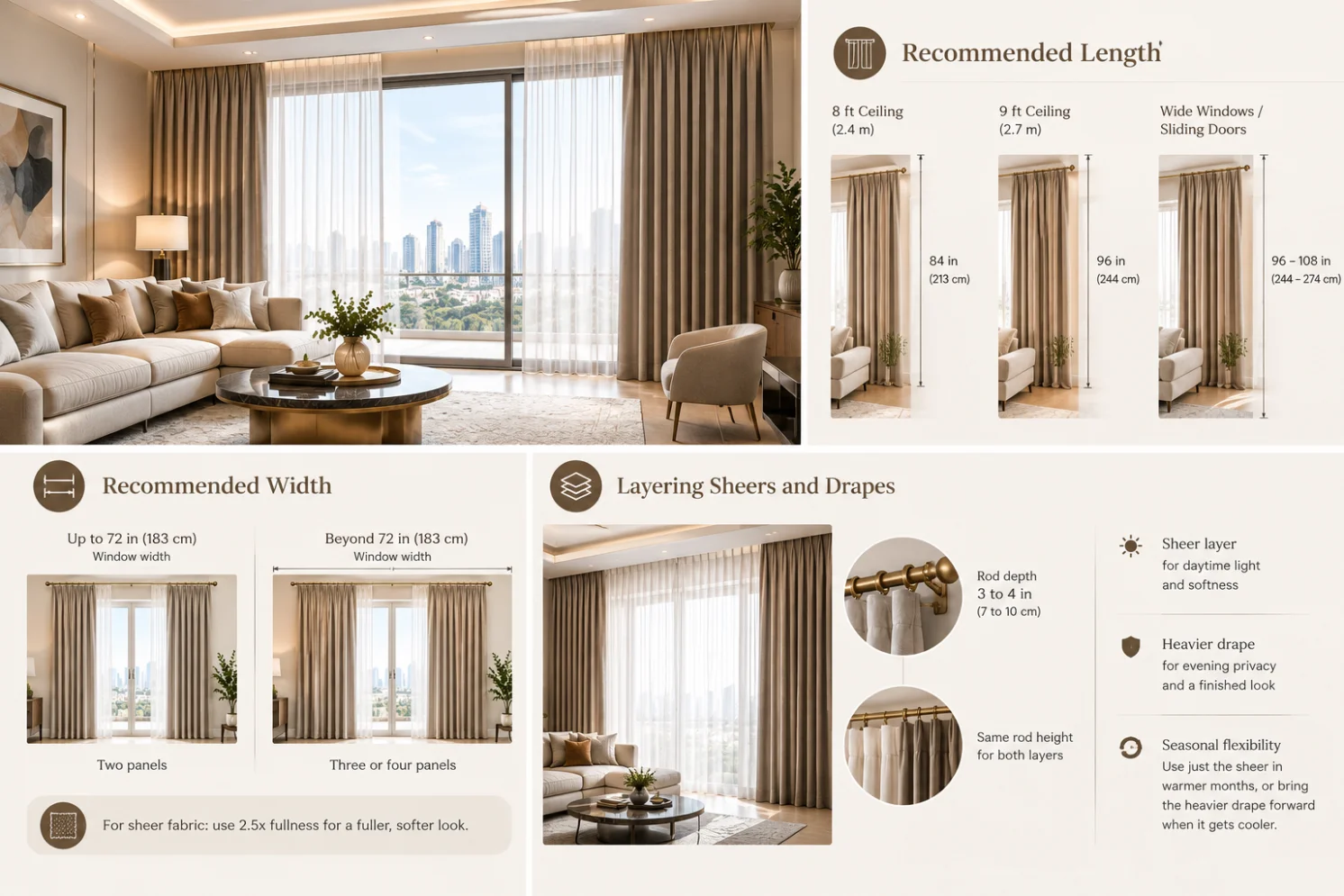
Living rooms are usually the most visible room in a home, so curtain size here does real work for how the entire space feels, not just the window itself.
Recommended Length for Living Rooms
Floor-length is the standard almost everywhere. On a standard 8-foot (2.4 m) ceiling with the rod mounted 4 to 6 inches above the frame, curtains around 84 inches (213 cm) long reach the floor correctly. On a 9-foot (2.7 m) ceiling, 96 inch (244 cm) curtains give the same result. For very wide living room windows or sliding glass doors, 96 to 108 inch (244 to 274 cm) panels are often needed just to reach the floor from a higher rod placement.
Recommended Width for Living Rooms
Living room windows often run wider than bedroom windows, sometimes 60 inches (152 cm) or more. Two panels usually work up to about 72 inches (183 cm) of window width. Beyond that, three or four panels give more even, less stretched coverage than trying to stretch two oversized panels across the same span. For sheer fabric specifically, lean toward the fuller end of the range, closer to 2.5x, since thin fabric looks flat and skimpy at lower fullness levels.
Layering Sheers and Heavier Drapes
Living rooms commonly layer two curtain types on a double rod: a sheer panel close to the glass for daytime light and softness, and a heavier drape further out for evening privacy and a more finished look. A double rod typically sits 3 to 4 inches (7 to 10 cm) apart in depth, close enough that both layers move as one visual unit rather than looking like two separate windows stacked on top of each other. Sizing both layers to the same rod height keeps the look even, and this layering also means the same window can shift with the seasons: a lighter sheer drawn alone through warmer months and a heavier fabric brought forward once the weather turns, without buying a whole new set of curtains twice a year.
What Curtain Size Works Best for a Bedroom?
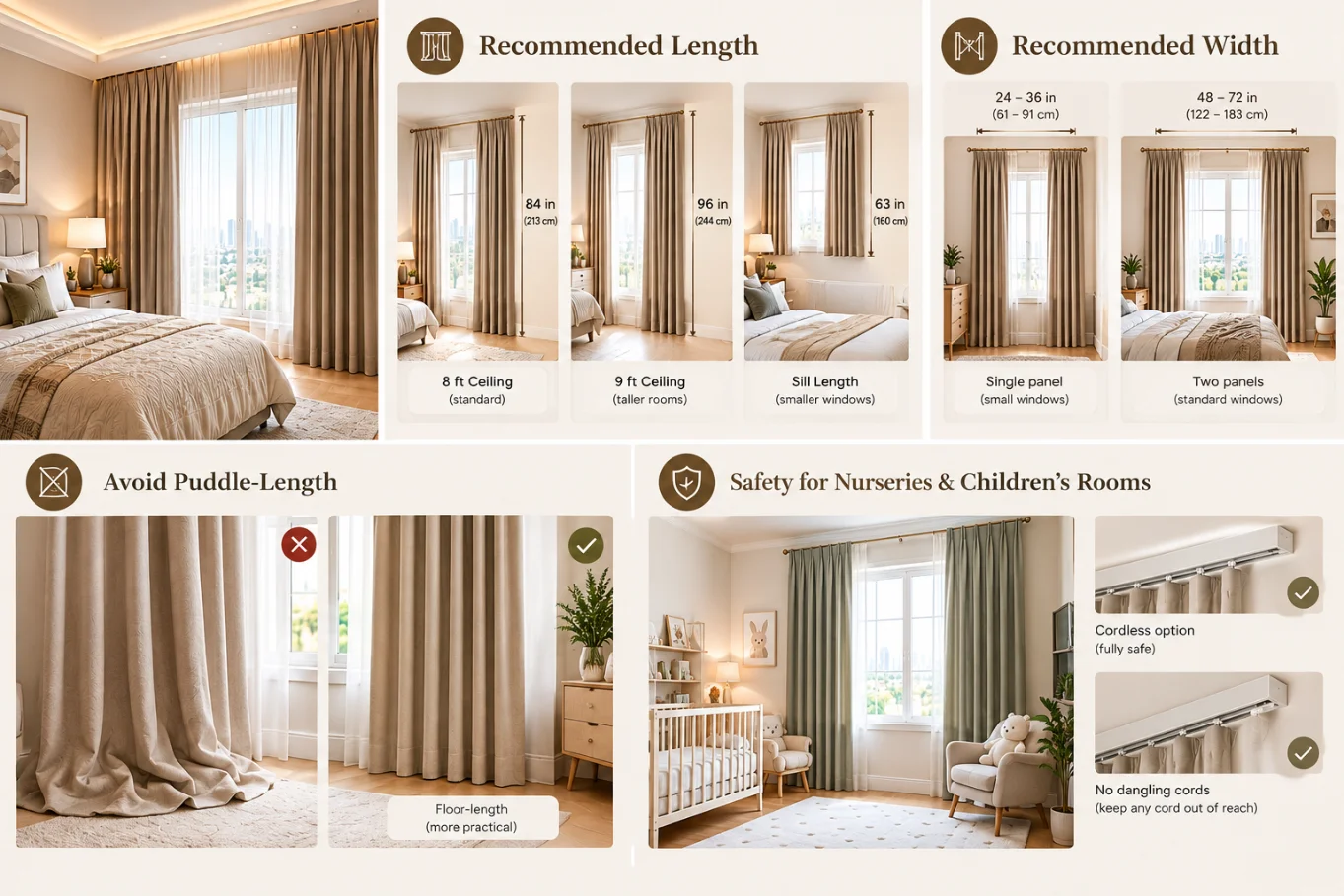
Bedrooms have a different job than living rooms. Blocking light and giving full privacy at night matters more here than how tall the window looks to a visitor.
Recommended Length for Bedrooms
The same floor-length logic as living rooms generally applies: 84 inches (213 cm) on an 8-foot ceiling, 96 inches (244 cm) on a 9-foot ceiling. For a smaller bedroom window, such as one above a headboard or in a compact room, sill-length curtains around 63 inches (160 cm) can work, though most bedrooms benefit from the fuller, floor-length option since it blocks more light at the edges.
Recommended Width for Bedrooms
Most bedroom windows run 36 to 48 inches (91 to 122 cm) wide, and two panels at standard fullness comfortably cover this range. For a bedroom that needs strong light-blocking, going toward the fuller end of the width range and choosing a proper blackout fabric with the right lining matters more than the exact inch count, since a narrow blackout curtain still leaks light around the edges no matter how well it blocks light through the fabric itself. Extending the rod a little further than the stacking minimum, so the panels overlap the frame generously on both sides when closed, closes that edge gap for good.
Avoid Puddle-Length in Bedrooms
Puddled curtains look elegant in photographs but collect dust and get stepped on in a room opened and closed daily. Floor-length without the extra puddle allowance is the more practical, everyday choice for a bedroom.
A Safety Note for Nurseries and Children’s Rooms
This is a detail almost no sizing guide mentions, and it matters more than most style decisions. According to the U.S. Consumer Product Safety Commission, window covering cords are a serious strangulation hazard for young children, and cordless curtains or blinds are the only fully safe option in any room where a child sleeps or plays. For a nursery or a child’s bedroom, choosing a curtain and hardware setup with no dangling cord, or keeping any cord fully out of reach and anchored well away from a crib or bed, is worth deciding before length or fabric even enters the conversation.
What Curtain Size Works Best for a Kitchen?
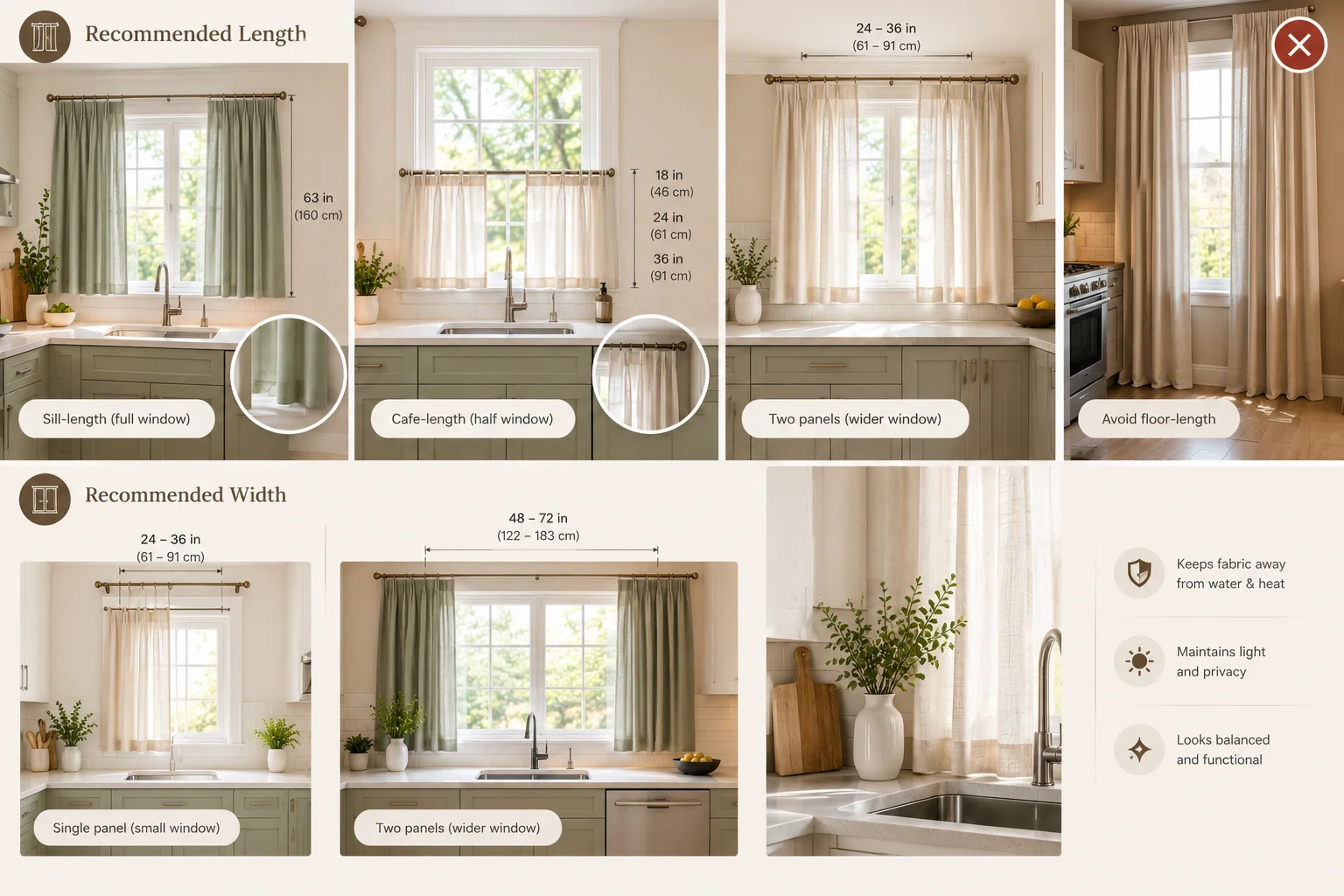
Kitchens are the room where length choice has a real, practical consequence rather than just a visual one, since fabric hanging near a sink, stove, or counter creates an actual hazard and an actual mess.
Recommended Length for Kitchens
For a full kitchen window, sill-length around 63 inches (160 cm), or whatever ends just above the sill for that specific window, keeps fabric clear of water and countertops. For a half-window above a sink, cafe curtains in 18, 24, or 36 inch (46, 61, or 91 cm) lengths cover just the lower portion, leaving the top open for light while keeping fabric away from the sink entirely.
Recommended Width for Kitchens
Kitchen windows tend to run smaller, often 24 to 36 inches (61 to 91 cm) wide. A single panel is frequently enough for a small kitchen window. For a wider kitchen window, two panels give a fuller look without overwhelming what is usually a smaller, more functional space than a living room or bedroom.
Never Floor-Length in a Kitchen
Floor-length curtains simply do not belong near a stove, sink, or high-traffic cooking area. Cafe-length or sill-length are the only lengths worth considering here, regardless of how the rest of the home is styled.
Curtain Size Comparison Table by Room
| Room | Most Common Length | 8 ft Ceiling | 9 ft Ceiling | Typical Width Approach |
|---|---|---|---|---|
| Living Room | Floor-length | 84 in (213 cm) | 96 in (244 cm) | 2x to 2.5x rod width |
| Bedroom | Floor-length | 84 in (213 cm) | 96 in (244 cm) | 2x rod width, fuller for blackout |
| Kitchen (full window) | Sill-length | 63 in (160 cm) | 63 in (160 cm) | 1.5x to 2x rod width |
| Kitchen (half window) | Cafe-length | 18–36 in (46–91 cm) | Same | 1.5x to 2x rod width |
How Do You Size Curtains for Bay Windows, Corner Windows, and Doors?
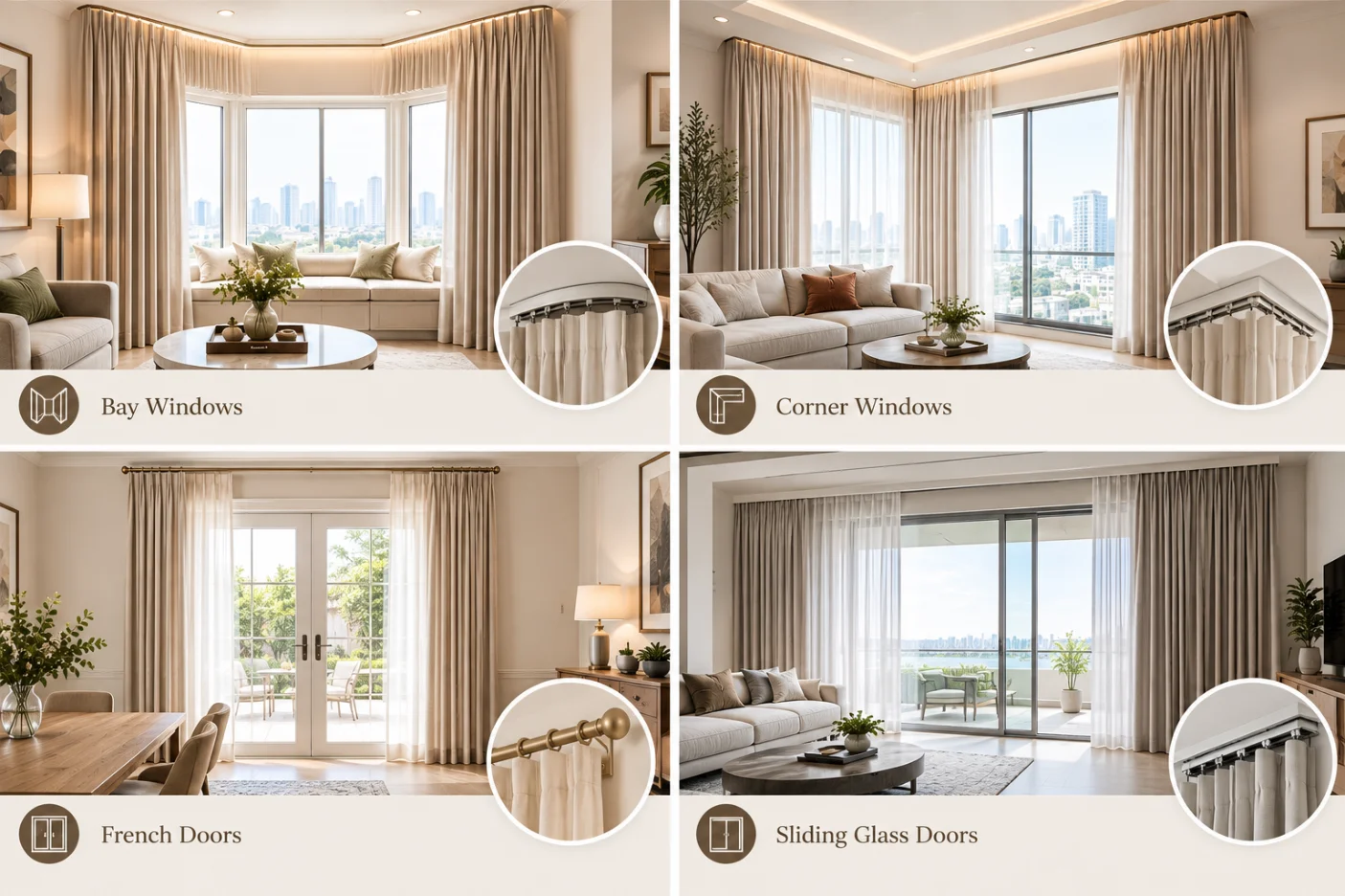
Standard formulas assume one flat window on one flat wall, and several common window shapes need their own approach.
- Bay windows need a curved or angled track rather than a single straight rod, and the width calculation runs separately for each angled section of the bay rather than as one flat total, since a single continuous panel cannot follow the angle cleanly. Measuring each section on its own and adding the same stacking allowance to each keeps the corners from binding when the curtain opens.
- Corner windows, where two windows meet at a right angle with little or no wall between them, usually work best with a single continuous track that wraps the corner, since two separate rods meeting at the corner leave an awkward gap exactly where the light gets in.
- French doors need a length that clears the floor without dragging on the door’s swing path, and width that allows the panel to be pulled fully clear of the door itself, since a curtain that blocks the door’s opening arc defeats the point of a door in the first place.
- Sliding glass doors usually need a wider rod than a standard window of the same glass size, since the curtain has to stack entirely to one side (or split to both sides) without covering any of the door’s sliding path. A track-based system built for wide, heavy panels tends to hold up better here than a single fixed rod, and for anyone still deciding between a full curtain setup and a blind-style option for this kind of opening, the trade-offs come up again in the comparison between curtains and blinds for a sliding door.
What Fabric Weight Does to Fullness
Heavier fabric, like velvet or a fully lined drape, needs less fullness to look rich, since the weight and natural drape of the fabric does most of the visual work on its own. Lighter fabric, like sheers or voile, needs more fullness, closer to 2.5x, because thin fabric without extra width looks flat and stretched rather than soft and gathered. In fabric terms, this comes down to grams per square meter (GSM): a heavier weave in the 300 to 500 GSM range holds a fold on its own weight, while a lightweight sheer under 100 GSM needs the extra fullness to create any visible fold at all. This is one of the more overlooked parts of curtain sizing, since two curtains cut to the exact same width formula can look completely different once hung, purely because of what they are made from. A heavier velvet and a lighter linen weave sized with the same formula will settle into two noticeably different silhouettes on the same window, which is worth seeing in person before committing to a fullness level on a fabric that has never been hung in that specific room.
What Mistakes Ruin Curtain Sizing?
- Measuring the glass instead of the full frame. Measuring just the visible glass rather than the full window opening, including trim, leads to a curtain that does not fully cover the window when closed.
- Choosing width without fullness in mind. Buying a curtain exactly the width of the window, with no added fullness, is one of the most common sizing mistakes. The result looks stretched and thin, no matter how nice the fabric is.
- Mounting the rod too low. A rod mounted right at the top of the window frame, rather than 4 to 6 inches above it, makes the window look shorter and the room feel lower than it actually is.
- Using the same length in every room. Floor-length everywhere ignores that kitchens need short, functional lengths for safety, not the same drama that works in a living room.
- Ignoring ceiling height when choosing length. The same 84-inch curtain that works perfectly on an 8-foot ceiling will hang short of the floor on a 9-foot ceiling, leaving an awkward gap that reads as a mistake rather than a style choice.
- Skipping the worked math. Guessing at width rather than actually calculating window width plus stacking room plus fullness multiplier is how most undersized curtains happen in the first place.
- Choosing a rod that is too short for the wall. Even a perfectly sized curtain looks cramped on a rod that barely clears the window frame, since there is nowhere for the fabric to stack when opened.
How Curtain Size Connects to the Rest of the Setup
Size on its own does not finish the job. A well-measured curtain still needs the right hardware to hang correctly, and rod spacing, wall anchors, bracket weight ratings, and even the style of hook or ring used to attach the fabric all interact with the width and length decided here. Heavier fabric on a thin rod sags in the middle over time regardless of how carefully it was measured, so size and hardware really do need to be planned together rather than treated as two separate purchases. For a curtain being made to the exact measurements of a specific window rather than bought off the shelf, starting from a custom cut removes most of the guesswork covered in this piece entirely, since the fabric gets cut to the real numbers from the start rather than adjusted afterward. Once the rod is up and the fabric is ready, the actual hanging follows the same basic sequence regardless of room, measuring, marking, leveling, and checking for gaps once the panel is drawn closed.
Frequently Asked Questions
What is the standard curtain size for a living room?
84-inch (213 cm) floor-length curtains work for most living rooms with a standard 8-foot ceiling, with total width at 2 to 2.5 times the rod width for good fullness. On a 9-foot ceiling, 96 inch (244 cm) curtains give the same floor-skimming result. A living room with an unusually wide window or a sliding glass door may need panels closer to 108 inches to reach the floor once the rod is mounted higher for the ceiling-height trick.
What curtain length is best for a kitchen window?
Sill-length around 63 inches (160 cm) for a full kitchen window, or a short cafe curtain, 18 to 36 inches (46 to 91 cm), for a half-window above a sink. Floor-length curtains do not belong in a kitchen because of the real risk near water, heat, and countertops, no matter how well they might suit the rest of the home’s style.
How wide should curtains be compared to the window?
Total fabric width should be 1.5 to 2.5 times the width of the rod, depending on how full a look is wanted and how heavy the fabric is. Heavier fabric can use less fullness since its own weight creates folds, while sheer fabric needs more fullness to avoid looking flat and thin.
Should bedroom curtains touch the floor?
Generally yes. Floor-length curtains, ending about half an inch (1 cm) above the floor, are the standard for bedrooms since they block more light at the bottom edge than a shorter length and give a more finished look than sill-length in most cases. The exception is a small window above a headboard, where a shorter length can work without losing much light control.
Do I need different curtain sizes for every room in the house?
Yes, realistically. A kitchen needs short, practical lengths for safety, a bedroom needs full floor-length coverage for light blocking, and a living room usually wants floor-length for visual height, sometimes with the rod mounted higher still for drama. Using one size everywhere ignores what each room is actually being asked to do.
How high should curtain rods be mounted?
4 to 6 inches (10 to 15 cm) above the window frame is the standard height for most rooms. For a room where making the ceiling look taller matters, mounting 6 to 12 inches (15 to 30 cm) above the frame, or close to the ceiling itself, creates that illusion, and the curtain length simply needs to grow to match the new drop.
What happens if I choose the wrong curtain size?
A curtain that is too narrow will not fully close and looks stretched thin against the window. A curtain that is too short looks like a measuring mistake rather than a style choice. Both problems are visible immediately, and both are harder to fix after the fact than simply measuring correctly before ordering, particularly once a custom-cut fabric has already been sewn to the wrong number.
Do curtain sizes need to change for bay windows or sliding doors?
Yes. A bay window needs its width measured and calculated section by section rather than as one flat total, since the angled corners will not sit right under a single straight rod sized for a flat wall. A sliding door usually needs a wider rod and a track built for a heavier stack, since the entire panel has to clear to one side without blocking the door’s path.