Office window curtains do three jobs at once: they control how much light hits a screen, they decide how much sound travels between rooms, and they shape how the whole workspace feels the moment someone walks in. Picking the wrong type, the wrong fabric, or hanging them on rod holders that sit too close to the frame can undo all three jobs, even if the fabric itself looks expensive.
A good office curtain setup rests on four choices working together: the curtain type (blackout, sheer, layered, or a blind-style alternative), the heading style (pinch pleat, eyelet, wave, or tab top), the fabric weight, and the rod holder placement. Get the fabric right but mount the rod too low, and light still leaks in around the edges. Get the rod placement perfect but pick a thin fabric, and glare still hits every monitor by mid-morning. This guide covers every major curtain type used in offices today, how to pick a heading style, how rod holders and tracks decide the final result, and the exact steps for installing curtains that actually block what they are supposed to block.
Why Do Office Windows Need Curtains in the First Place?
A window without any covering does four things badly at once:
- It lets glare hit computer screen
- It lets outside noise travel straight into meeting rooms
- It lets heat build up through the glass
- It leaves the whole room visible to anyone outside.
Curtains fix all four with one product, which is why so many workplaces treat window treatment as part of the fit-out rather than an afterthought.
Beyond the practical side, curtains also set the tone of a room the second someone steps in. A boardroom with heavy, well-hung drapes reads as serious and deliberate. A reception area with soft sheer panels reads as open and welcoming. The fabric and the fold do that work quietly, without a single word being said.
What Types of Curtains Work Best for Office Windows?
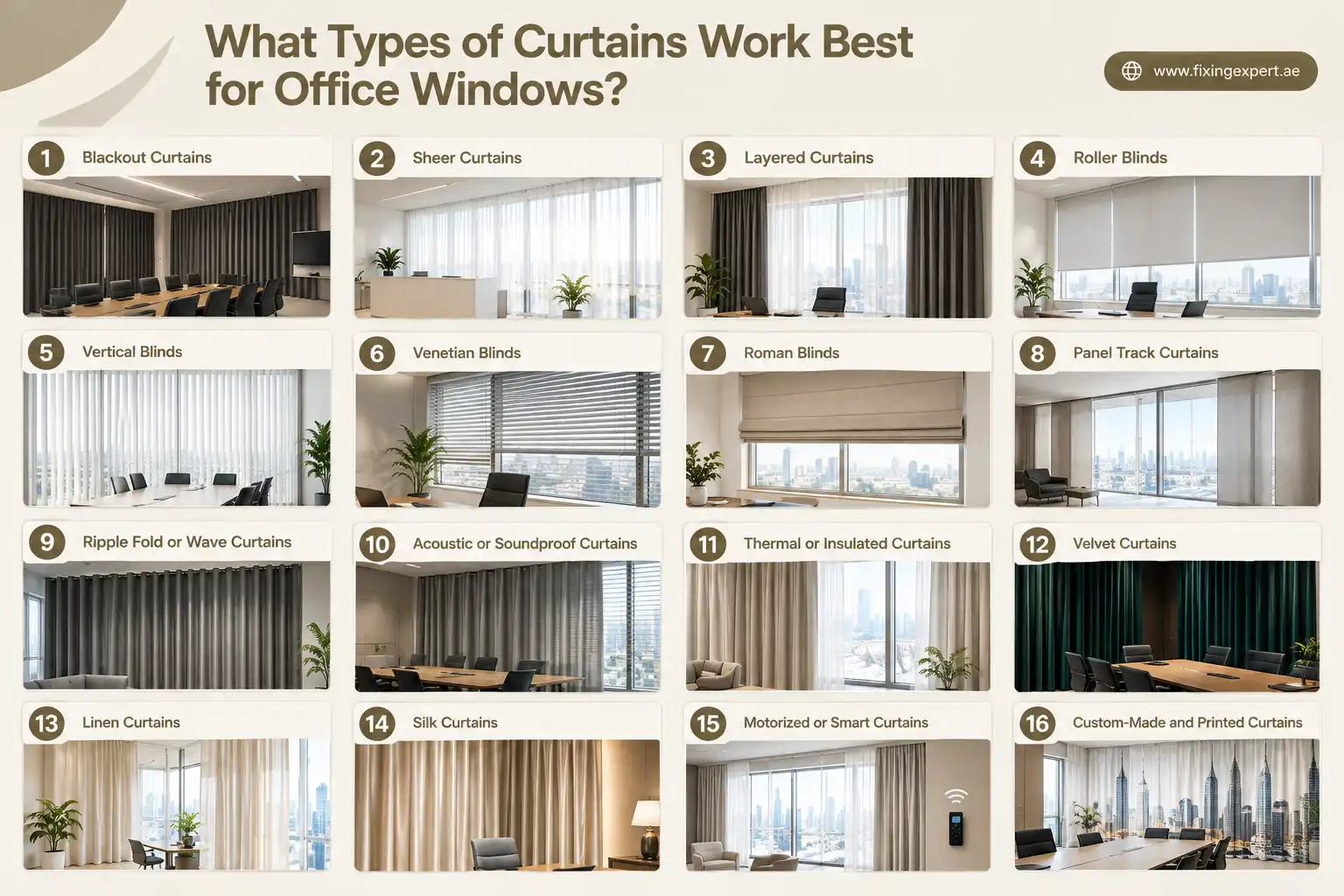
Office curtains fall into a wider range of categories than most people expect, and mixing them up leads to buying the wrong one for the wrong room. Below is a full breakdown of the types actually used across workspaces today, from full fabric panels to blind-style alternatives that get grouped under the same shopping search.
1. Blackout Curtains
Blackout curtains use a dense, tightly woven face fabric backed by a foam or triple-weave lining that stops nearly all light from passing through. They suit conference rooms, presentation spaces, and any office running projectors or screen-heavy meetings where glare ruins visibility. A dedicated blackout fabric range usually lists the light-block percentage directly on the product, which is the number worth checking rather than judging by how thick the fabric feels.
2. Sheer Curtains
Sheer curtains are made from voile, chiffon, or organza, fabrics thin enough to let daylight filter through while still softening the view from outside. They fit reception desks, open-plan floors, and any room that wants natural light without a bare, exposed window. Many offices treat a lighter sheer fabric option as the daytime layer in a two-curtain setup rather than the only covering on the window.
3. Layered Curtains (Sheer Plus Blackout)
Layering solves the problem of wanting both daylight and full privacy from the same window. A sheer panel hangs closer to the glass, and a blackout panel hangs on an outer rod in front of it. During the day, only the sheer gets drawn. For a screen-share meeting or an evening session, the blackout panel closes over it in seconds.
4. Roller Blinds
Roller blinds are a single flat piece of fabric that rolls up around a tube at the top of the window. They suit small offices, startups, and any workspace going for a clean, minimal look, since there is no bulk of fabric stacking to either side when open.
5. Vertical Blinds
Vertical blinds use individual fabric or PVC slats that rotate to control light direction without fully closing. They are common on large glass walls, floor-to-ceiling windows, and sliding glass partitions between meeting rooms, since the slats can be angled instead of fully drawn.
6. Venetian Blinds
Made from horizontal wood, aluminum, or PVC slats, venetian blinds give a crisp, formal look and let a room fine-tune exactly how much light enters by adjusting the slat angle. They work well in private cabins and executive offices that want a tidy, structured finish.
7. Roman Blinds
Roman blinds fold into neat horizontal pleats when raised instead of rolling or stacking to the side. They give a softer, more tailored look than a roller blind while still sitting flat against the window when fully open.
8. Panel Track Curtains
Panel track systems run wide, flat fabric panels along a track, sliding side to side like a sliding door instead of gathering into folds. They suit very wide windows or glass walls where a normal curtain would need an unusually long rod.
9. Ripple Fold or Wave Curtains
Wave curtains hang from evenly spaced carriers so the fabric forms one continuous, uniform curve from top to bottom instead of separate pleats. The result reads as modern and architectural, which is why newer office fit-outs increasingly choose this style over traditional pleats.
10. Acoustic or Soundproof Curtains
Made from thick, dense weaves, sometimes with an added acoustic lining, these curtains absorb sound rather than just blocking light. Open-plan offices, call centers, and rooms next to a busy street benefit most, since a fabric option built specifically for sound control dulls both outside traffic noise and echo bouncing around a hard-floored room.
11. Thermal or Insulated Curtains
Thermal curtains use a multi-layer lining that traps air and slows heat transfer through the glass. They lower how hard an air conditioning system has to work in summer and how much heat escapes in winter, which makes them a genuine energy-saving choice rather than just a style pick. The U.S. Department of Energy notes that well-fitted window coverings can meaningfully cut both heat gain and heat loss through a window, which lines up with why thermal linings earn their place in an office budget.
12. Velvet Curtains
Velvet’s dense weave gives strong light blocking and real sound absorption alongside its look. A heavier velvet weave suits executive offices, boardrooms, and any space aiming for a premium, formal finish, though the fabric needs regular vacuuming to stay free of dust.
13. Linen Curtains
Linen brings a natural, breathable texture that suits open, modern office interiors. A natural linen fabric line lets in a soft, diffused light rather than blocking it outright, which fits casual workspaces and creative studios better than a formal boardroom.
14. Silk Curtains
Silk gives the most luxurious finish of any common curtain fabric, with a natural sheen that changes look depending on the light in the room. A silk fabric selection tends to go into reception areas, executive suites, or hospitality-style office lobbies rather than everyday workspaces, since the fabric needs careful cleaning.
15. Motorized or Smart Curtains
Motorized tracks open and close curtains by remote, app, or voice command, and many can be scheduled to open at sunrise and close at sunset automatically. Fora motorized curtain setup, wide windows and hard-to-reach glass walls benefit the most, since no one has to physically walk over and adjust the fabric by hand every time light shifts through the day.
16. Custom-Made and Printed Curtains
Some offices want a curtain that carries a logo, a brand color, or a specific pattern rather than a stock fabric. A custom-made curtain service allows a business to specify width, fabric, header style, and even printed branding, turning a functional item into a piece of the interior identity.
Picking from this list comes down to matching the room’s purpose to the fabric’s strength: a conference room needs light block, a reception area needs a soft welcoming look, and a call center needs sound absorption above everything else. No single curtain type wins every category, which is why most fitted-out offices end up using two or three different types across different rooms.
What Header Style Should an Office Window Curtain Use?
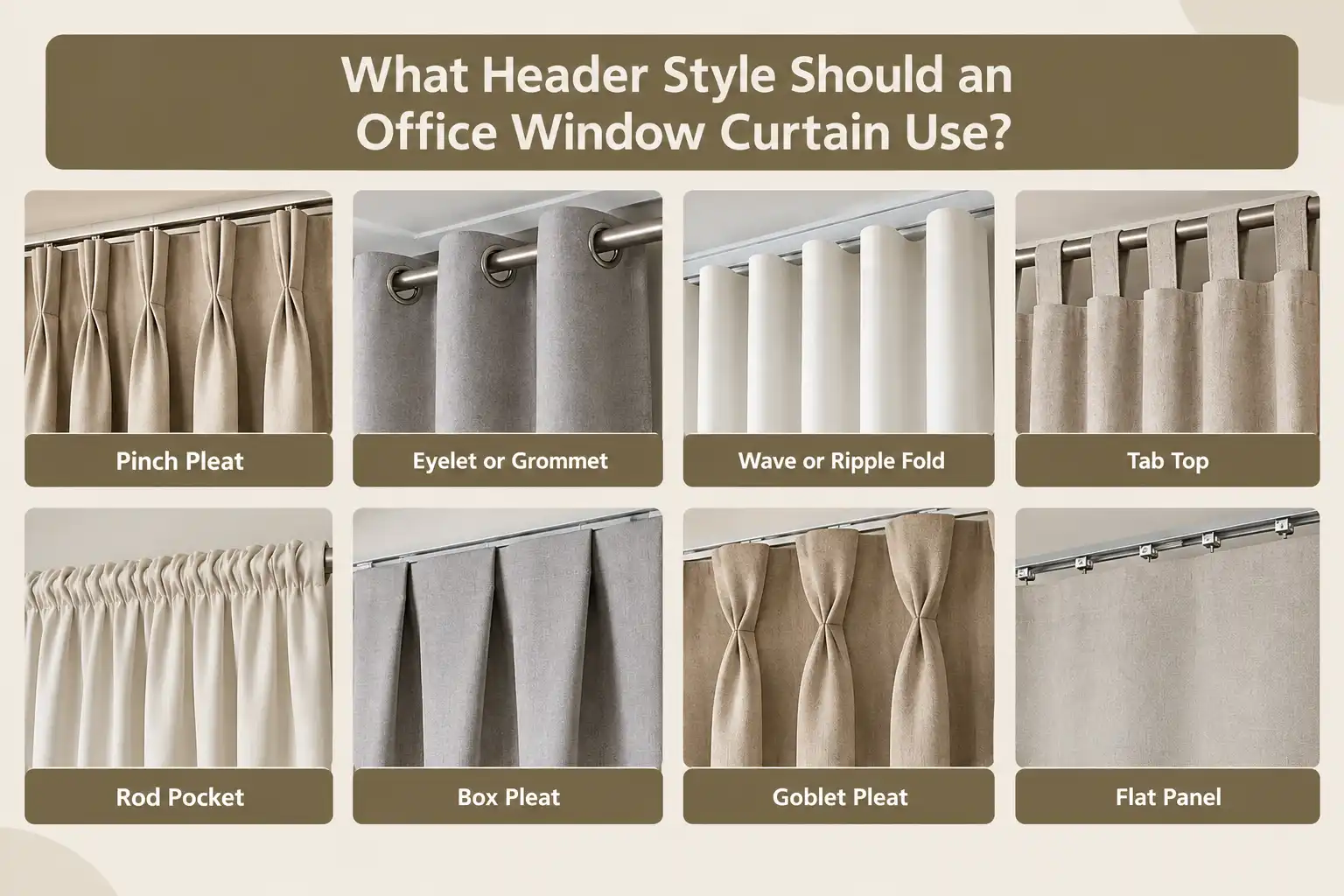
The heading style, meaning how the fabric attaches to the rod or track, changes both the finished look and how well the curtain blocks light at the top edge. Some styles sit flush against the rod with no gap, and others leave small spaces that let light stream through even when the curtain is fully closed.
Pinch Pleat
Pinch pleat gathers the fabric into small, evenly spaced folds stitched at the top. It gives a tailored, formal finish and sits close to the rod, which limits light gaps. Apinch pleat curtain style is one of the more traditional choices for executive offices and boardrooms.
Eyelet or Grommet
Metal rings punched into the top of the fabric slide directly over the rod. This style is quick to open and close but leaves visible gaps between the fabric folds, letting in small streaks of light along the top even when drawn.
Wave or Ripple Fold
As covered above, wave heading creates one smooth, continuous curve. It sits close to the track with minimal gapping and gives the cleanest, most modern line of any heading style.
Tab Top
Fabric loops sewn directly into the top of the panel slide over the rod. It gives a casual, relaxed look but, like eyelet, leaves gaps between the tabs that let light through.
Rod Pocket
A sewn channel at the top of the fabric slides directly onto the rod with no visible hardware. It gives a soft, gathered look and sits flush against the rod, closing off most of the top gap.
Box Pleat
Box pleats form crisp, flat-fronted folds rather than the rounded look of a pinch pleat. This style suits formal spaces that want structure and symmetry over softness.
Goblet Pleat
A more decorative version of pinch pleat, shaped like a goblet at the top and often stuffed with interlining to hold its shape. It is less common in everyday offices but shows up in high-end reception areas.
Flat Panel
No pleating at all, just a flat piece of fabric clipped or tab-hung across the top. This is the simplest and least expensive heading, most often paired with panel track systems on very wide glass walls.
Choosing between these largely comes down to how much light control the room needs. A boardroom running afternoon presentations should lean toward pinch pleat, wave, or rod pocket, since all three sit close to the rod. A casual open-plan floor can afford the gaps that come with eyelet or tab top, since light leakage matters less when the room is not trying to go fully dark. Anyone unsure which header pairs best with a chosen fabric can look through the range of available curtain hooks and header hardware before finalizing the order.
Curtains or Blinds for an Office: Which One Wins?
Both options control light, but they do it differently, and the right pick depends on what the room prioritizes.
| Factor | Curtains | Blinds |
| Light block | Full block possible with blackout lining and correct fit | Depends on slat fit; gaps are common at edges |
| Noise reduction | Strong; fabric absorbs sound | Minimal |
| Style range | Wide, any color, pattern, or fabric | Narrower, mostly neutral finishes |
| Maintenance | Occasional washing or dry cleaning | Dusting or wiping slats |
| Best for | Boardrooms, reception, sound-sensitive rooms | Compact spaces, minimalist offices |
Curtains generally win on noise reduction and style flexibility, while blinds win on a tidy, compact footprint for smaller rooms. A growing number of offices avoid picking one over the other entirely and pair blinds with a curtain layer instead, getting the blind’s daytime light control and the curtain’s full darkness and sound absorption in one window. For teams still weighing the two against shutters as a third option, a fuller breakdown of how curtains, blinds, and shutters compare covers cost and upkeep differences in more depth.
What Fabric Should an Office Curtain Be Made Of?
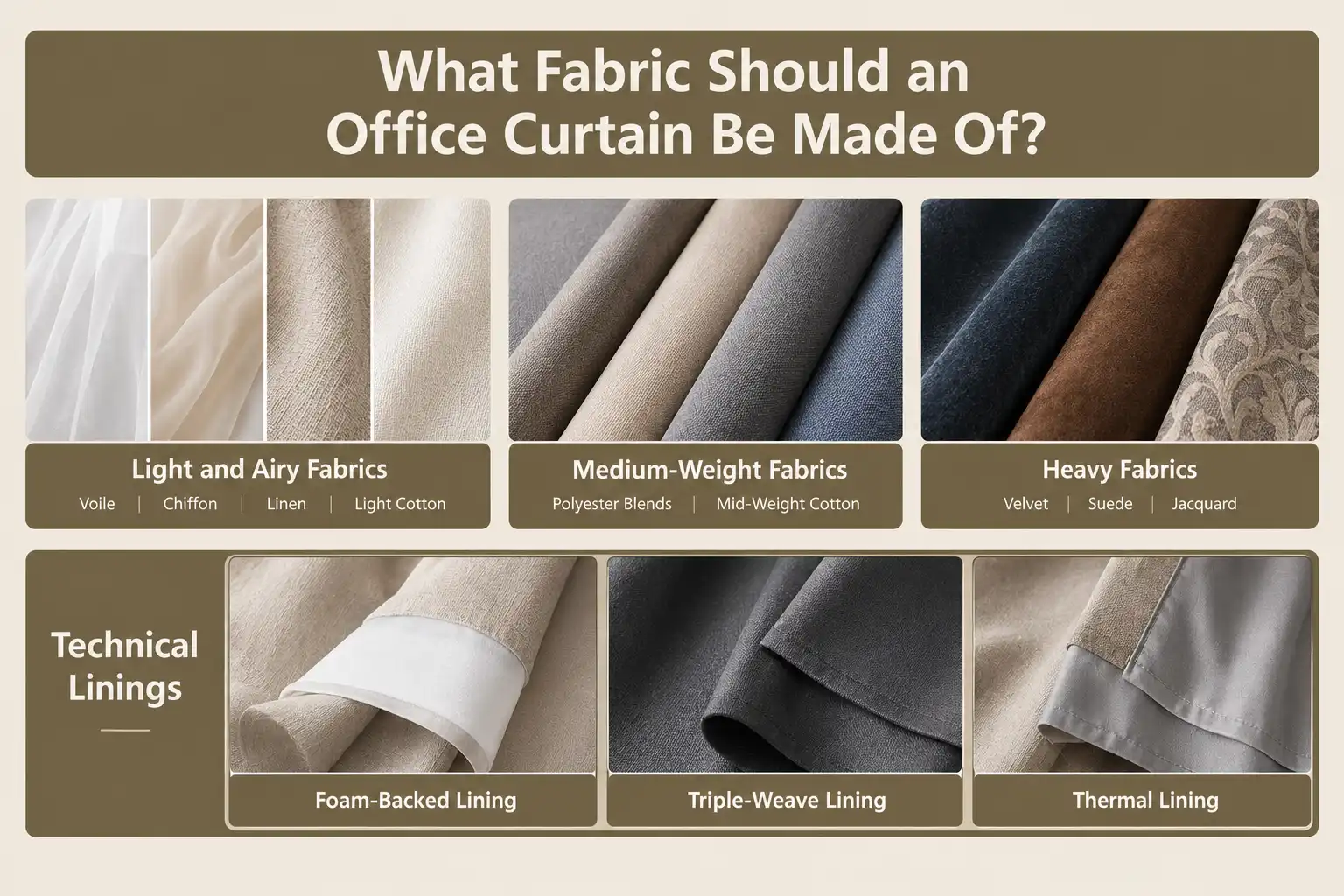
Fabric choice affects light blocking, sound absorption, durability, and how the curtain looks day to day, and different rooms call for different weights.
Light and Airy Fabrics
Voile, chiffon, linen, and light cotton let daylight filter through while still softening the view. These fit reception areas and open-plan floors where a fully dark room is not the goal.
Medium-Weight Fabrics
Polyester blends and mid-weight cotton strike a balance between light control and cost, making them the most common choice for standard offices without a specialist need for full blackout or full sound absorption.
Heavy Fabrics
Velvet, suede, and jacquard bring the strongest light block, insulation, and sound dampening of any fabric group. They cost more and need more upkeep, but for a boardroom or an executive office, the trade-off is usually worth it.
Technical Linings
Behind any face fabric, the lining does most of the functional work. Foam-backed linings give solid light block at a lower cost, triple-weave linings push that further for rooms needing full blackout, and thermal linings focus more on temperature control than total darkness. A curtain with a thin face fabric and a strong lining will often outperform a thick fabric with no lining at all, so checking what sits behind the visible layer matters as much as the fabric itself.
Fire safety is worth a mention here too, since commercial spaces often have different requirements than a home. Fabrics carrying a flame-retardant treatment or certification, in line with standards set out by bodies like the National Fire Protection Association, are worth confirming before ordering for any shared commercial building, particularly in larger office towers with stricter fit-out rules.
How Do Curtain Rod Holders Affect Light and Noise Control?
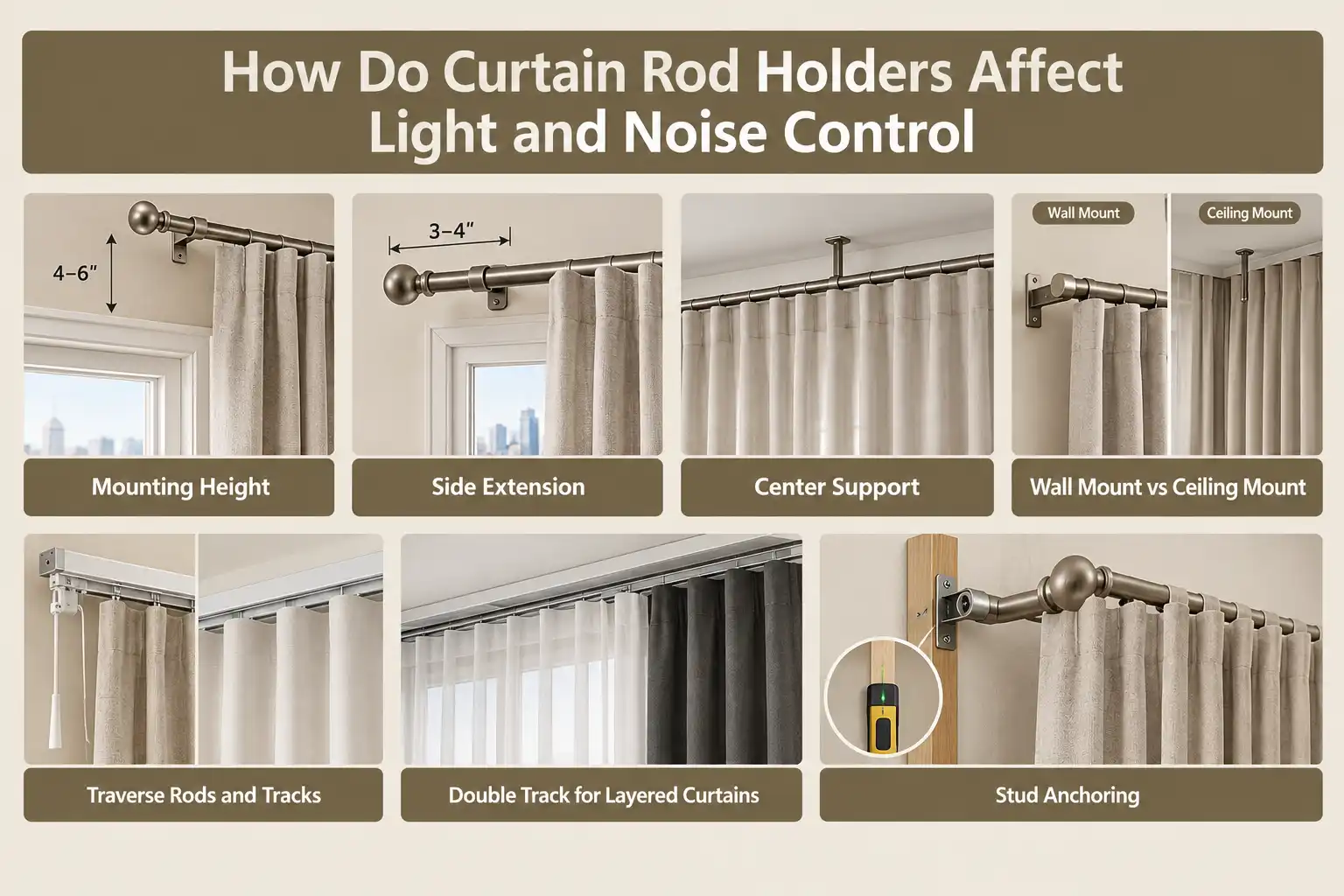
This is the step most guides skip, and it is often the exact reason a well-chosen curtain still leaks light or sags in the middle. The fabric decides how much light a closed curtain blocks. The rod holders decide how much escapes around it.
Mounting Height
Holders placed 4 to 6 inches above the top of the window frame let the fabric rise high enough to cover the gap where light leaks in first. Mounting directly at frame level leaves that top strip exposed no matter how good the fabric is.
Side Extension
Extending holders 3 to 4 inches beyond each side of the frame gives the fabric room to stack fully closed without pulling away from the wall. A rod that ends right at the frame edge leaves a triangle of light at both sides every time the curtain is drawn.
Center Support
Any rod running longer than about four feet benefits from a center bracket. Without one, the middle of the rod sags under the fabric’s weight, pulling the curtain away from the wall exactly where the gap is most visible.
Wall Mount vs Ceiling Mount
Wall-mounted brackets attach directly into the wall beside the window and suit most standard offices. Ceiling-mounted brackets work better for floor-to-ceiling glass or windows with very little wall space above the frame, letting the curtain hang from just below the ceiling for maximum coverage. Looking through the range of curtain rod styles available helps match the hardware to the window type before committing to one setup.
Traverse Rods and Tracks
A traverse rod uses a cord or wand mechanism to open and close the curtain without anyone touching the fabric directly, which keeps panels cleaner over time in a high-traffic office. Track systems, meanwhile, are what wave heading and panel track curtains run on, since they need a continuous channel rather than a single round pole. A closer look at the different curtain track options is worth doing before choosing between a wave heading and a more traditional pleat.
Double Track for Layered Curtains
A layered sheer-and-blackout setup needs two separate rods or a double track mounted at slightly different depths, one closer to the glass for the sheer, one further out for the blackout panel. Getting this measurement right at the planning stage avoids having to replace hardware later if a second layer gets added down the line.
Stud Anchoring
Heavier fabrics, especially velvet or a double-layer setup, need brackets anchored into a wall stud rather than drywall alone. A stud finder used before drilling gives a stronger hold and stops the whole rod from pulling loose under the fabric’s weight over time.
Getting hardware right is genuinely the difference between a curtain that performs close to its rated light-block percentage and one that looks the part but lets in a visible line of light every morning. Fabric and lining decide the ceiling on performance. Rod placement decides how close the actual result gets to that ceiling.
What Mistakes Do Offices Make When Installing Curtains?
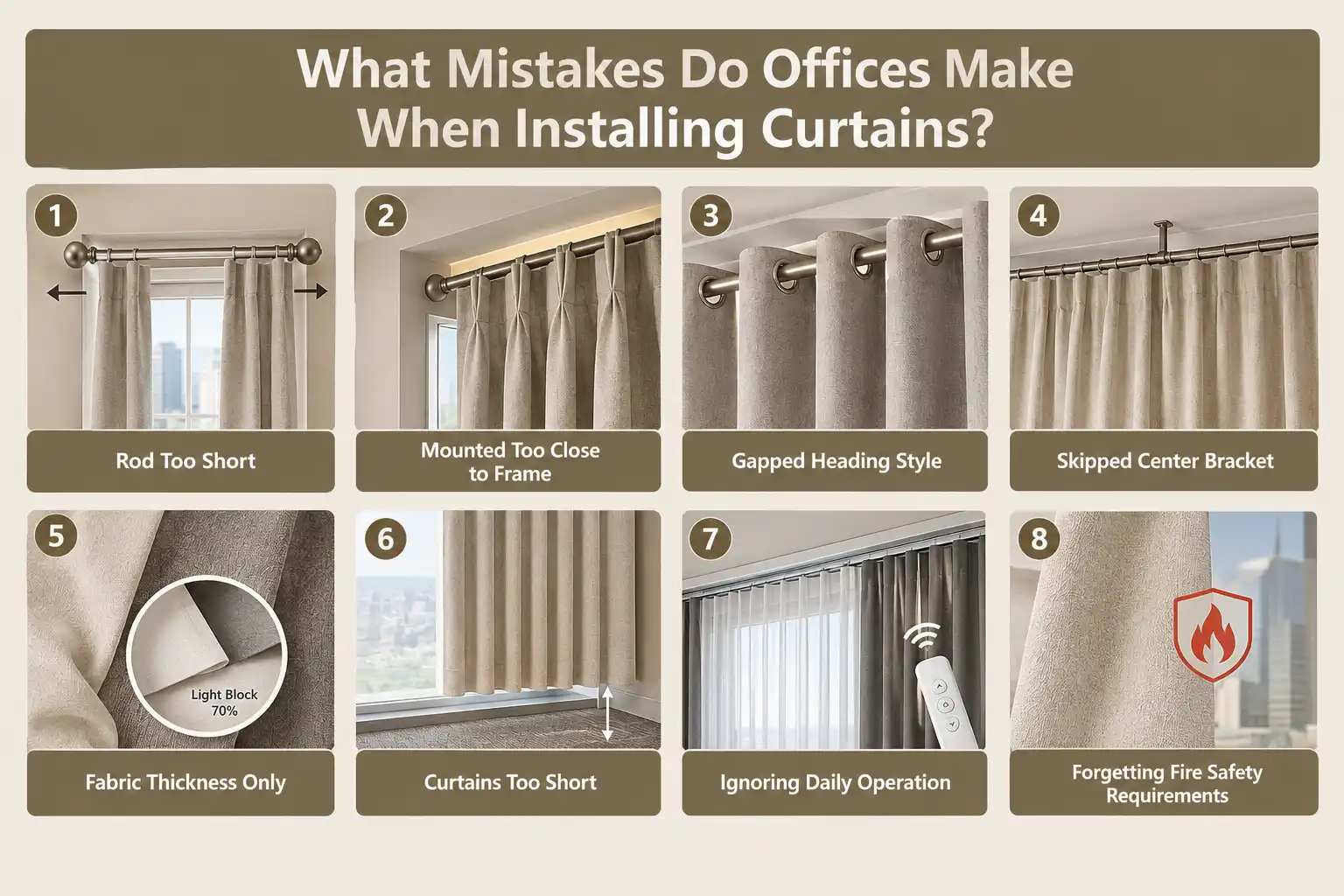
Most underperforming curtains trace back to one of these avoidable errors rather than a poor fabric choice.
- Choosing a rod that is too short, leaving the fabric unable to stack fully closed and creating a light gap at both sides.
- Mounting the rod too close to the frame, exposing the top edge to a visible strip of light.
- Picking a gapped heading style, like eyelet or tab top, for a room that actually needs full blackout.
- Skipping the center bracket on a wide window, letting the rod sag and pull the curtain away from the wall.
- Buying based on fabric thickness alone, instead of checking the stated light-block percentage or lining type.
- Leaving curtains too short, creating a bottom gap that a slightly longer length would close.
- Ignoring daily operation on a wide window, where a motorized track saves the hassle of manually lining up wide panels every time.
- Forgetting fire safety requirements for commercial buildings, an easy detail to overlook when ordering fabric based on look alone.
Fixing hardware placement solves most of these issues faster and cheaper than replacing the curtain entirely, so a slow, careful install is usually a better investment than a more expensive fabric hung carelessly.
How to Match Curtains to Each Room in an Office
Different rooms in the same office often need entirely different curtain choices, since a boardroom and a reception desk are solving different problems.
Boardrooms and Conference rooms
Pick blackout or heavy velvet curtains on a pinch pleat or wave heading, since screen glare during presentations is the main issue to solve.
Reception Areas
Reception Areas work best with sheer or linen curtains that keep the space bright and welcoming without exposing the room fully to the street.
Private cabins and executive offices
Venetian blinds or a heavier pinch pleat curtain suit them, giving a formal, adjustable look for someone controlling their own light through the day.
Open-Plan Floors
These often do well with roller blinds or lighter layered curtains, balancing daylight across a large shared space without one person’s preference blocking light for everyone else.
Call Centers & Sound-Sensitive Rooms
should prioritize acoustic or velvet curtains over anything thin, since sound absorption matters more here than in almost any other office space.
Glass-walled Meeting Rooms & Sliding Partitions
Glass-walled meeting rooms and sliding partitions often pair better with vertical blinds or panel track curtains, both of which are built for wide, uninterrupted glass, and the same trade-offs come up again when weighing curtains against blinds for a sliding glass door elsewhere in the building.
Our Honest Rating: Are Office Curtains Worth It?
Judged as a category against the factors that matter most for a workspace, here is how office curtains score.
| Factor | Score (out of 5) | Why |
| Light and glare control | 4.5 | Near-total block achievable with the right fabric, lining, and rod placement together |
| Noise reduction | 4 | Genuine improvement in shared or open spaces, though not a substitute for dedicated soundproofing |
| Style and branding flexibility | 5 | Unmatched range of colors, patterns, and even custom printing compared to blinds or shutters |
| Energy efficiency | 4 | Strong performance with a thermal or foam-backed lining, backed by wider research on window coverings and heat transfer |
| Ease of installation | 3.5 | Straightforward with the right tools, though rod placement takes real care to get right |
| Overall | 4.2 / 5 | A strong, well-rounded choice for most offices, with real-world performance depending heavily on hardware, not just fabric |
The half-point deductions across the board trace back to the same theme: installation quality. A well-chosen curtain hung with correctly placed rod holders performs close to a full score for its purpose, and the gap between a good curtain and a great one usually comes down to hardware, not fabric.
Step-by-Step: How to Install Office Window Curtains
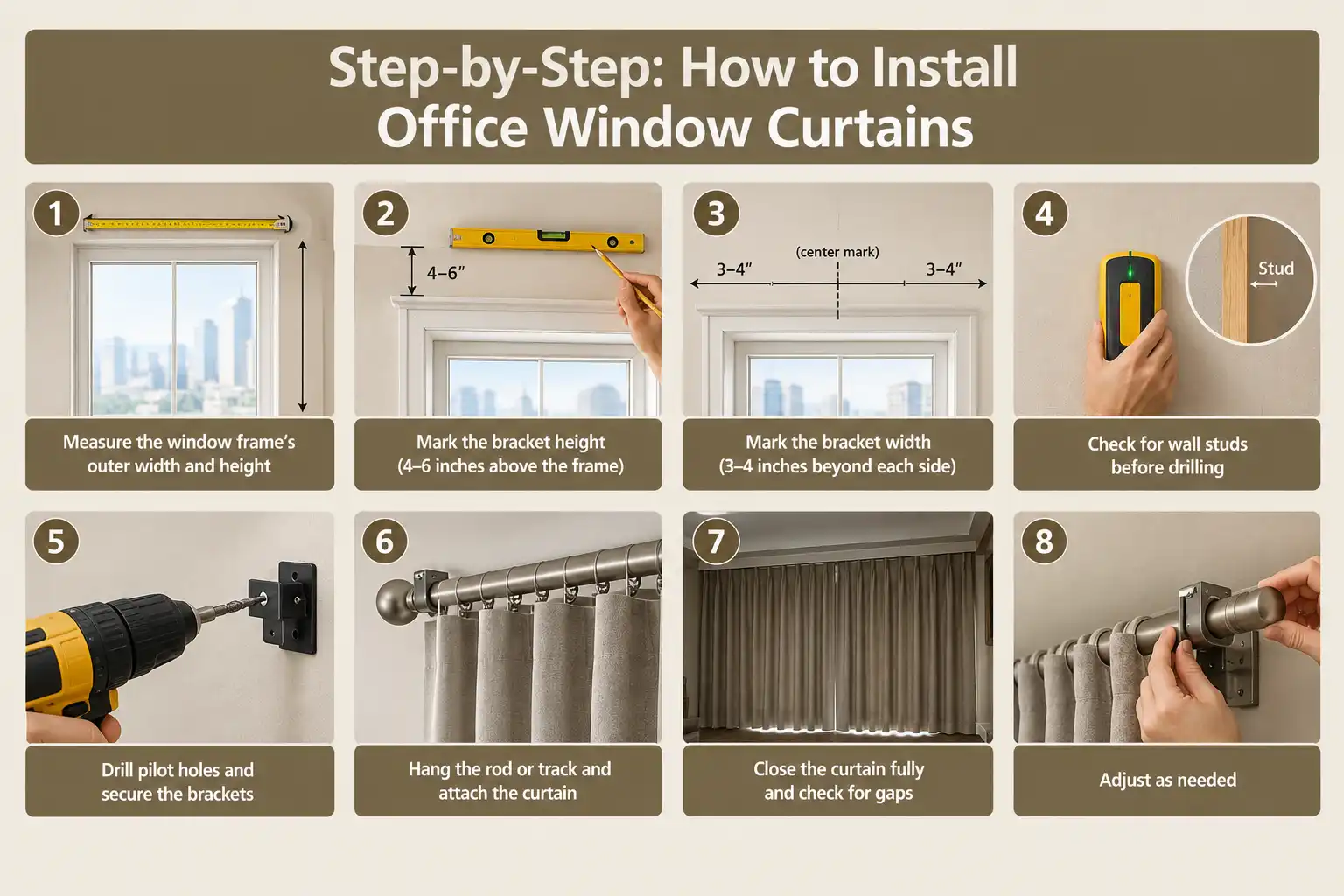
Getting a curtain to actually perform as intended comes down to a careful installation process rather than the fabric alone.
- Measure the window frame’s outer width and height, not just the visible glass, since rod holders need to extend beyond the frame on both sides.
- Mark the bracket height 4 to 6 inches above the top of the frame, using a level to keep both sides even.
- Mark the bracket width 3 to 4 inches beyond each side of the frame, adding a center mark for any rod over four feet.
- Check for wall studs before drilling, anchoring into a stud wherever possible for a stronger hold.
- Drill pilot holes and secure the brackets, keeping the drill bit slightly smaller than the anchor size.
- Hang the rod or track and attach the curtain, sliding rings, hooks, or carriers on before setting the rod into its brackets.
- Close the curtain fully and check for gaps in a darkened room during daylight, looking along the top, sides, and bottom for any visible line of light.
- Adjust as needed, whether that means shifting a bracket, adding a center support, or fitting a small side fastener to close a persistent gap.
Most of this follows the same order of measuring, marking, and leveling covered in a broader walkthrough of hanging curtains correctly, and on wider commercial runs the hardware fitting itself often ends up in the hands of someone experienced with rod and bracket work, since a slightly uneven bracket stands out far more across a large office window than it would at home.
Frequently Asked Questions
What is the best curtain type for an office?
There is no single best type, since a boardroom, a reception desk, and a call center each need something different. Blackout or velvet curtains suit rooms that need full light and sound control, sheer or linen suits open, casual spaces; and layered sheer-plus-blackout setups suit rooms that need to switch between the two throughout the day. A boardroom running daily presentations, for example, gets far more value from a blackout panel than a sheer one, even though both are technically office curtains.
How often should office curtains be cleaned?
Every 3 to 4 months is a reasonable baseline for most fabrics, though this shifts based on dust exposure and how heavy the fabric is. A busy street-facing window collects dust faster than an interior courtyard window, and heavier fabrics like velvet need more frequent vacuuming between full washes than a light cotton panel.
Can the same curtains work for both a home office and a corporate office?
Technically yes, though a corporate space often has different requirements around fire safety and durability that a home office fabric was never tested against. A home office can get away with almost any fabric that suits personal taste, while a shared commercial building usually expects some level of flame-retardant certification, which is worth checking before ordering fabric based on appearance alone.
Do office curtains actually reduce energy costs?
Yes, to a measurable degree. A curtain with a thermal or foam-backed lining slows heat transfer through the glass, reducing how hard air conditioning or heating systems work to maintain a room’s temperature. This lines up with wider guidance from energy efficiency researchers on how window coverings affect a building’s heating and cooling load, and the effect compounds across a building with many windows rather than just one.
What is the difference between blackout curtains and blackout lining?
A blackout curtain is a full panel that already has the blackout layer built into it. Blackout lining is that same functional layer sold on its own, meant to be added behind a curtain someone already owns. Buying a complete blackout curtain is simpler for a new fit-out, while adding lining separately suits an office wanting to upgrade curtains it already has without replacing them entirely.
How wide should curtain rod holders extend beyond the window frame?
3 to 4 inches on each side is the standard range for a curtain that needs to stack fully closed without pulling away from the wall. Going narrower than that often leaves a visible triangle of light at the edges once the curtain is drawn, even with a good fabric.
Are motorized curtains worth it for an office?
For wide windows or glass walls that get adjusted often through the day, yes. A motorized track closes the same gap every time instead of relying on manual alignment, and scheduling options mean curtains can open and close automatically with sunrise and sunset without anyone needing to remember. For a single small window opened once a day, the extra cost is harder to justify.
Can curtains help with video call quality in an office?
Indirectly, yes. Heavier or acoustic curtains reduce echo bouncing around a hard-floored room, which noticeably improves how clear a call sounds on both ends. Blackout or layered curtains also help by controlling glare and backlighting from a window, which is one of the most common reasons a video call looks poorly lit even with good camera equipment.