Traffic hum through a bedroom window, a shared wall with a noisy Neighbor, or an echoey home office can turn a quiet evening into a frustrating one. Sound-deadening curtains are one of the simplest upgrades for this problem, and understanding how they work is the difference between a curtain that actually helps and one that only looks heavy.
A well-built sound deadening curtain will not make a room silent, but the right combination of weight, layering, and full coverage can measurably soften everyday noise and make a space feel calmer.
Sound-deadening curtains work by adding mass and density to a window opening, absorbing and scattering sound waves instead of reflecting them into a room. Quality options reduce noise by roughly 5 to 20 decibels depending on the number of layers, with 5-layer designs performing best against mid- and high-frequency sounds such as traffic, voices, and street activity. They do little against low-frequency bass or heavy machinery unless paired with other treatments like weather-stripping or double glazing. Full-width coverage, a properly sealed track, and dense fabric matter more than price alone.
What Are Sound Deadening Curtains?
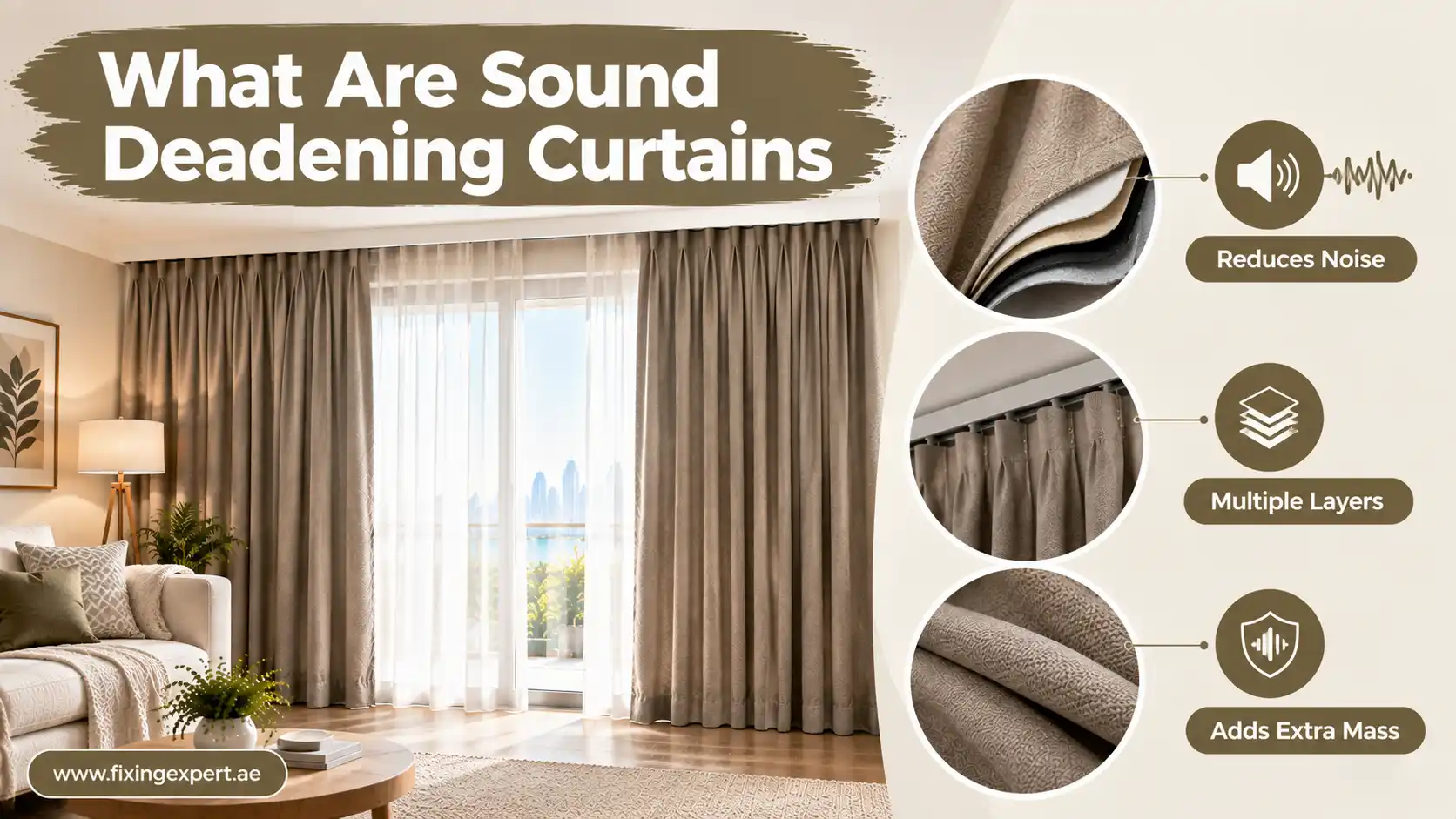
Sound-deadening curtains, also called acoustic or noise-reducing curtains, use extra mass and layering to reduce sound moving through a window. Unlike decorative curtains, which are chosen mainly for colour and light control, these are engineered around weight, density, and fabric structure.
They are not the same as soundproofing. True soundproofing blocks sound almost completely and require solid, sealed building materials, insulated walls, double-glazed windows, or dedicated acoustic panels. Curtains cannot replicate that, because fabric, however heavy, still allows some sound energy to pass through. What sound-deadening curtains actually do is dampen and absorb sound, which is why the industry increasingly favours the term “sound-dampening” over “soundproof.”
How They Differ From Regular Curtains
A regular curtain panel is usually a single layer of fabric chosen for its look. A sound-deadening curtain typically has two to five layers, including a decorative outer fabric, a dense core, and sometimes a mass barrier such as mass-loaded vinyl sandwiched between them. The extra layers add weight, and weight is what absorbs sound energy instead of letting it bounce straight back into the room.
How They Differ From Acoustic Panels
Acoustic wall panels and foam tiles are built to control echo and reverberation inside a room, not necessarily to block outside noise. Sound-deadening curtains do both jobs to a lesser degree: they reduce some interior echo because of their folds and texture, and they reduce some noise transmission through the window because of their mass. For a home office or bedroom, that combination is usually enough without permanent wall treatments.
In short, sound-deadening curtains sit between decorative drapery and true acoustic treatment. They will not create silence, but layering and mass make them noticeably more effective than a standard curtain at softening noise around a window.
How Do Sound Deadening Curtains Actually Work?
Sound travels as a wave. When it hits a hard, flat surface such as glass, most of it reflects straight back into the room, which is part of why bare windows make a space feel noisier and echoey. A thick, layered curtain interrupts that reflection in three ways: mass, texture, and coverage.
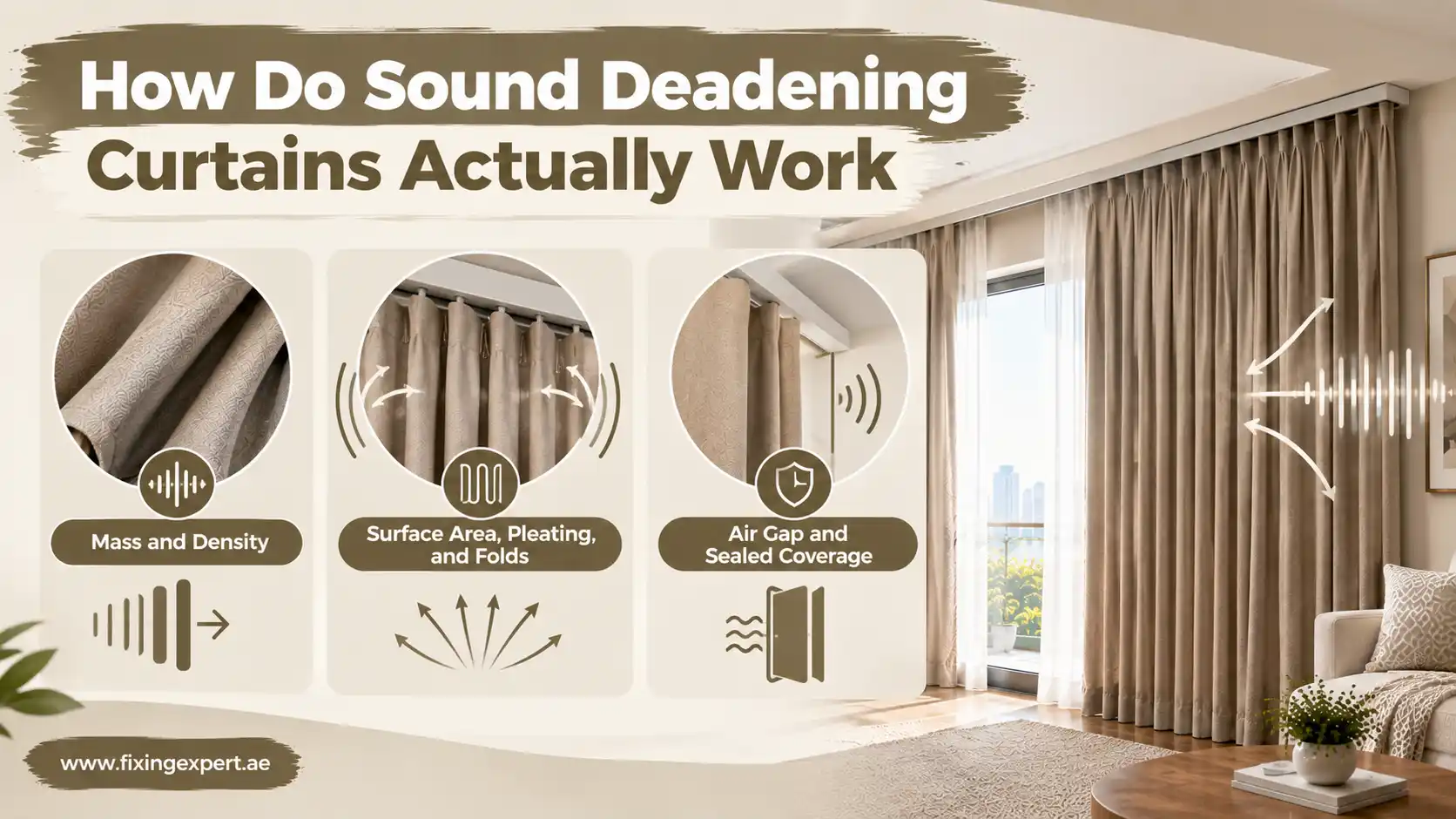
Mass and Density
Heavier fabric absorbs more sound energy rather than reflecting it. This is the same principle used in mass-loaded vinyl barriers in construction: the denser the material, the harder it is for sound waves to pass through cleanly. A thin sheer panel does almost nothing for noise, while a heavy, multi-layered curtain performs measurably better.
Surface Area, Pleating, and Folds
A flat panel of fabric reflects sound in a fairly predictable way. Pleated, gathered, or wave-style folds scatter sound waves in multiple directions instead, which reduces how cleanly they bounce back into the room. This is one reason fuller curtain styles consistently outperform flat panels in noise tests, even at a similar fabric weight.
Air Gap and Sealed Coverage
Sound behaves like water: it finds any gap. A curtain that stops short of the floor, doesn’t extend past the window frame, or hangs loosely on either side lets sound leak around the edges no matter how heavy the fabric is. Mounting the curtain closer to the wall, extending it well beyond the frame, and using a wraparound or ceiling-mounted track seals that pocket of air and noticeably improves performance. The right curtain track makes this kind of full coverage far easier to achieve than a basic rod set close to the frame.
The physics is straightforward. More mass absorbs more sound, more folds scatter more sound, and fewer gaps mean less sound sneaks through. A curtain that gets all three right will outperform a heavier curtain that gets only one right.
How Many Decibels Can Sound Deadening Curtains Reduce?
This is the number most buyers actually want before spending money. Independent tests and manufacturer data generally place noise reduction from quality sound-deadening curtains between 5 and 20 decibels (dB), depending on the number of layers and how well the curtain is installed.
| Curtain Type | Typical Noise Reduction | Best Suited For |
| Standard single-layer curtain | 1–3 dB | Minimal noise concerns, purely decorative use |
| 3-layer acoustic curtain | 5–10 dB | Bedrooms, rental apartments, moderate street noise |
| 5-layer acoustic curtain (with mass barrier) | 10–20 dB | Homes near main roads, home theatres, offices near traffic |
Why the Decibel Scale Matters More Than It Sounds
The decibel scale is logarithmic, not linear, so small-looking numbers matter more than they appear to. According to the CDC’s guidance on noise exposure, sound intensity climbs far faster than the decibel numbers suggest, and every roughly 10 dB increase is perceived by the human ear as about twice as loud. That means a curtain cutting noise by 10 dB isn’t shaving off “a bit” of sound; it is roughly halving how loud that noise feels inside the room. This is also why a 5-layer curtain (10–20 dB) can feel dramatically quieter than a 3-layer one (5–10 dB), even though the numeric gap looks small on paper.
Sound-deadening curtains are consistently most effective against mid- and high-frequency sound: traffic hum, conversation, footsteps, and general street noise. They are far less effective against low-frequency bass, such as heavy trucks, subwoofers, or construction machinery, because those longer sound waves need a solid structural barrier rather than fabric to stop them.
Expect a realistic 5–20 dB reduction depending on layers, treat that as a meaningful drop in perceived loudness thanks to the logarithmic scale, and don’t expect curtains alone to stop deep bass or heavy machinery noise.
What Materials and Layers Make a Curtain Effective at Reducing Noise?
Layer count is the single biggest factor separating a curtain that genuinely dampens sound from one that only looks thick. Most acoustic curtains fall into a 3-layer or 5-layer build.
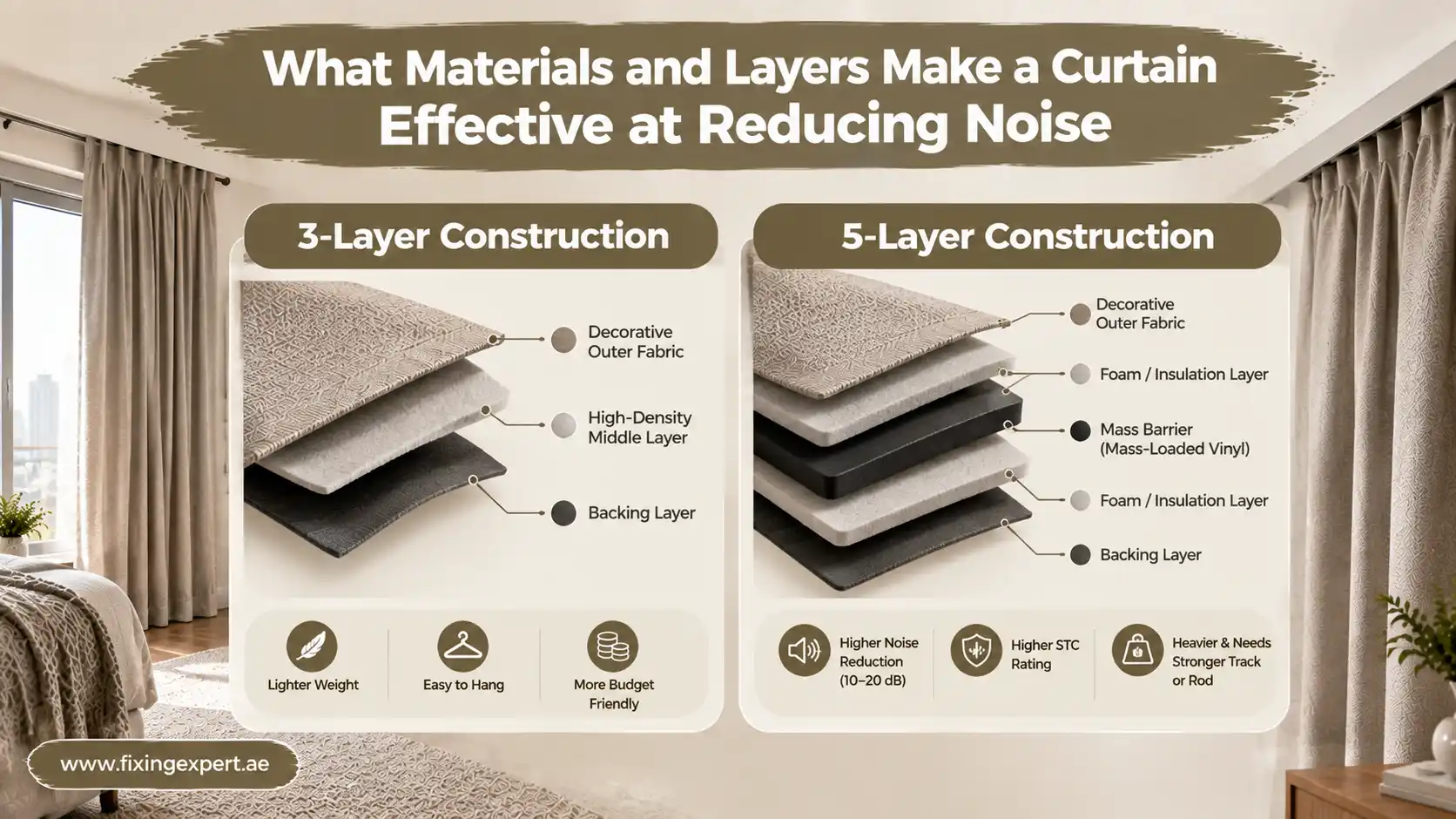
3-Layer Construction
A 3-layer sound-deadening curtain typically includes a decorative outer fabric, a high-density middle layer, and a backing layer. This combination is lighter, easier to hang on a standard rod, and more budget-friendly, making it a practical choice for rental apartments or bedrooms with moderate noise. Its main limitation is a lower ceiling on performance: it struggles against heavier traffic or construction noise and has a lower Sound Transmission Class rating than thicker builds.
5-Layer Construction
A 5-layer curtain adds a dedicated mass barrier, often mass-loaded vinyl, along with a foam or insulation layer between the decorative fabric and thermal backing. That extra mass is what pushes noise reduction into the 10–20 dB range and gives the curtain a meaningfully higher Sound Transmission Class rating. The trade-off is weight: these curtains need a heavier-duty track or rod and cost more upfront, which is worth confirming before ordering.
Fabric Weight as a Rough Indicator
As a general guide, curtain fabric under roughly 200 grams per square metre contributes very little to noise reduction regardless of how it’s marketed. Denser fabrics, commonly in the 400–600+ grams per square metre range, such as velvet or multi-layer acoustic textiles, perform measurably better. Weight alone isn’t the full story, but it’s a useful sanity check when comparing two similar-looking products.
| Factor | 3-Layer Curtains | 5-Layer Curtains |
| Noise reduction | 5–10 dB | 10–20 dB |
| Best frequency range | Moderate-frequency sound | Broader range, including higher-frequency noise |
| Installation | Standard rod, easy | Heavy-duty rod or track required |
| Cost | Lower | Higher |
| Thermal insulation | Moderate | Stronger |
| Ideal setting | Rental homes, bedrooms, offices | Homes near highways, home theatres, studios |
More layers generally mean better noise reduction and better insulation, but also more weight, higher cost, and a need for sturdier hardware such as a reinforced curtain rod.
Which Curtain Fabrics Reduce Noise Best?
Fabric choice affects performance almost as much as layer count, because density and weave tightness both influence how much sound a curtain can absorb.
Fabrics That Perform Well
Velvet is one of the most consistently effective fabrics for sound dampening because of its dense pile and heavy drape.Velvet curtains also add a noticeable thermal benefit, which matters in a hot climate. Suede and tightly woven wool blends perform similarly well. Heavier linen blends, particularly multi-layered ones, sit in the middle: better than cotton, not quite as dense as velvet.
Linen curtains with an added lining layer strike a reasonable balance between acoustic performance and a lighter, more breathable look.
Fabrics to Avoid for Noise Control
Sheer and voile fabrics are built for light diffusion and airy style, not density, so they add almost nothing to noise reduction. That doesn’t make them useless: they still have a strong place in layered window treatments for light and privacy, and they have many uses in homes, but a household relying on sheers alone to quiet a room will be disappointed. Thin, unlined cotton panels share the same limitation.
For noise control specifically, prioritise velvet, suede, or lined heavy linen over sheer or thin cotton, and treat sheers as a style layer rather than a noise-reduction solution.
How Should Sound Deadening Curtains Be Hung for Maximum Effect?
Fabric and layering only account for part of the result. Installation decides whether that potential is actually realised.
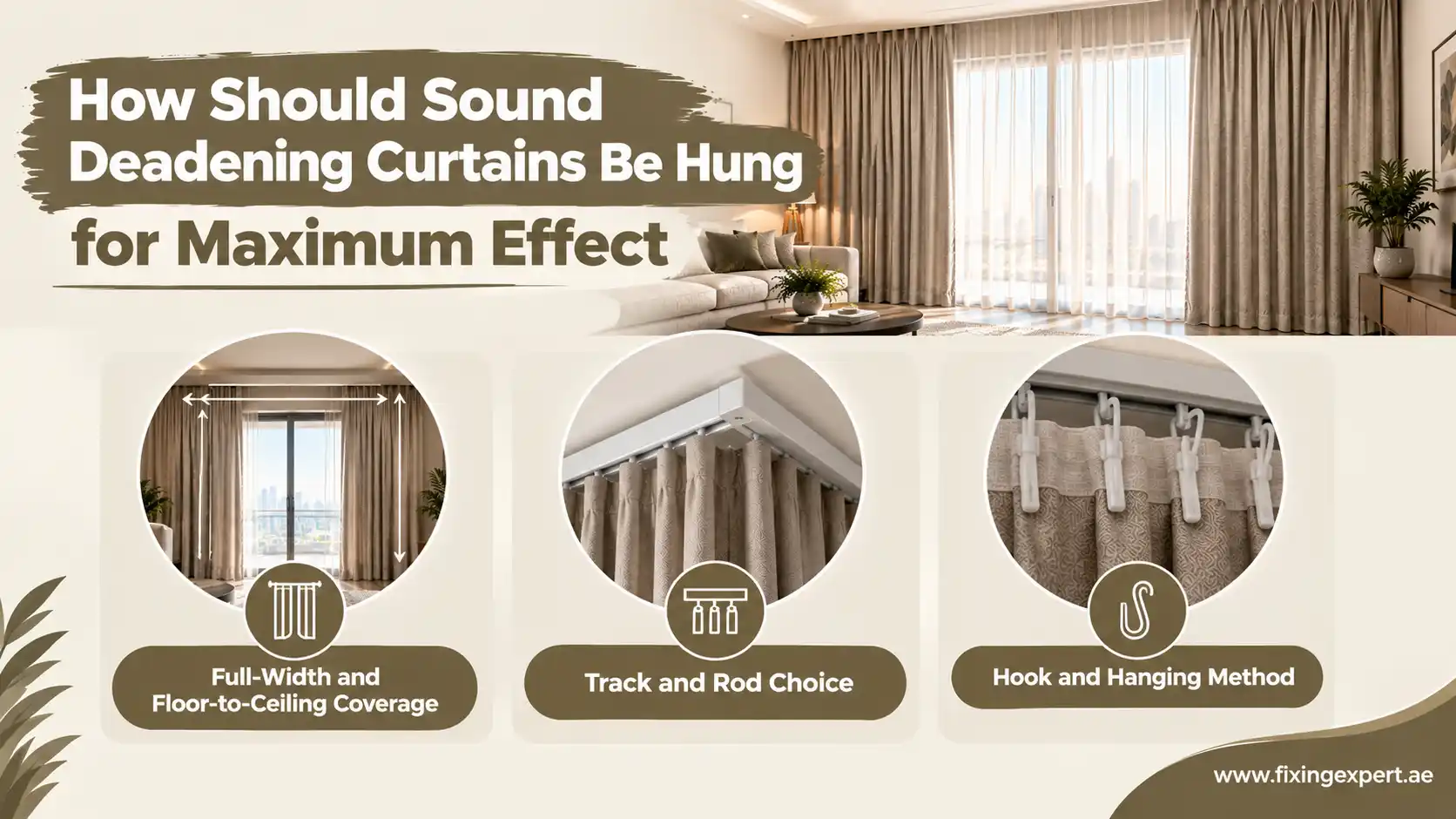
Full-Width and Floor-to-Ceiling Coverage
Sound leaks around any gap the same way light does. A curtain should extend well beyond the window frame on both sides, and ideally run from close to the ceiling down to the floor. Hanging curtains the right way is one of the simplest, most overlooked upgrades in sound control.
Track and Rod Choice
A wraparound or ceiling-mounted curtain track seals the pocket of air between the curtain and the window far more effectively than a basic rod set close to the frame. Heavier 5-layer curtains in particular need sturdier hardware, so checking the weight rating of a rod or track before hanging an acoustic curtain avoids sagging over time.
Hook and Hanging Method
The hanging method affects how tightly folds sit against each other, which in turn affects how much sound scatters instead of passing straight through.
A well-installed 3-layer curtain with full coverage and a sealed track will often outperform a poorly hung 5-layer curtain with gaps at the edges, so installation is not an afterthought.
Sound Deadening Curtains vs. Soundproof Blinds: Which Should You Choose?
This is one of the most common comparisons buyers make before purchasing, and the answer depends on the room.
| Factor | Sound Deadening Curtains | Soundproof Blinds |
| Noise reduction range | 5–20 dB depending on layers | Generally lower, 3–8 dB |
| Light control | Strong, especially with blackout layers | Moderate |
| Insulation | Strong | Moderate |
| Aesthetic flexibility | High (fabric, colour, style options) | Lower |
| Ease of layering with other treatments | Very easy to pair with blinds underneath | Limited |
Curtains generally win on both noise reduction and thermal insulation because they carry more mass and more surface area for scattering sound. Blinds win on a cleaner, more minimal look and can suit smaller windows or spaces where full-length fabric isn’t practical.
Curtains generally outperform blinds for noise and insulation, but the two aren’t mutually exclusive, and combining them often produces better results than either alone.
Where Are Sound Deadening Curtains Most Useful?
Not every room needs the heaviest available option, and matching the curtain to the actual noise source avoids overspending.

-
Bedrooms Facing Traffic or Shared Walls
Bedrooms are the most common use case, since consistent low-level noise, traffic, neighbours, or street activity, disrupts sleep more than most people realise. A 3-layer curtain is often sufficient here unless the road is a major one.
-
Home Offices and Video Call Spaces
Background noise bleeding into a video call or concentration-heavy work is a growing reason buyers search for this solution. A denser 5-layer option, paired with full coverage, noticeably reduces both incoming street noise and the echo that makes small home offices sound harsh on calls.
-
Sliding Doors and Balconies
Sliding glass doors are a common weak point for noise, because the glass area is large and the seals are often looser than a standard window. In general, a heavier curtain with full-width coverage performs better here than a blind alone.
-
Homes Near Highways or Airports
For genuinely high-noise environments, a 5-layer curtain with a mass barrier is worth the extra cost, and pairing it with the treatments below closes most of the remaining gap.
Match the curtain to the source. Moderate street noise usually only needs a 3-layer curtain, while major roads, airports, or shared walls justify the heavier 5-layer build.
How Can Sound-Deadening Curtains Be Combined With Other Noise Solutions?
Curtains alone have a ceiling on what they can achieve, and buyers with a serious noise problem get the best results by layering solutions rather than relying on fabric alone.
Weather stripping around the window frame closes small air gaps that let sound in even with a heavy curtain covering the glass. Double glazing addresses the window itself rather than what’s hung in front of it, and is the single biggest structural upgrade available for low-frequency noise that curtains cannot stop. A secondary blind mounted behind the curtain adds another barrier for sound to work through before it reaches the room, and pairing a blind with a heavier, light-blocking curtain layer often means the same dense construction that helps with noise is already doing double duty on light control, so one purchase covers both.
Each additional layer- weather stripping, glazing, a secondary blind- adds a barrier for sound to work through, and the combined effect is consistently greater than any single treatment on its own.
What Mistakes Do People Make When Buying Sound Deadening Curtains?

-
Buying by Weight Alone, Not Layer Structure
Two curtains can weigh the same, but if one uses a genuine mass barrier and the other simply uses a heavier single fabric, the layered one will perform noticeably better against noise. Weight is a proxy for density, not a guarantee of it.
-
Leaving Gaps at the Sides or Floor
This is the most common installation mistake, and it undoes much of the fabric’s potential. Even a premium 5-layer curtain loses a large share of its effectiveness if it stops several centimetres short of the floor or doesn’t clear the window frame on either side.
-
Expecting Curtains to Replace Structural Fixes
For a room next to a major highway, no curtain, regardless of layer count, replaces double glazing or proper wall insulation. Curtains reduce noise; they do not eliminate a serious structural noise problem on their own.
-
Choosing Sheer or Thin Fabric for a Noise-First Room
Sheers are picked for light and style, and that’s a reasonable choice for many rooms. But choosing a sheer or thin unlined panel specifically to solve a noise complaint, then being disappointed by the result, is one of the most common regrets buyers report.
Most disappointment with these curtains traces back to installation gaps or mismatched expectations rather than the fabric itself, so getting the fit and layer choice right the first time avoids a second purchase.
How Effective Are Sound Deadening Curtains as a Noise Solution? Our Rating
Judged against cost, ease of installation, realistic noise reduction, and everyday usability, sound deadening curtains rate as follows:
| Criteria | Score (out of 5) | Notes |
| Noise reduction | 3.5/5 | Strong against mid/high frequency, weak against bass |
| Cost-effectiveness | 4.5/5 | Far cheaper than double glazing or wall treatments |
| Ease of installation | 4/5 | Straightforward with the right rod or track |
| Aesthetic flexibility | 5/5 | Wide range of fabrics, colors, and styles |
| Overall | 4.2/5 | A strong first step for noise control, best combined with other treatments for serious noise problems |
The main caveat, and the reason the noise-reduction score isn’t higher, is that fabric alone cannot compete with structural soundproofing for low-frequency noise. As an affordable first step that also improves insulation, light control, and room aesthetics, though, it earns a strong score.
Putting It All Together
Sound deadening curtains are not a magic fix, but they are one of the most cost-effective upgrades available for a noisy room. The layer count, fabric density, and, just as importantly, how the curtain is hung, determine whether the result is a genuinely quieter space or an expensive panel that looks heavy but does little. For most homes, matching the curtain to the actual noise source, a 3-layer option for moderate street sound, a 5-layer option for busier roads or dedicated home offices, and installing it with full coverage on a proper curtain track or rod, delivers the best return.
Frequently Asked Questions
Do sound deadening curtains really work?
Yes, within realistic limits. They reduce noise by roughly 5 to 20 decibels depending on layering, which is a meaningful drop given the logarithmic decibel scale. They will not create silence, and they perform far better against mid- and high-frequency noise like traffic and conversation than against low-frequency bass or heavy machinery. A household near a busy road that installs a properly fitted 5-layer curtain will typically notice less sharp traffic noise, particularly at night, but will still hear a passing heavy truck.
How many layers should a sound deadening curtain have?
Most effective designs use either 3 or 5 layers. A 3-layer curtain suits moderate noise, rental properties, and situations where budget or a lighter rod is a priority. A 5-layer curtain, which adds a mass barrier such as mass-loaded vinyl, suits homes near major roads, home theatres, or rooms used for calls and recording. Weighing how serious the noise problem actually is against the extra cost and hardware needed for the heavier option usually settles the decision.
What is the best fabric for reducing noise through curtains?
Velvet consistently performs best because of its dense pile and heavy drape, followed closely by suede and tightly woven wool blends. Heavier lined linen sits in the middle. Sheer and thin cotton fabrics do very little for noise control regardless of how many panels are layered, since density matters more than the thickness of a single layer.
Can sound deadening curtains block traffic noise completely?
No single curtain blocks traffic noise completely, and any product claiming full soundproofing should be treated with caution. What a quality 5-layer curtain does is noticeably soften mid- and high-frequency traffic sounds, tyre hum and passing conversation, for example, while doing less against low-frequency engine rumble. Pairing the curtain with weather-stripping or double glazing closes more of that remaining gap.
Do sound deadening curtains also help with heat and light?
Yes, and this is often an underrated part of the value. The same density and layering that absorbs sound also blocks a significant amount of light and heat, which is why many acoustic curtains double as blackout curtains and thermal insulators. A bedroom curtain chosen for noise reduction will typically also lower a room’s temperature and improve blackout performance as a side benefit.
Is it worth paying more for a 5-layer curtain over a 3-layer one?
It depends on the noise source. For moderate, everyday street noise, a 3-layer curtain is often enough and keeps costs and hardware requirements lower. For a home directly on a busy road, near an airport, or with genuinely disruptive noise, the extra reduction a 5-layer curtain with a mass barrier provides is usually worth the higher cost and heavier-duty rod it requires.