
The best blackout curtains for a bedroom are not just dark, heavy fabric panels. Light blockage depends on fabric weave, lining, curtain length, and how the rod and brackets are installed above and beside the window frame. A curtain that looks like a blackout curtain can still let in a visible strip of light along the top and sides if the hardware is wrong, and that one detail is what separates a room that stays genuinely dark from one that only looks dark.
A true blackout curtain blocks 95 to 100% of light using a tightly woven face fabric paired with a foam-backed or triple-weave blackout lining. Room-darkening curtains, by comparison, block 75 to 94.9% of light and are a lighter option for kids’ rooms. Full coverage depends on three things working together: the fabric grade, the curtain length (floor-length or a slight break is best), and curtain rod holders mounted at least 4 to 6 inches above the frame and 3 to 4 inches out on each side. Get all three right and a bedroom stays dark enough for daytime naps, shift work, or simply sleeping past sunrise. Anyone putting together a full curtain setup for a bedroom from scratch will hit all three of these decisions in one go.
What Makes a Curtain Count as “Blackout” in the First Place?
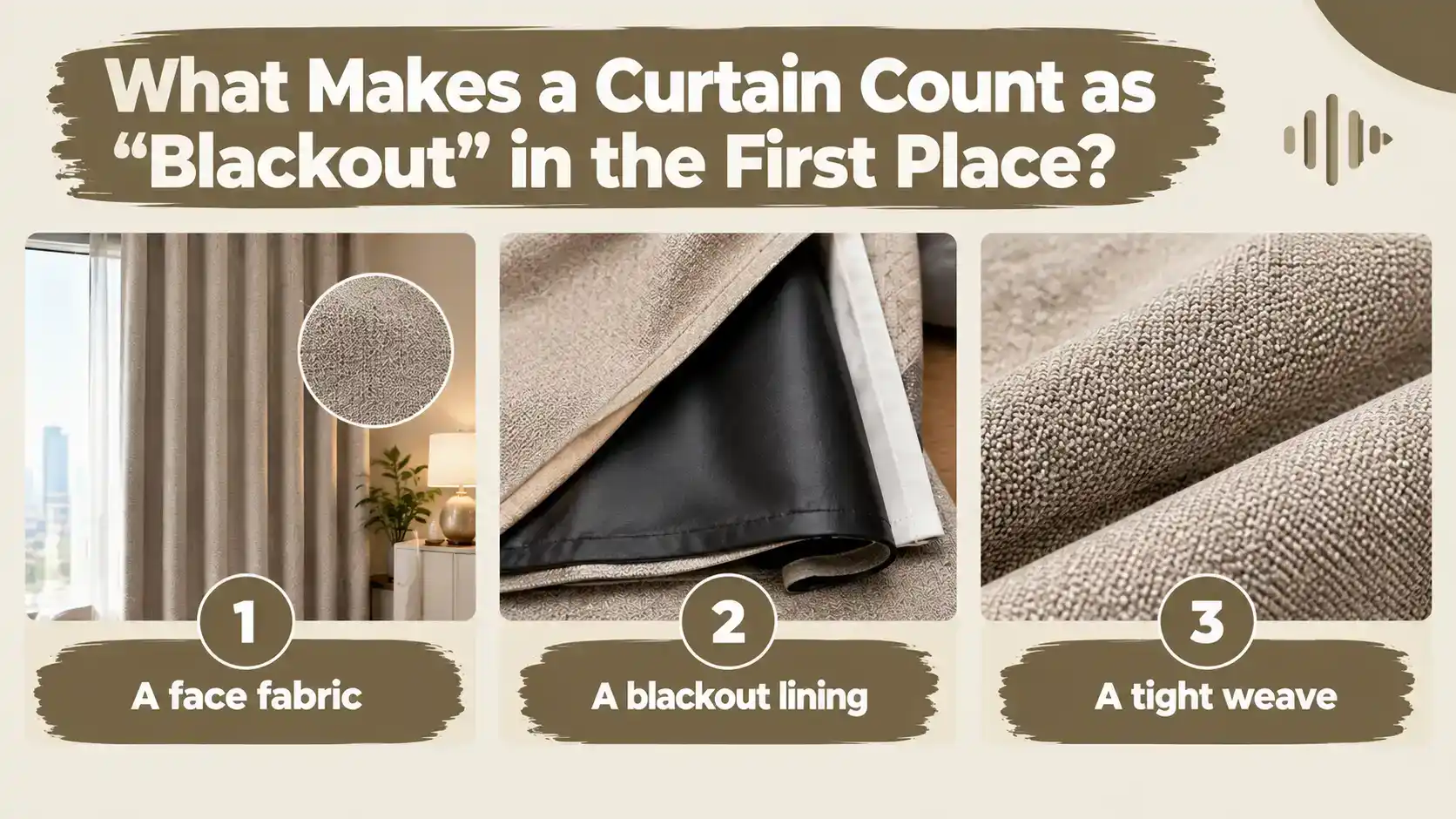
Not every dark-colored curtain is a blackout curtain. The term refers to a specific construction, not a color.
A true blackout curtain has three layers working together:
1. A face fabric
The visible side, in any color or pattern
2. A blackout lining
A foam-backed, rubber-coated, or triple-weave layer sewn or clipped behind the face fabric
3. A tight weave
Fabric threads packed closely enough that light cannot pass through the gaps
The lining does the real work. A thin cotton curtain with a proper blackout lining behind it will block more light than a thick velvet curtain with no lining at all. This is why two curtains that look identical in a shop can perform very differently once hung, and why browsing a dedicated blackout fabric range rather than a generic curtains section usually turns up better-rated options.
Light-blocking curtains are graded by the percentage of light they stop:
| Grade | Light Blocked | Best For |
| Light filtering | Under 75% | Living rooms, kitchens |
| Room darkening | 75% to 94.9% | Kids’ rooms, guest rooms |
| Full blackout | 95% to 100% | Bedrooms, night-shift sleepers, home theaters |
For a bedroom curtain that needs to block a sunrise or a streetlight outside the window, the 95% to 100% category is the one to shop in, and a curtain earns that label from its lining and weave rather than its color, so checking the percentage on the listing matters more than judging the swatch by eye.
Blackout Curtains vs. Blinds vs. Shutters: Which Fits a Bedroom Best?
Each option controls light differently, and the right choice depends on the room’s priorities.
| Feature | Blackout Curtains | Blinds | Shutters |
| Light block | 95-100% with proper lining and install | Depends heavily on slat fit; gaps common at edges | Strong block when slats are closed and frame fits tightly |
| Noise reduction | Good, soft fabric absorbs sound | Minimal | Minimal to moderate |
| Insulation | Strong, especially with thermal lining | Light to moderate | Good, due to solid panel construction |
| Style flexibility | High, any color, pattern, or texture | Moderate, mostly neutral tones and slat finishes | Lower, mostly wood tones or painted finishes |
| Maintenance | Occasional washing or dry cleaning | Dusting, wiping slats | Wiping, occasional repainting |
| Typical cost | Low to mid, depending on fabric and lining | Low to mid | Higher, due to custom fitting |
For a bedroom where sleep quality and darkness are the top priority, blackout curtains generally win on light block and comfort together; shutters compete closely on light block but cost more and offer far less style variation. Blinds alone rarely reach full blackout unless paired with side channels or an added layer of fabric alongside them, and the same trade-offs come up again when weighing these window treatments against each other for a specific room. Blackout curtains offer the strongest overall mix of darkness, comfort, and design flexibility for a bedroom, while blinds and shutters each trade one of those for a different strength.
Blackout vs. Room-Darkening vs. Dimout: What’s the Real Difference?
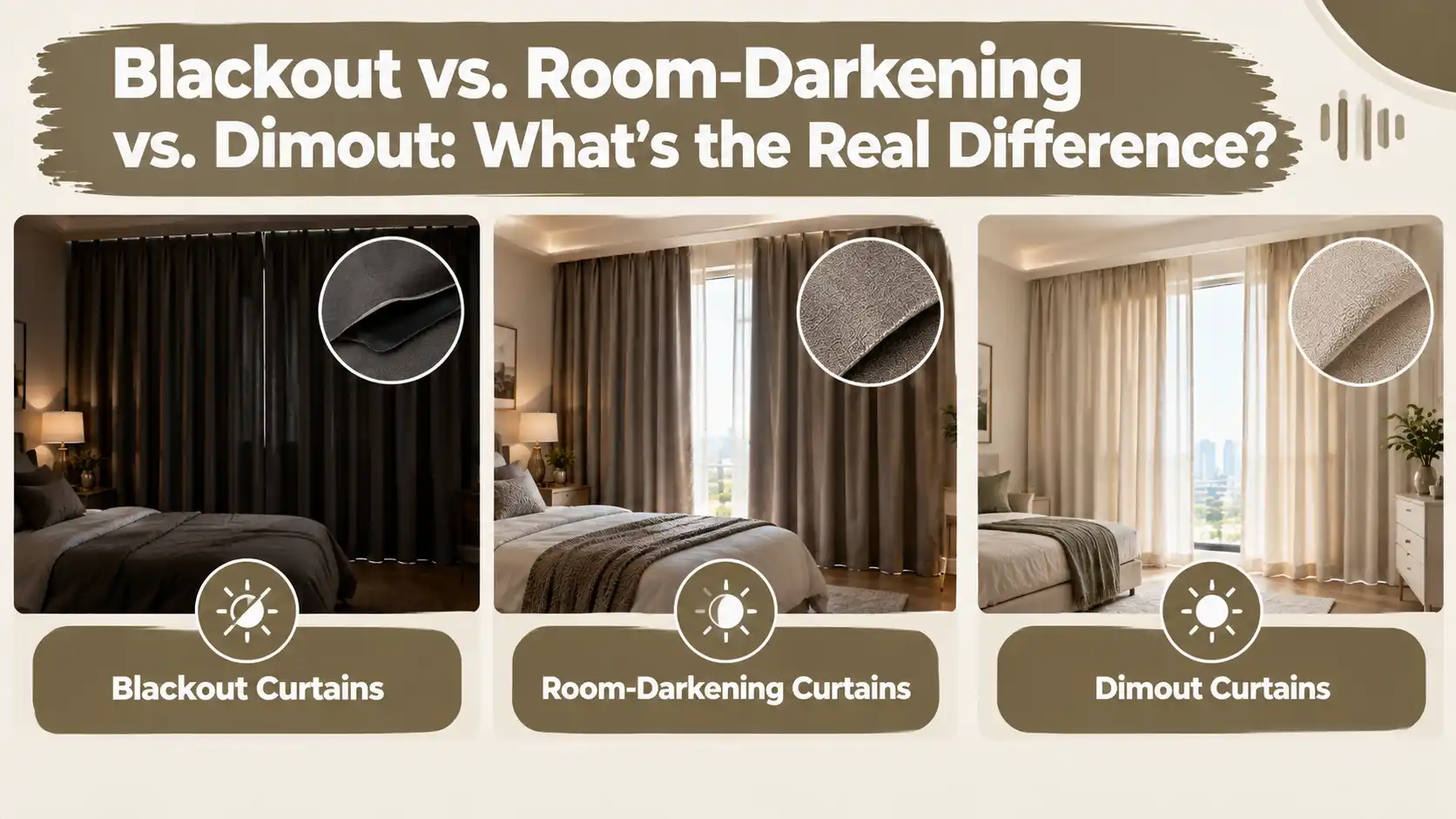
These three terms get used loosely, and mixing them up is the most common shopping mistake.
Blackout curtains
Block 95% to 100% of light using a foam-backed or triple-pass lining. No visible light passes through the fabric itself, though gaps around the rod or sides can still let some in.
Room-darkening curtains
Block roughly 75% to 94.9% of light. They noticeably dim a room without making it fully dark, which suits a child who is uneasy in total darkness.
Dimout curtains
Sit in a similar range to room-darkening but are usually described by their percentage rating (commonly 60% to 85%) and are chosen more for partial light and heat control than full sleep darkness.
A quick way to decide: if the goal is uninterrupted sleep for a shift worker, a light-sensitive sleeper, or anyone who wants a pitch-dark room at any hour, full blackout is the right category. If the goal is just softening morning glare in a guest room, room-darkening or dimout will do the job with a lighter, more decorative fabric, and either way the percentage printed on the product label is the number that actually decides which category a curtain belongs to, not how thick the fabric feels in the shop.
Which Blackout Curtain Fits Which Bedroom?
Not every bedroom has the same priority, so the right pick shifts depending on who is sleeping in the room.
- For a shift worker sleeping during the day, full blackout with a triple-weave lining and floor-length coverage matters most, since any daylight gap will be more noticeable at midday than at night.
- For a child’s room, room-darkening rather than full blackout is often the better fit, since some children sleep more easily with a small amount of ambient light rather than total darkness.
- For a shared or light-sleeping household, pairing blackout panels with a layered sheer gives flexibility, keeping the room bright during the day and fully dark only when both layers are drawn.
- For a home office or media corner inside a bedroom, blackout curtains double as screen-glare control, which is worth factoring in alongside sleep if the room serves more than one purpose.
Matching the curtain grade to the specific person using the room avoids overspending on full blackout where room-darkening would do the job, or underspending on light control for someone who genuinely needs total darkness to sleep.
Why Do Blackout Curtains Matter for a Sleeping Room?
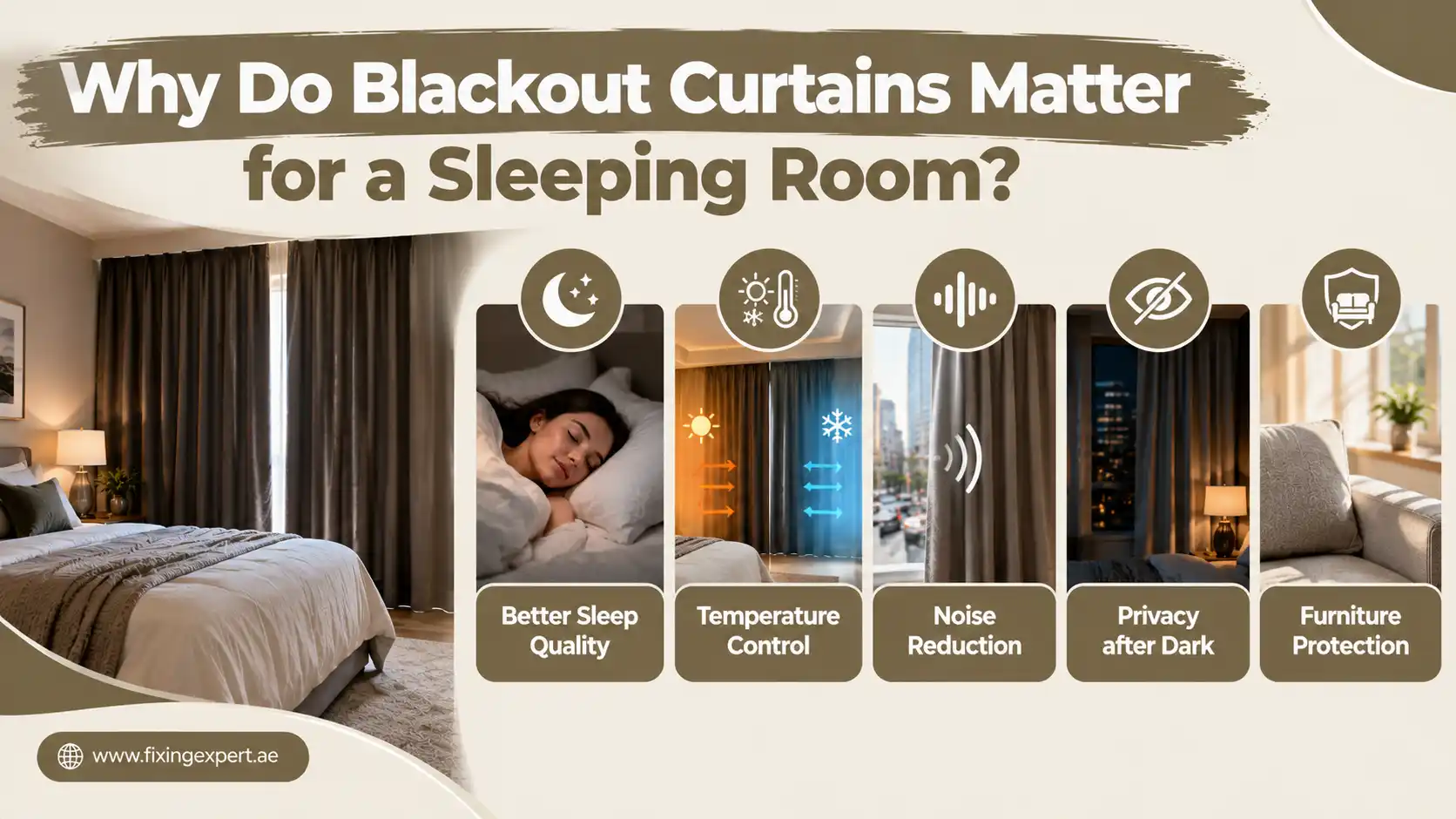
The appeal of a dark bedroom is not just comfort. It connects directly to how the body regulates sleep.
1. Better sleep quality
Darkness triggers the body to release melatonin, the hormone that controls the sleep-wake cycle. According to the Sleep Foundation, even small amounts of light exposure at night can suppress melatonin production and shorten its duration, which is why a phone charger LED or a streetlamp through thin curtains can lead to lighter, more broken sleep.
2. Temperature control
A curtain with a dense, layered lining acts as a barrier between the glass and the room. In hot months it blocks the sun’s heat from warming the room through the window. In cooler months it holds the room’s heat in, reducing how hard the air conditioning or heater has to work.
3. Noise reduction
The same dense weave that blocks light also absorbs some sound. It is not full soundproofing, but a heavy blackout curtain does noticeably dull traffic noise, street conversations, and early-morning deliveries.
4. Privacy after dark
Thin curtains can turn semi-transparent once a room’s interior light is on at night, showing silhouettes to anyone outside. A properly lined blackout curtain removes that concern completely.
5. Furniture protection
Direct sunlight fades wood finishes, fabric upholstery, and flooring over time. A blackout curtain blocks the UV rays responsible for that fading, protecting whatever furniture sits near the window.
The case for blackout curtains in a bedroom is not decorative; it is functional, covering sleep quality, energy bills, sound, privacy, and furniture lifespan with a single product.
Fabric and Lining: What to Check Before Buying
The face fabric and the lining behind it work as a pair, and both choices affect how dark the room ends up.
Face fabric:
1. Thick, tightly-woven fabrics
Such asheavier woven textures like velvet or jacquard support the lining better than sheers or thin linen.
2. Darker face fabrics :
They absorb light rather than reflecting it, which slightly boosts the blackout effect. Lighter face fabrics, includingsofter linen weaves, still work well as long as the lining underneath is rated for full blackout.
Lining type:
1. Foam-backed lining
It is the most common and cost-effective, giving strong light block with moderate insulation.
2. Triple-weave lining
It stacks three tightly woven layers for maximum light and sound block, usually at a higher price point.
3. Thermal lining
This Focuses more on temperature control and offers good, though not full, light blocking.
A simple two-question checklist before buying: does the listing state a specific light-block percentage instead of just the word “blackout,” and is the lining sewn in permanently or clip-on and removable?
Clip-on linings are convenient for washing but can shift and create small light gaps over time, so pairing a dense face fabric with a foam-backed or triple-weave lining, and confirming the actual percentage on the label, avoids the common trap of buying a curtain that looks heavy but performs like a room-darkening one.
Best Blackout Curtain Setup by Priority
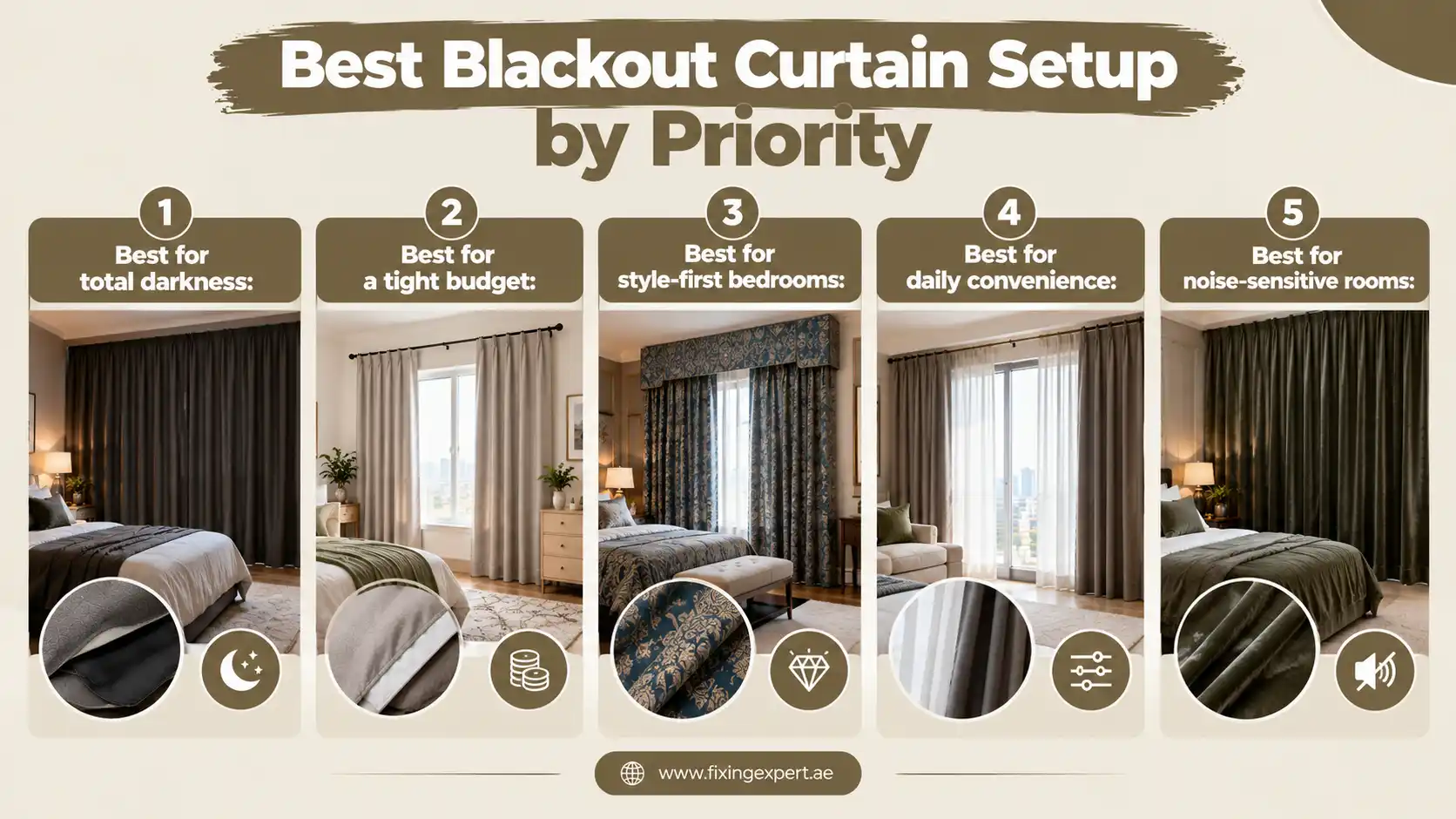
Since the right choice depends on what matters most in a specific room, here is the best setup to aim for by priority rather than by brand:
1. Best for total darkness:
A triple-weave lining behind a dense, dark-toned face fabric, hung floor-length with holders extended 4 to 6 inches above the frame and 3 to 4 inches to each side.
2. Best for a tight budget:
A foam-backed lining behind a mid-weight cotton or polyester face fabric, in a kissing-length cut, using a basic fixed rod rather than a track or motorized system.
3. Best for style-first bedrooms:
A patterned or jewel-toned face fabric with a blackout lining sewn in behind it, paired with a matching valance to hide the header hardware.
4. Best for daily convenience:
A layered setup with a sheer on an inner rod and a blackout panel on an outer rod, letting the room switch between bright and fully dark without swapping curtains.
5. Best for noise-sensitive rooms:
A triple-weave lining paired with a heavier face fabric such as velvet, since the added density does more for sound dampening than a lighter fabric with the same lining grade.
Curtain Rod Holders and Hardware: Getting Full Coverage Right
This is the step most guides skip, and it is often the reason a blackout curtain still lets in a strip of morning light.
Placement of curtain rod holders decides how much light escapes around the edges, no matter how good the fabric is. The rod and its holders need to be positioned so the fabric fully overlaps the window frame on all sides.
Key placement rules:
- Mount holders 4 to 6 inches above the top of the window frame. This lets the curtain rise high enough to cover the gap where light usually leaks in first.
- Extend holders 3 to 4 inches beyond each side of the frame.
- This gives the fabric room to stack fully closed without pulling away from the wall.
- Add a center support bracket for rods over four feet wide. A sagging rod pulls the curtain away from the wall in the middle, creating a light gap right where it is most visible.
- Choose full-coverage heading styles. Pinch pleats, rod pockets, and back tabs sit flush against the rod. Grommet and tab-top styles have gaps between the fabric and the rings, which let in small streaks of light along the top, and the choice of hooks that attach the fabric to the rod plays into this as much as the heading style itself.
- Use a stud finder before drilling. Anchoring into a wall stud gives a stronger hold for heavier blackout fabric than drywall anchors alone, particularly for wide windows or double-layer setups with a sheer behind the blackout panel.
A simple trick worth adding at the end: a small hook-and-eye fastener installed at the point where the curtain’s leading edge meets the wall closes the side gap completely once the curtains are drawn, without needing extra hardware. Anyone unsure about matching the rod style to the fabric weight can look over the range ofavailable rod styles before settling on hardware, and it is worth remembering that the fabric decides how much light a closed curtain blocks while the rod holders and their placement decide how much light escapes around it, so both need attention for a genuinely dark room.
How Long Should Bedroom Blackout Curtains Be?
Length affects both looks and function, and bedrooms benefit from going longer rather than shorter.
There are four common length styles:
1. Floating length
Stopping about an inch above the floor. Practical for high-traffic rooms, though it leaves a small gap at the bottom where light can enter.
2. Kissing length
Just touching the floor without extra fabric pooling.
3. Break-puddle length
Extending slightly past the floor by about an inch, softening the bottom edge.
4. Full puddle length
Pooling 6 to 16 inches of extra fabric on the floor for a more formal look, though it is not ideal for rooms with heavy daily foot traffic.
For a bedroom aiming at full darkness, kissing length or a slight break-puddle is the safer choice over floating length, since even a small floor gap under a short curtain lets in visible light at floor level. Floor-to-ceiling curtains, hung from just below the ceiling to just past the floor, give the strongest coverage and also make the window and the room appear larger, and for windows where a fixed rod is not practical,a track-based hanging system can achieve the same full-height coverage. Shorter curtain lengths trade a small amount of darkness for easier daily use, so a bedroom focused on total light block should lean toward floor-length or slightly past it.
How To Layer Blackout Curtains With Sheers?
Layering solves the problem of wanting both natural daylight and full darkness from the same window, at different times of day.
The setup is straightforward: alightweight sheer fabric hangs on an inner rod closer to the window, and the blackout curtain hangs on an outer rod in front of it. This usually needs a double curtain rod or two separate rods mounted at slightly different depths.
During the day, drawing only the sheer lets soft, filtered light in while still blurring the view from outside for privacy.
At night or for a nap, drawing the blackout panel over the sheer creates full darkness in seconds without removing anything.
This setup also adds visual depth to the window, since the sheer’s texture shows through slightly when both are open, and it lets the two layers be styled in different colors or patterns without one canceling out the other’s benefit. The same layering logic works in other rooms where sheer fabric fits. In a bedroom, it lets one window switch from bright and airy by day to fully dark at night, just by drawing a second layer.
Step-by-Step: Installing Blackout Curtains for Zero Light Leaks
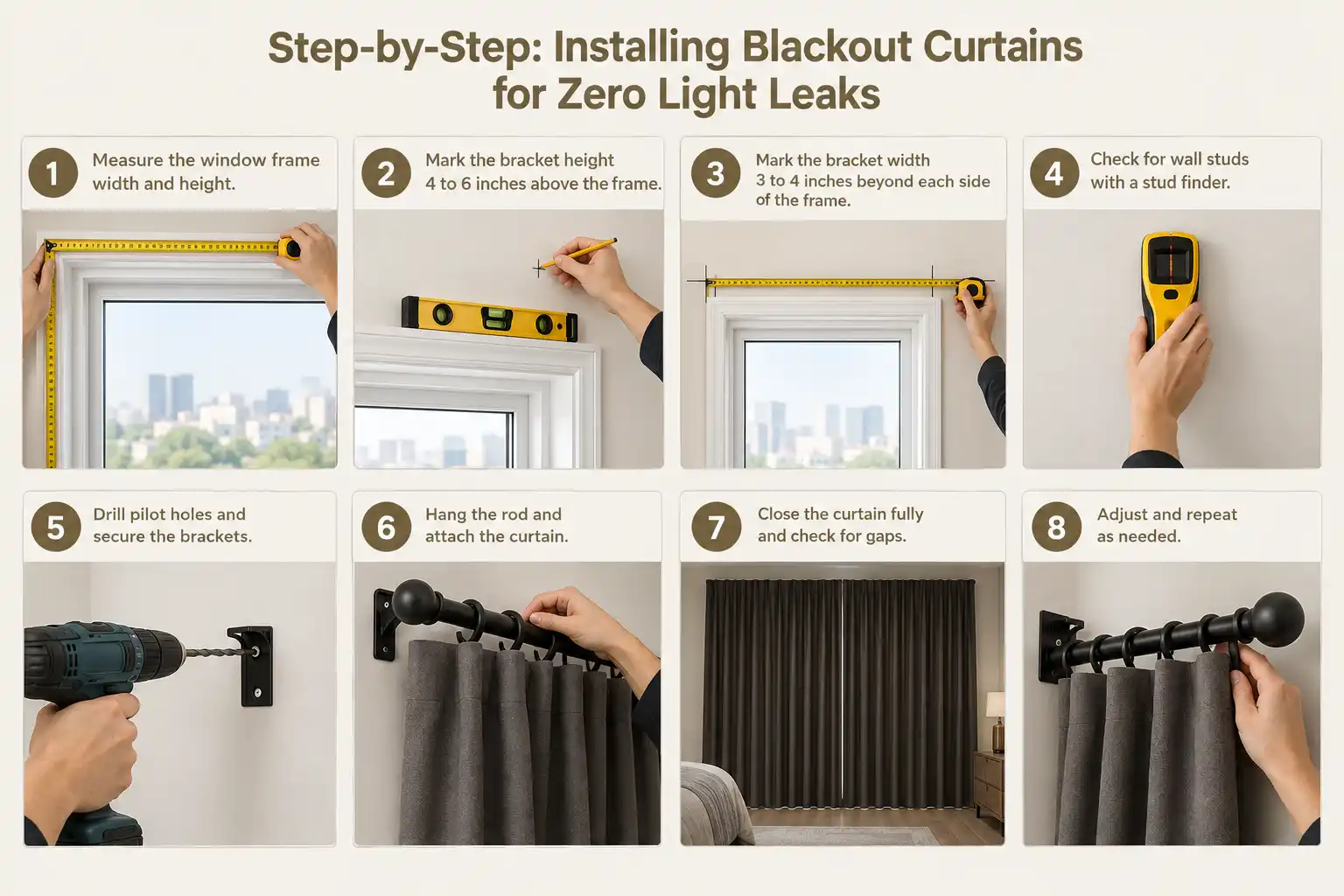
Getting a blackout curtain to actually block light comes down to careful installation, not just buying the right fabric. Here is the process from measuring to final adjustment:
Step 1: Measure the window frame width and height.
Note the outer edges of the frame, not just the glass, since holders need to sit beyond the frame on both sides.
Step 2: Mark the bracket height 4 to 6 inches above the frame.
Use a pencil and a level to keep both marks even on either side.
Step 3: Mark the bracket width 3 to 4 inches beyond each side of the frame.
For a wide window or heavy fabric, add a center bracket to prevent the rod from bowing.
Step 4: Check for wall studs with a stud finder.
Anchor into studs where possible for the strongest hold; use wall anchors rated for the curtain’s weight where a stud is not available.
Step 5: Drill pilot holes and secure the brackets.
Keep the drill bit slightly smaller than the anchor size, and tap anchors in flush with the wall before driving the screws.
Step 6: Hang the rod and attach the curtain.
Slide rings or hooks onto the rod before setting it into the brackets, then fit finials on each end to keep the curtain from sliding off.
Step 7: Close the curtain fully and check for gaps.
Look along the top, sides, and bottom in a dark room during daylight hours; any visible line of light shows exactly where a hook-and-eye fastener or an extra few inches of rod width is needed.
Step 8: Adjust and repeat as needed.
Small adjustments to bracket position or adding side fasteners usually close any remaining leaks without needing new hardware.
Anyone who wants a broader refresher on the general process of hanging curtains before tackling a blackout-specific setup can work through that alongside these steps. A blackout curtain only performs as well as its installation, and checking for light leaks in a darkened room after hanging is the fastest way to catch and fix any gap.
Color and Style Options That Still Look Good
Blackout curtains no longer mean dark, heavy fabric in a limited color range. The lining does the light-blocking work invisibly, which frees up the face fabric to be almost any color or pattern.
Popular directions include:
Light pastels and off-whites
For a room that should feel bright and spacious when curtains are open, with full blackout when closed
Deep jewel tones
Such as navy, forest green, or burgundy for a cozy, dramatic bedroom look
Patterned or textured fabrics
Include options with eyelet-style headers for a cleaner, more structured look, all of which can carry a blackout lining behind them without affecting the pattern’s visibility from the front
Adding trims, tiebacks, or a matching valance at the top of the window also helps disguise the hardware and closes off any remaining light gap at the header, doubling as both a style choice and a functional one. The blackout function lives in the lining rather than the face fabric, so color and pattern choice can be based purely on the room’s decor without any trade-off in light block.
What Mistakes Let Light Sneak In Even With Blackout Curtains?
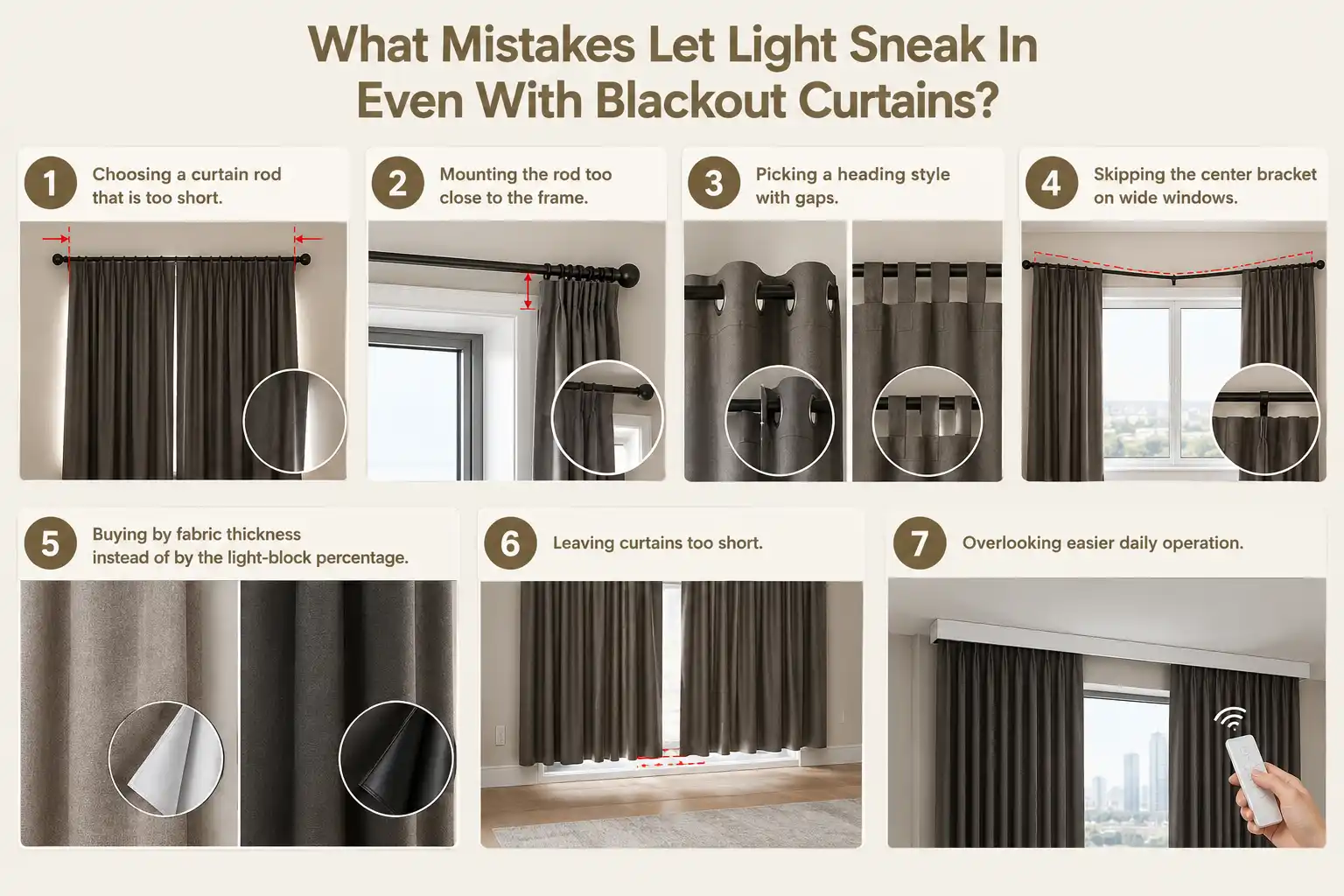
Even a correctly bought blackout curtain can underperform because of small, avoidable setup errors.
- Choosing a curtain rod that is too short. If the rod ends right at the window frame’s edge, the fabric cannot fully stack closed, leaving a triangle of light at the sides every time.
- Mounting the rod too close to the frame. A rod set directly above the frame instead of 4 to 6 inches higher leaves the top gap exposed.
- Picking a heading style with gaps. Grommets and tab tops look modern but leave visible spaces between the fabric and the rod.
- Skipping the center bracket on wide windows. A sagging rod pulls the curtain’s middle section away from the wall.
- Buying by fabric thickness instead of by the light-block percentage. A thick curtain with no proper lining can still let in more light than a thinner one with a genuine blackout lining behind it.
- Leaving curtains too short. A floating length that stops well above the floor creates a bottom gap that a longer, kissing-length curtain would close.
- Overlooking easier daily operation. For a wide window that gets opened and closed often,a motorized track closes the same gap every time instead of relying on someone lining the panels up by hand.
Most light leaks trace back to hardware placement or heading style rather than the fabric itself, so fixing the install usually solves the problem faster than buying a heavier curtain, and for anyone who would rather not handle the drilling and leveling themselves,getting the hardware fitted by someone experienced removes that risk entirely.
Our Honest Rating: Are Blackout Curtains Worth It?
Judged as a category rather than one single product, here is how blackout curtains score against the factors that matter most for a bedroom:
| Factor | Score (out of 5) | Why |
| Light blocking | 4.5 | Near-total block when fabric, lining, and install all line up; loses half a point only for the install-dependent edge gaps |
| Noise reduction | 3.5 | Noticeable dulling of everyday noise, but not a substitute for dedicated soundproofing |
| Temperature control | 4 | Strong performance, especially with thermal or foam-backed lining |
| Style variety | 4.5 | Almost unlimited color and pattern choice since the lining is hidden |
| Ease of installation | 3.5 | Straightforward with basic tools, though correct bracket placement takes care to get right |
| Overall | 4.2 / 5 | A strong, well-rounded choice for most bedrooms, with performance depending more on installation than on the fabric alone |
The half-point deductions consistently trace back to the same cause: installation. A blackout curtain bought with the correct light-block percentage, hung with properly placed curtain rod holders, performs close to a 5 out of 5 for its purpose, and skipping the hardware details is what pulls the real-world score down.
Frequently Asked Questions
Do blackout curtains really block 100% of light?
Yes, curtains rated for full blackout block 95% to 100% of light through the fabric itself. The remaining gap most people notice comes from around the curtain, not through it, usually at the top, sides, or bottom where the fabric does not fully overlap the window frame. Fixing rod placement and curtain length closes that remaining gap almost completely.
Can I make regular curtains into blackout curtains?
Yes, by adding a clip-on or sew-in blackout lining behind the existing curtain. This works best with a face fabric that already has some weight to it, since thin fabrics like sheers do not hold a lining well. It is a lower-cost option than replacing the curtains entirely, though a permanently sewn lining will outperform a clip-on one over time.
Are blackout curtains bad for air circulation in a bedroom?
Not directly. Blackout curtains affect light and, to a lesser extent, heat transfer through the window glass, but they do not block a room’s air vents or general ventilation. Keeping a small gap between the curtain and any air conditioning vent, and opening curtains regularly during the day, keeps air moving normally.
What is the difference between blackout curtains and blackout lining?
A blackout curtain is a complete curtain panel that already includes a blackout layer built in. Blackout lining is just that inner layer, sold separately to be added behind any existing curtain. Buying a full blackout curtain is simpler, while adding lining separately is more cost-effective for someone who already owns curtains they want to keep.
Do dark colors block more light than light colors in blackout curtains?
Slightly, yes. Darker face fabrics absorb light rather than reflecting it, adding a small boost to the lining’s blocking power. That said, the difference is minor compared to the lining itself, so a white or pastel blackout curtain with a proper foam-backed or triple-weave lining will still block close to the same amount of light as a dark one.
How high above the window should curtain rod holders be mounted for blackout curtains?
4 to 6 inches above the top of the window frame is the standard range. Mounting higher than that can work for ceiling height rooms and gives the illusion of a taller window, but going lower than 4 inches increases the chance of a visible light gap at the top edge once the curtain is drawn.
Can blackout curtains help reduce noise from outside?
Yes, to a moderate degree. The dense, layered fabric absorbs and dampens sound waves better than a single-layer curtain, noticeably softening traffic noise, street conversations, or early morning sounds. It is not equivalent to dedicated soundproofing, though anyone dealing with a particularly loud street or shared wall may want to look at options built specifically for blocking sound on top oat optionsard blackout curtain, and for windows facing a sliding glass door, the same fabric-and-hardware approach used there is covered in the comparison of treatments for that kind of opening.