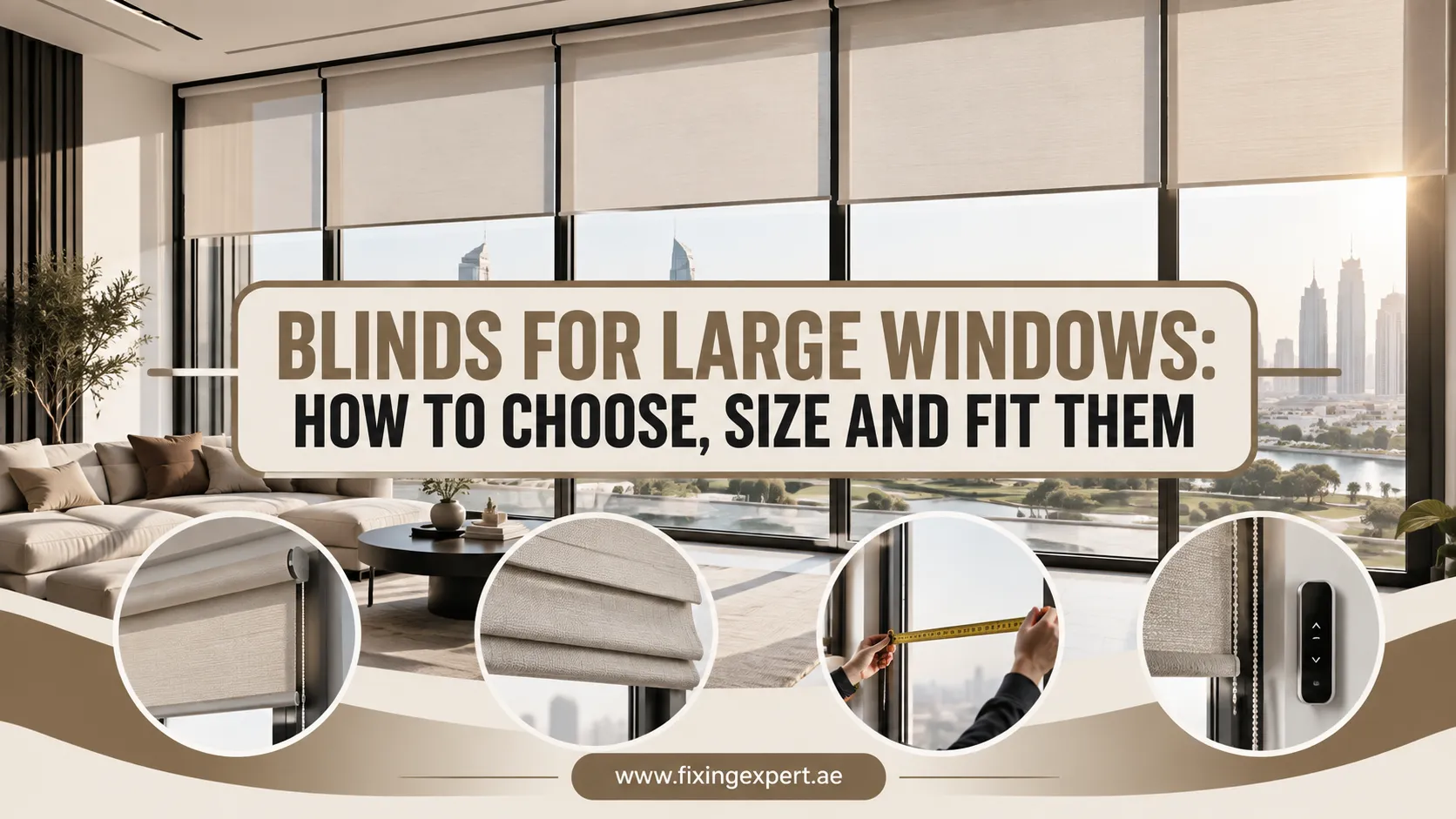
Blinds for large windows work best when the blind type matches the span, the fabric is light enough not to sag, and the control suits the height. For all this to be present, check width limits, weight, and reach before you check color.
Large windows bring in light and views, and they also bring glare, heat, privacy problems and fitting headaches. A blind that works well on a small window can bow, drift or jam when it is stretched across a wide opening. This article explains how to pick the blinds that suit them, how wide and tall a single blind can go, and how to measure and fit without surprises.
Which Blinds Are Best For Large Windows?
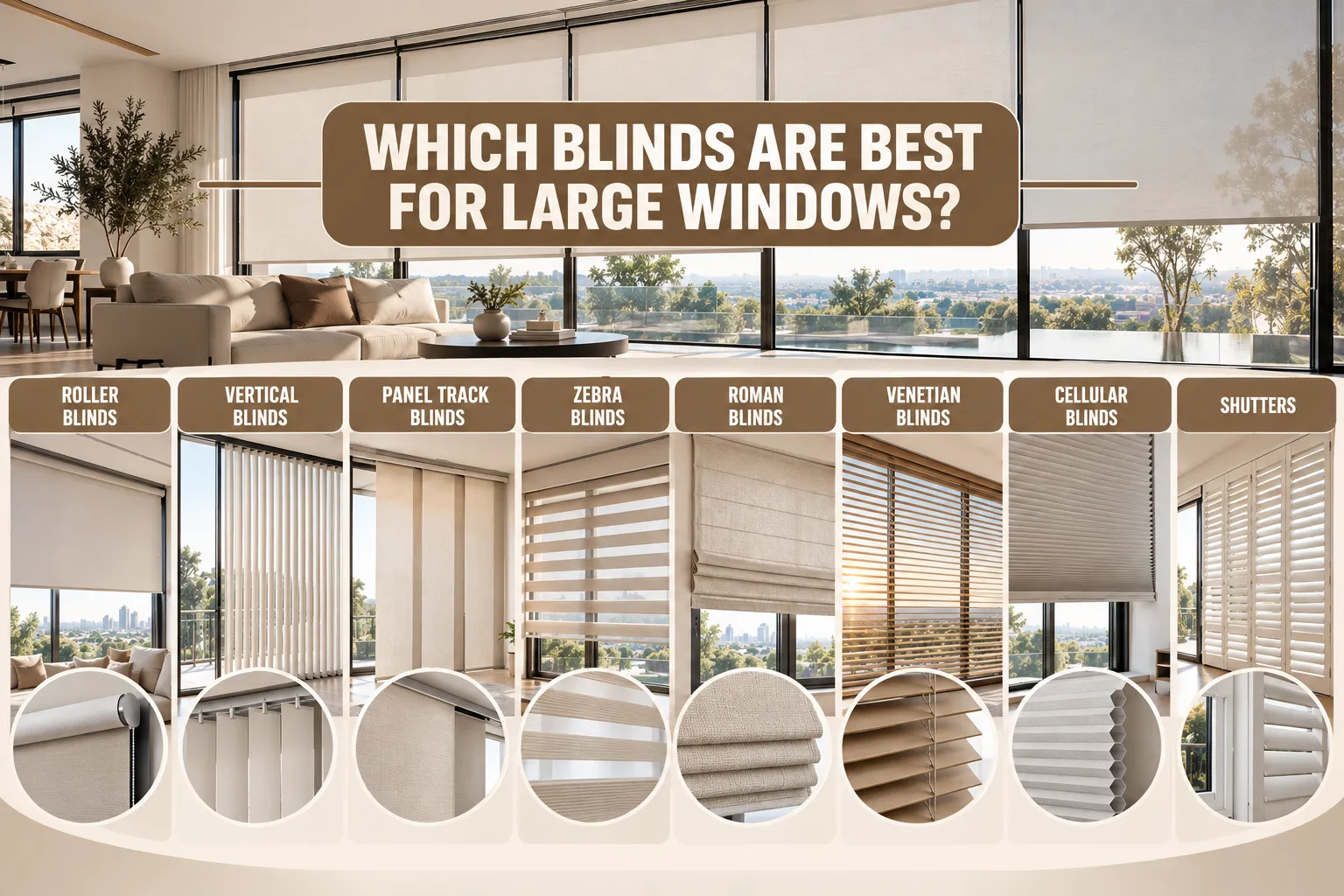
Several blind types handle size well. The right one depends on how the window is used, how much light you want and how often the blind moves.
| Blind Type | Why It Suits Large Windows | Watch Out For |
| Roller | Clean, flat look, many fabrics, works with motors | Needs a center support on wide spans |
| Vertical | Covers very wide glass and doors, slides to one side | Vanes can swing or tear if handled roughly |
| Panel track | Wide fabric panels glide on a track, modern look | Needs room to stack at the side |
| Zebra (day and night) | Quick switch between light and privacy | Layers need clean handling |
| Roman | Soft fabric folds, good for formal rooms | Heavy when very wide, harder to lift by hand |
| Venetian | Tilting slats give fine light control | Wide slats can bow, often split into sections |
| Cellular | Honeycomb pockets help with heat | Harder to wipe clean |
| Shutters | Strong, durable, good control on big panes | Higher cost, needs space to open |
Roller Blinds
Roller blinds are the most flexible choice for big glass. They roll away neatly and leave the whole view open. They suit modern rooms because the lines are simple. For large windows, look at roller fabric made in wide formats and add a center support once the span grows. Heavier fabrics need strong brackets and a stronger tube.
Vertical Blinds
Vertical blinds hang as separate vanes and slide sideways on a track. They cover very wide spans and floor to ceiling glass with one headrail. The vanes tilt to control light, and they stack to one side or split in the middle. Choose sturdy vanes with weights in the hem so they hang straight.
Panel Track Blind
Panel track blinds use wide fabric panels on a track. They look more modern than classic vertical blinds. They suit sliding doors, large patio windows and room dividers. Panels can stack on one side or split to both sides.
Zebra Blinds
Zebra blinds use alternating sheer and solid bands on one rolling fabric. Slide the bands apart and light enters. Align them and the glass is covered. This gives two settings on one blind, which is handy on large windows where light changes through the day.
Roman Blinds
Roman blinds fold into soft layers. They suit formal living rooms and dining rooms. On very wide windows they can get heavy, so many are fitted with a motor or split into two or three blinds across the window.
Venetian Blinds
Venetian blinds use horizontal slats that tilt. They give fine control of light angle and privacy. On wide windows, wide slats can bow, so the blind is usually split into sections that share one frame.
Cellular Blinds
Cellular blinds trap air in small pockets, which gives a layer of insulation. They suit big rooms that overheat in summer or lose heat in winter. They are best in low traffic rooms because the cells are harder to wipe than a flat fabric.
SHUTTERS
Shutters are made of solid panels and built to last. They fold or slide to open. Broad panels suit large windows and glass doors. For a closer comparison, this look at how shutters compare with curtains and blinds covers cost, upkeep and style.
Start with the shortlist for your window shape, then narrow it with light, heat and control needs.
How To Choose Blinds For Different Large Window Shapes?
Each window shape has its own best pick. This section covers the most common ones.
WIDE WINDOWS
Wide windows suit vertical blinds, panel track blinds and roller blinds with a center support. Split Venetian or Roman blinds also work. Pick a blind that stacks small, so it does not hide the view when open.
TALL WINDOWS
Tall windows make the controls hard to reach. Motors, remote controls and wall switches solve this. A long chain can work, but it needs a cord clip and safe placement. A light fabric is easier to lift if there is no motor.
FLOOR TO CEILING GLASS
Full height glass needs a blind that covers the whole drop and still lets people pass. Vertical blinds, panel track blinds and roller blinds with a motor are common. A privacy fabric helps at night, when the room looks like a display case from outside.
SLIDING GLASS DOORS
Glass doors need a blind that moves out of the way for daily use. Vertical and panel track blinds suit this well. A good starting point is thinking about what suits a sliding door in daily use, because people walk through the opening many times a day and the blind must not snag.
BAY WINDOWS
A bay window has angled sections. Each section usually needs its own blind, with enough clearance at the corners so two blinds do not collide. For angled bay windows how to mark and fit each panel is the real game.
Picture Windows
A picture window is one large fixed pane. Roller and Roman blinds suit it well. Because the glass does not open, there is no handle to block the fit, which makes an inside mount easier.
Corner And Double Height Windows
Corner windows need two blinds that meet cleanly at the edge. Double height windows are best with a motor and a long, strong track. Reaching a double height blind by hand is hard, so plan the controls before you plan the fabric.
Match the blind to the window shape first, then choose fabric and color.
Fabrics and Materials For Large Window Blinds
Material changes weight, price and care. On large windows, weight matters more than anywhere else.
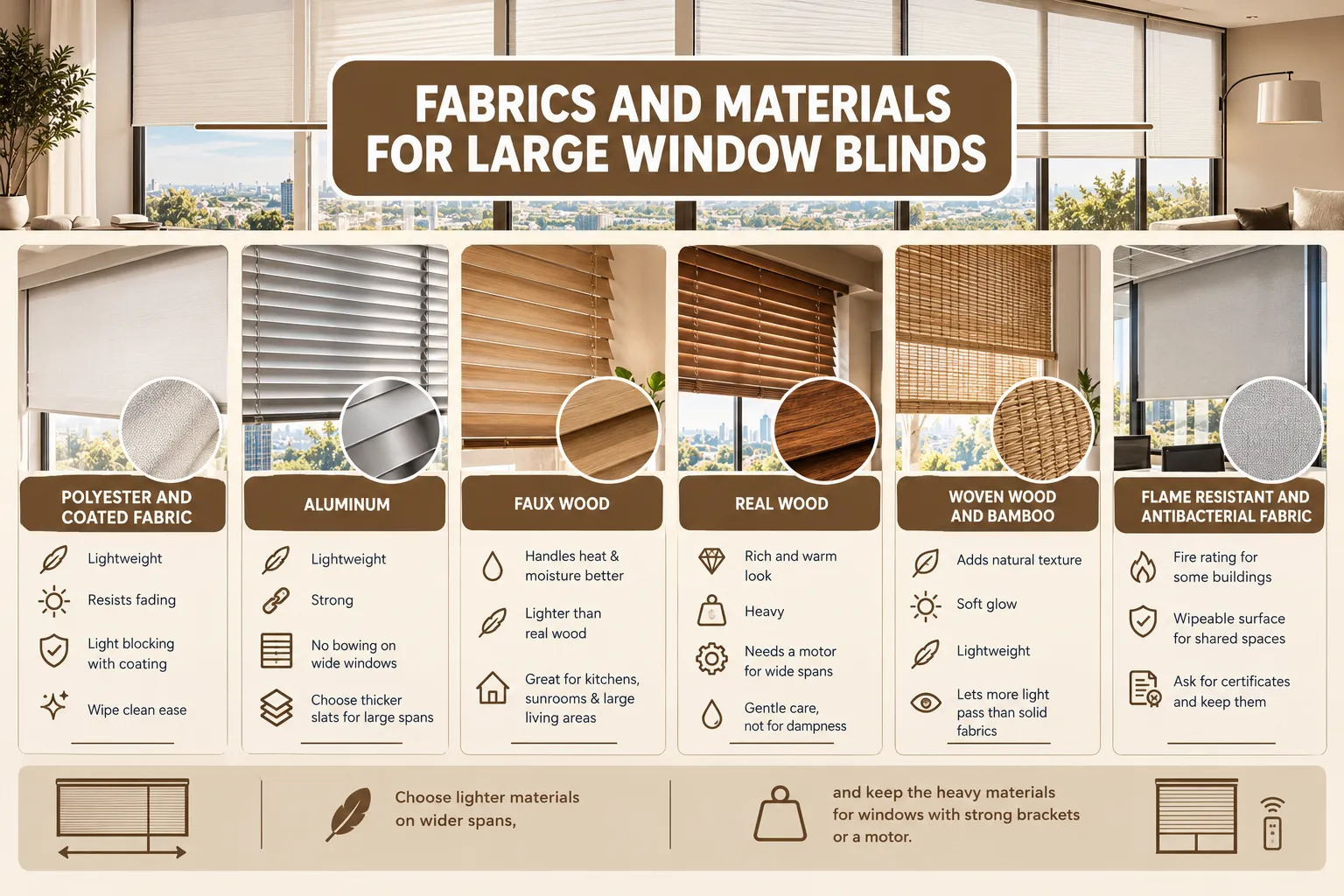
Polyester and Coated Fabric
Polyester blends are light, hold their shape and resist fading. A coating adds light blocking and wipe clean ease. This is the most common choice for large rollers and Romans.
Aluminium
Aluminum slats are light and strong. They suit Venetian blinds on wide windows because they bow less than wide wood slats. Pick thicker slats for big spans.
Faux Wood
Faux wood handles heat and moisture better than real wood. It is lighter than real wood, which helps on wide spans. It suits kitchens, sunrooms and big living areas.
Real Wood
Real wood looks rich and warm. It is heavy, which limits width and makes a motor useful. It needs gentle care and does not like dampness.
Woven Wood and Bamboo
Natural weaves add texture and let a soft glow through. They are light, but they let more light pass than solid fabrics.
Flame Resistant and Antibacterial Fabric
Some buildings need fabric with a fire rating, and shared spaces benefit from wipeable surfaces. Ask the supplier for certificates and keep them.
Choose lighter materials on wider spans, and keep the heavy materials for windows with strong brackets or a motor.
Blind Colors and Styles That Work on Large Windows
Large windows are a focal point in a room. The blind color and style should support the space.
Light and Warm Colors
White, cream, sand and soft grey keep a big room bright and open. Warm neutrals suit rooms with natural light and wood tones.
Dark Colors
Charcoal, navy and deep green add depth and cut glare. They suit large rooms with strong light. In small or dim rooms, dark blinds can make a large window feel heavy.
Matching a Row of Windows
Use the same fabric and color across neighboring windows so the wall looks planned. Different shades side by side stand out from the street and from inside.
Patterns
Large patterns suit large windows. Small prints can look busy across a big surface. Keep patterns to one window wall, and use a plain fabric elsewhere.
Framing the View
If the view is the main feature, choose a blind that stacks small or rolls into a neat cassette. If privacy is the main need, a fuller fabric that sits flat is better.
Pick the color to suit the light, the walls and the view, and keep a row of windows consistent.
Should Blinds For Large Windows Be Motorized?
Often yes. Large and tall windows are the best case for a motor.
| OPTION | STRENGTHS | LIMITS |
| Chain | Low cost, simple | Slow on wide blinds, needs cord safety |
| Cordless spring | Clean look, no loose cord | Hard to lift on heavy or very wide blinds |
| Motor with remote | Smooth, quiet, easy for tall windows | Higher cost, needs power or battery |
| Motor with timer or sensor | Moves on a schedule or by sunlight | Needs setup and testing |
Why Motors Help
A motor lifts the weight for you. Several blinds can open together from one button, which keeps a row of windows level. For big, high or awkward windows, motors that move several blinds together take the strain off both people and brackets.
Power and Setup
Motors run on a battery, a plug or hard wiring. Plan this before ordering. A wired blind needs a power point near the headrail. A battery blind needs a charge now and then.
Smart Control
Some systems connect to timers, light sensors or voice assistants. They lower the blinds in strong sun and raise them in the evening. This gives better glare control and cooler rooms.
Child Safety
Motors remove the loose cord, which makes them a safer choice in homes with children and pets. Manual blinds need a cord clip or tensioner.
Choose a motor when the window is tall, wide, heavy or hard to reach.
How Do you Measure Large Windows For Blinds?
Good measuring avoids gaps, rubbing and returns. Large windows are more likely to be out of square, so extra care pays off.
Inside or Outside Mount
An inside mount sits within the window recess. It looks neat but needs enough depth for the headrail or tube. An outside mount sits on the wall or frame, works on any depth and covers more at the edges.
Measuring Steps
- Measure the width at the top, middle and bottom.
- Measure the drop on the left, center and right.
- For an inside mount, use the smallest figure in each case.
- For an outside mount, add overlap on each side, commonly about 50mm, and add space above the glass for brackets.
- Check the recess depth and look for handles, locks or radiators that could block the blind.
- Write the figures down for each window on its own.
Tall Windows
Use a stable ladder or tower, and have a second person hold the tape. A wrong reading on a tall window costs more to fix than on a small one.
Check the Market Limits
Compare your measurements with the maximum width and drop for the blind. If you are close to the limit, split the window or choose a heavier build.
Measure each window on its own and use the tightest figure inside a recess.
HOW Wide Can a Single Blind Be?
Every blind type has a size limit. Beyond it, the blind sags, jams or fails early. Limits vary by maker and by fabric, so always check the figures for the blind you plan to buy.
| BLIND TYPE | TYPICAL MAXIMUM WIDTH |
| Roller | About 2.5 to 3 meters, depending on fabric and tube |
| Vertical | About 4 to 5 meters on one track |
| Panel track | Often 4 meters or more with multiple panels |
| Shutters | About 2.4 meters per panel set |
| Venetian | Usually under 3 meters before slats bow |
| Roman | Often under 2.5 meters before weight becomes a problem |
These are rough ranges drawn from published maker limits. Your supplier’s own limits matter more than any general figure.
ONE WIDE BLIND OR SEVERAL?
When a window is wider than the maximum, or when the fabric would be very heavy, split it into two or three blinds. Fit them side by side on a shared bracket line so the fabrics hang at the same height. This also helps when you want to open only part of the window, such as one section for a view and another for shade.
WHAT ABOUT WINDOWS JOINED BY MULLIONS?
Wide runs of glass are often split by thin posts. Many people choose one blind per pane so the blind follows the frame. A single blind across several panes looks smoother, but it needs a strong headrail and center support.
WHY DO HEADRAILS AND TUBES SAG?
Weight and span are the cause. A thin tube can bend under a large piece of fabric. A thicker tube, a center bracket or a lighter fabric reduces the bow. A sagging tube also rolls unevenly, so the blind drifts to one side.
If the window is close to or beyond the limit, choose two blinds instead of stretching one.
How Are Blinds For Large Windows Get Installed?
Installation on large windows takes more planning. The brackets carry more weight, and the work is often at height.
Brackets and Walls
Check what the wall is made of before drilling. Brick and concrete need wall plugs and a masonry bit. Plasterboard needs fixings made for it, or a solid timber to screw into. A heavy blind pulling on weak fixings can fall.
Center Support
Add a center bracket once the blind passes the standard width. Wide blinds may need more than one support. This keeps the tube level and the fabric rolling straight.
Level and Aligned
Use a spirit level across every bracket. Even a small tilt shows as a leaning blind on a wide window. When several blinds sit side by side, align the brackets on one line.
TWO PEOPLE
Large blinds are long, heavy and awkward. Two people can lift the blind into the brackets without bending the tube or headrail.
SAFETY
Fit a cord clip or choose a cordless or motorized blind. Keep furniture away from the window so children cannot climb up to the controls.
When to Call a Professional
Tall ladders, high ceilings, wiring and big, heavy blinds are best left to trained fitters. They have the equipment and keep the blinds aligned across a whole wall.
What If the Bracket Fails
Over time brackets can bend or pull out of the wall. Replacing a weak or bent bracket is cheaper than replacing the blind and stops the problem from spreading.
Plan the fixings, supports and safety steps before the blinds arrive.
Can You Use Curtains and Blinds Together on Large Windows?
Yes, and large windows suit layering very well. The blind handles daily light control. The curtain adds softness, color and a little sound absorption. Glass reflects sound, so a large window with bare glass can make a room echo more.
Where Layering Helps
- Living rooms with a wide view, where a roller blind controls glare and drapes frame the glass.
- Bedrooms, where a blackout blind and a soft curtain give both darkness and comfort.
- Dining rooms, where a sheer blind lets in light and heavier drapes close for evening.
Depth and Spacing
Mount the blind close to the glass and the curtain rod further forward, so the two layers never rub. Leave enough stack space at the sides so drapes do not cover the view when open. The details of layering blinds under drapes explain how to space the two layers.
Noise
Thick fabrics and linings reduce echo in rooms with a lot of glass. They help with comfort, and for a clear picture of limits, see how much blinds and curtains really reduce noise.
Layer a blind for daily control and a curtain for softness, and keep the hardware at different depths.
Care And Upkeep
Large blinds collect more dust simply because they have more surface.
- Dust every one to two weeks with a soft cloth or a vacuum brush.
- Wipe wipeable fabrics monthly with a damp cloth.
- Check chains, clips and cords every few months.
- Raise and lower the blind regularly so the mechanism does not stiffen.
- For motorized blinds, keep water away from the motor and charge batteries on time.
- Look at the brackets now and then. A loose one needs fixing before the blind sags.
For real wood, use a dry or barely damp cloth. For faux wood and aluminum, a gentle wipe with mild soap is fine.
What Makes Large Windows Harder to Cover?
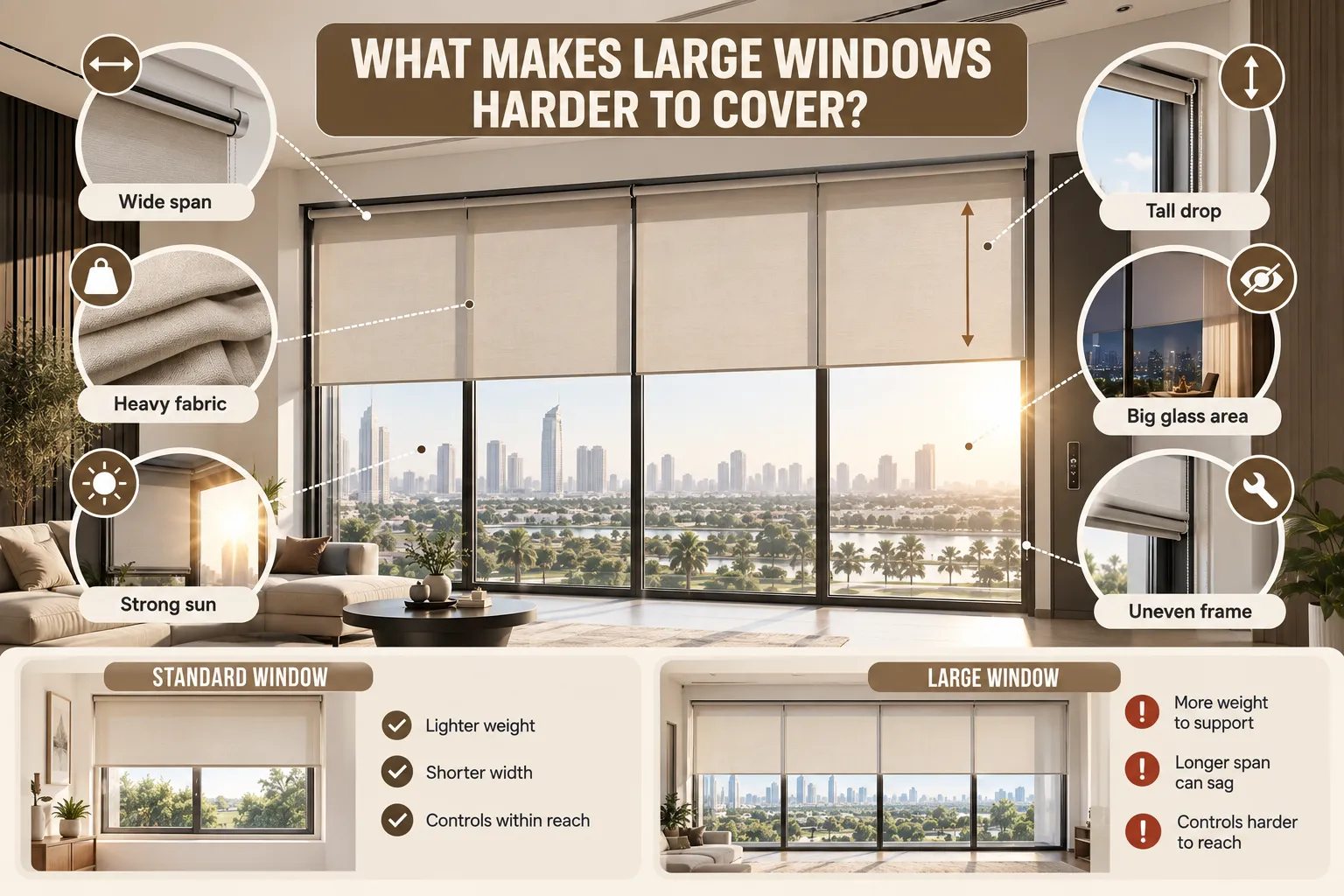
Size changes everything about a blind. More fabric means more weight. A longer tube or headrail bends more easily. A taller window puts the controls out of reach. Each of these problems has a clear fix.
| PROBLEM | WHAT IT CAUSES | WHAT FIXES IT |
| Wide span | Tube or headrail sags in the middle | Center support, lighter fabric, or two blinds side by side |
| Heavy fabric | Hard to lift, stress on brackets | Lighter weave, strong brackets, motor |
| Tall drop | Controls out of reach | Motor, remote or wall switch |
| Strong sun | Glare, heat, faded furniture | Low openness fabric, reflective backing, cellular blinds |
| Big glass area | Little privacy at night | Blackout or dense light filtering fabric |
| Uneven frame | Gaps and binding | Measure three times, use the smallest figure inside a recess |
WHAT COUNTS AS A LARGE WINDOW?
There is no fixed rule. As a rough guide, many standard windows are around 1.2 meters wide by 1.8 meters tall or smaller. Anything wider than about 1.5 to 2 meters, taller than about 2 meters, or reaching the floor is treated as large. Sliding glass doors and bay windows usually fall into this group too.
WHY DO STANDARD BLINDS STRUGGLE?
Most ready made blinds are built for standard sizes. When the width goes up, the roller tube or slat headrail has to carry more weight over a longer gap. Over time this shows up as a visible dip, uneven rolling or a blind that drifts to one side.
Do Blinds Help with Heat and Energy Savings in Rooms with Large Windows?
Yes, windows are responsible for roughly 25 to 30 percent of residential heating and cooling energy use, according to a state energy office, which also advises white shades or blinds to reflect heat away from the house and closing coverings on south and west facing glass during the day.

HEAT IN HOT MONTHS
A closed blind with a reflective or light colored backing sends some sun back out through the glass. A tight weave with low openness blocks more heat than an open one. Blinds on the inside cool less than shading outside, because the glass has already warmed.
COLD MONTHS
Cellular blinds trap air and add a thin layer of insulation. Closing blinds at night keeps more warmth in. Thick fabrics help too, though they cannot match double glazing.
LIGHTING COSTS
Good glare control means people can use daylight for longer. Sunscreen fabric keeps the room bright without hot patches, so lamps stay off for more of the day.
SMART TIMING
Motors can lower blinds when the afternoon sun hits and raise them in the evening. This keeps rooms cooler with no daily effort. For a closer look at how material choice changes heat and wear, this overview of how blind materials behave in strong sun is useful.
Insulation and reflective fabric help most on the windows that get the longest sun.
WHAT MISTAKES SHOULD YOU AVOID WITH BLINDS FOR LARGE WINDOWS?
- Stretching one blind past its width limit.
- Skipping the center support on a wide span.
- Choosing heavy fabric without strong brackets or a motor.
- Ignoring window direction when picking the fabric.
- Measuring once and trusting a single number.
- Using the biggest figure for an inside mount.
- Leaving out cord safety.
- Using different fabrics on neighboring windows.
- Fitting a tall blind with chain controls and no way to reach them.
- Ordering before checking the maker’s size limits.
HOW DO YOU MAKE THE FINAL CHOICE?
Follow this routine to turn the information above into an order.
STEP BY STEP
- List every large window with its width, height and direction.
- Decide the main need for each: view, privacy, darkness or heat control.
- Pick a blind type from the table above.
- Check the maker’s maximum width and drop against your measurements.
- Decide chain, cordless or motor.
- Request samples and hang them against the glass for a full day.
- Plan the fixings and who will fit the blinds.
- Order all blinds for one wall in the same batch.
FREQUENTLY ASKED QUESTIONS
What Are The Best Blinds For Large Windows?
Roller, vertical and panel track blinds are the most common picks. Roller blinds suit modern rooms and work with motors. Vertical and panel track blinds cover very wide glass and doors. A common case is a living room with a wide patio window. Panel track blinds slide to the side and keep the view open, while a roller blind with a center support suits a picture window.
How Do You Ccver A Very Wide Window?
Use a blind built for width, or split the window into two or more blinds.
Check the maker’s maximum width first. A window of three meters is often easier with two roller blinds side by side on one bracket line than with one stretched blind. A vertical blind on a track also handles long spans well.
Can One Blind Cover a Large Window?
Yes, if the size is within the maker’s limits. A roller blind can go about 2.5 to 3 meters wide in many ranges. Beyond that, a vertical blind or two blinds are safer. A center support keeps a wide tube level.
Why Does My Large Blind Sag In The Middle?
The tube or headrail is carrying more weight than it can support. Add a center bracket, switch to a lighter fabric, or split the window into two blinds. A thin roller tube on a wide window often sags within months, and a thicker tube fixes it.
Are Vertical Blinds Good for Large Windows?
Yes, for wide windows and glass doors. They slide sideways and cover long spans. Choose sturdy vanes with weights in the hem. A wide glass wall with vertical blinds in a light filtering fabric keeps a room bright and private.
What Are the Best Blinds for Tall Windows?
Motorized roller or Roman blinds are best for tall windows. A motor removes the need to reach cords or chains. Remote, wall switch and app controls all work. A tall stair window is a common case where a motor saves a ladder trip every day.
Should Blinds for Large Windows Be Motorized?
Often yes, especially for tall, wide or heavy blinds. Motors lift the weight, keep several blinds level and remove loose cords. If the window is small and low, a chain is enough. For a double height window, a motor is almost always the better choice.
What Blinds Are Best for Sliding Glass Doors?
Vertical and panel track blinds suit sliding glass doors. They move out of the way for daily use and do not snag on the door. A roller blind can also work if it sits above the door and does not touch the handle.
Do Large Windows Need Blackout Blinds?
Only in rooms that need darkness, such as bedrooms and media rooms. For living areas, a sunscreen or light filtering fabric keeps the view and cuts glare. A bedroom with a wide west facing window often needs blackout fabric with side channels to stop light around the edges.
What Color Blinds Suit Large Windows?
White, cream, sand and grey suit most rooms, and dark colors work in bright, large rooms. Light colors keep the room open. Dark colors cut glare and add depth. Using the same color on neighboring windows keeps the wall looking tidy.
Do Blinds Help Keep Large Rooms Cool?
Yes, when they are closed during the hottest hours. Reflective, tight weave and cellular blinds cut the most heat. A west facing living room that heats up in the afternoon often feels noticeably cooler once a low openness fabric is fitted.
How Do You Measure Large Windows for Blinds?
Measure the width and drop in three places and use the smallest figure for an inside mount. For an outside mount, add overlap on both sides and space above the glass for brackets. A wide window that is 1,998mm at the top and 1,992mm at the bottom is ordered at 1,992mm for an inside mount.
Can You Use Curtains with Blinds on Large Windows?
Yes, and the two layers work well together. The blind controls light daily, and the curtain adds softness and reduces echo. Mount the rod further forward than the blind so the fabrics never touch.