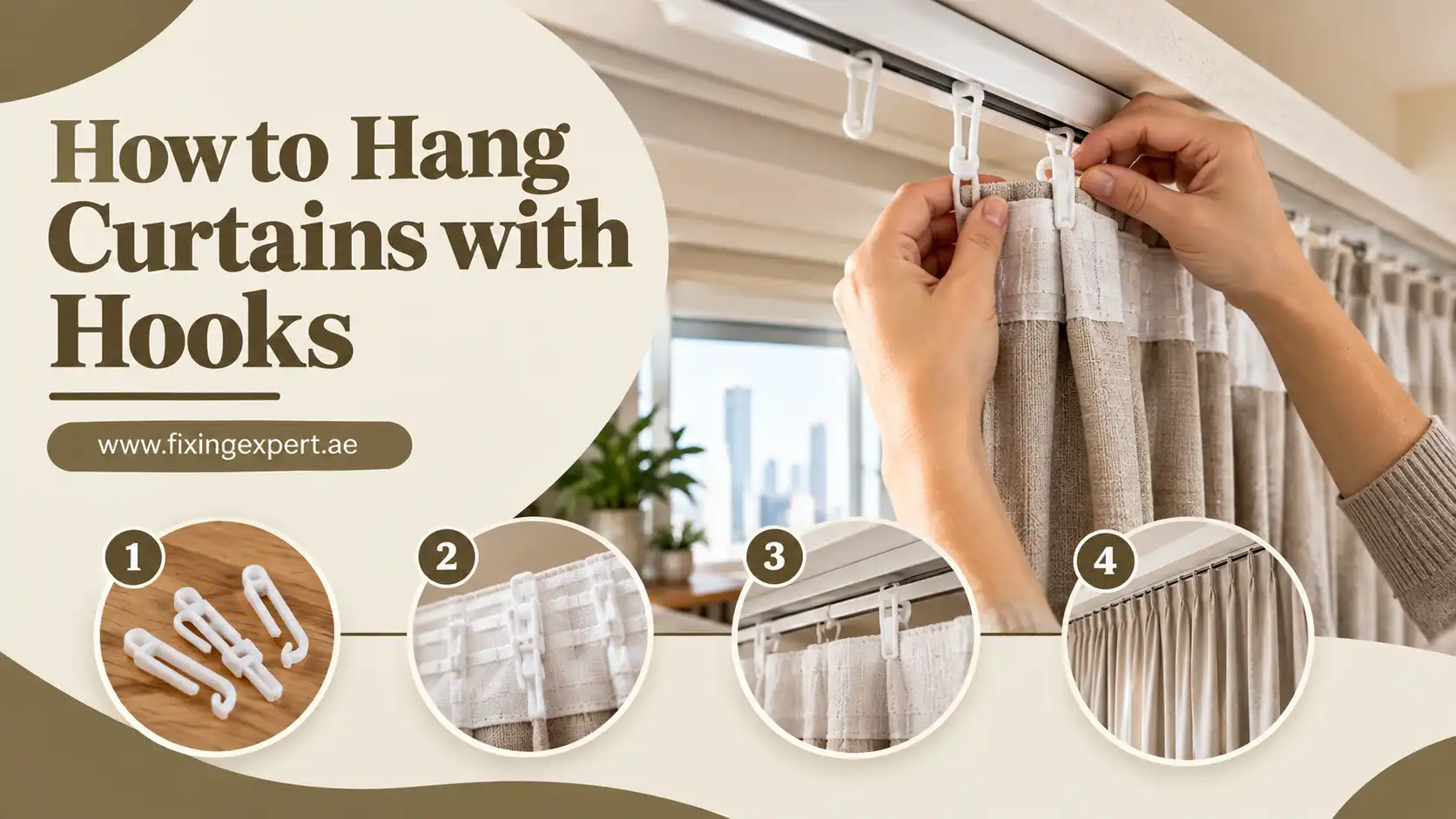
How to hang curtains with hooks comes down to four steps: match the hook to the curtain heading, place the hooks at the same height and spacing, attach them to rings or track gliders, then shape the folds.
Pencil pleat curtains use hooks that slide directly into the pockets on the header tape. Understanding proper curtain installation involves selecting the right heading style, gathering necessary hardware, calculating exact hook spacing, and troubleshooting sagging fabric. Combining poles with rings provides smooth movement and structured folds, where hanging curtains with rings offers an effective approach for heavy or unlined drapes.
Pencil pleat curtains use hooks that slide into the tape pockets. Place one hook every 4th to 6th pocket. Pinch pleat curtains use pin hooks that go behind each pleat. Add one extra pin at each outer edge and one at the centre.Rod pocket curtains can use pin-on hooks with eyelet rings for a ringed look.Wave curtains, also called S fold or ripple fold, use the fixed hook spots on the wave tape.Eyelet curtains need no hooks at all.Keep every hook at the same height. A small difference shows as a slanted hem.Tie the folds loosely for 24 hours or more after hanging so the pleats set.
What do you need to hang curtains with hooks?
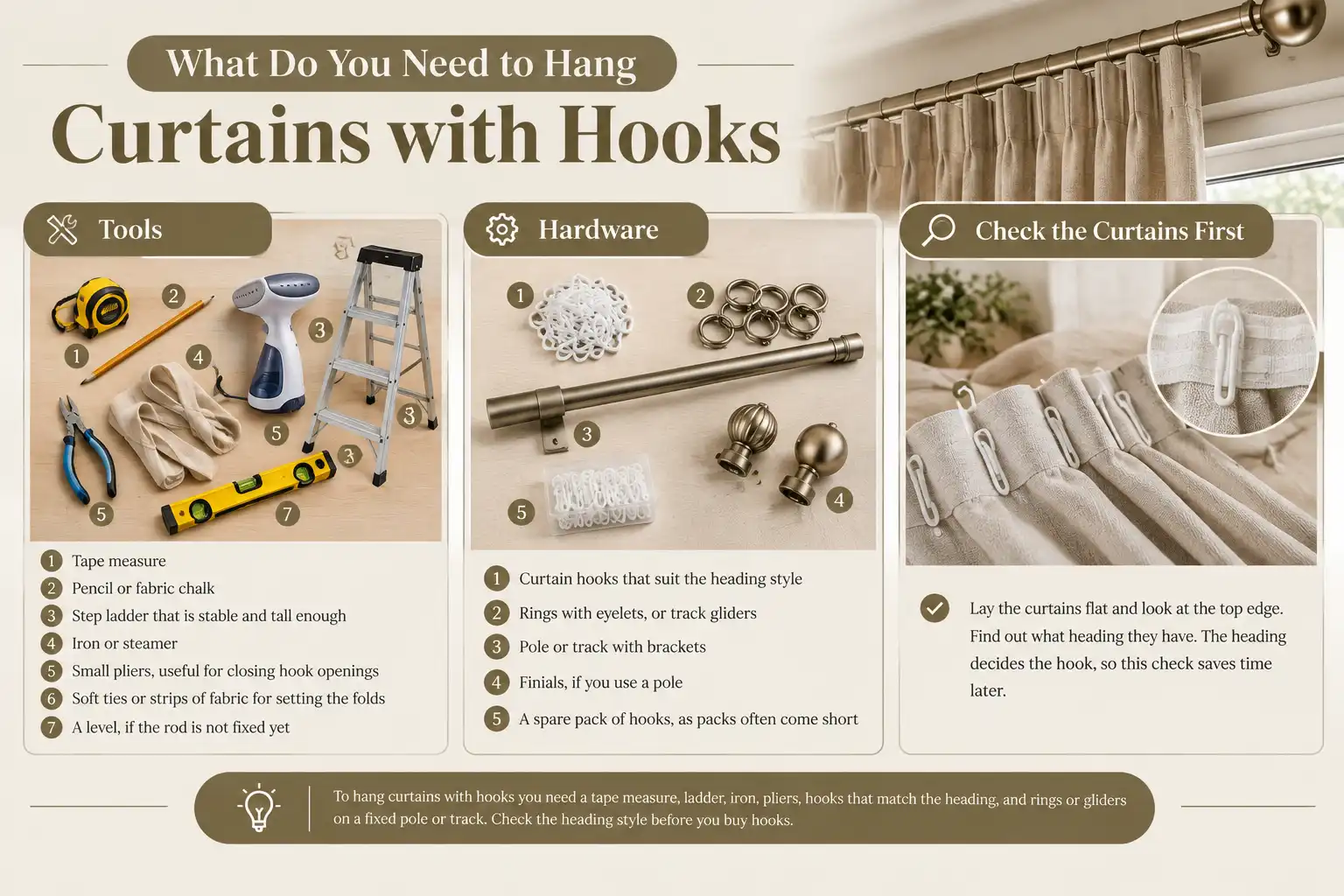
You need a short list of tools and the right hardware. Gather everything before you start, because you will be on a ladder and you do not want to climb up and down.
Tools
- Tape measure
- Pencil or fabric chalk
- Step ladder that is stable and tall enough
- Iron or steamer
- Small pliers, useful for closing hook openings
- Soft ties or strips of fabric for setting the folds
- A level, if the rod is not fixed yet
Hardware
- Curtain hooks that suit the heading style
- Rings with eyelets, or track gliders
- Pole or track with brackets
- Finials, if you use a pole
- A spare pack of hooks, as packs often come short
Check the curtains first
Lay the curtains flat and look at the top edge. Find out what heading they have. The heading decides the hook, so this check saves time later.
To hang curtains with hooks you need a tape measure, ladder, iron, pliers, hooks that match the heading, and rings or gliders on a fixed pole or track. Check the heading style before you buy hooks.
Which curtain hooks should you use?
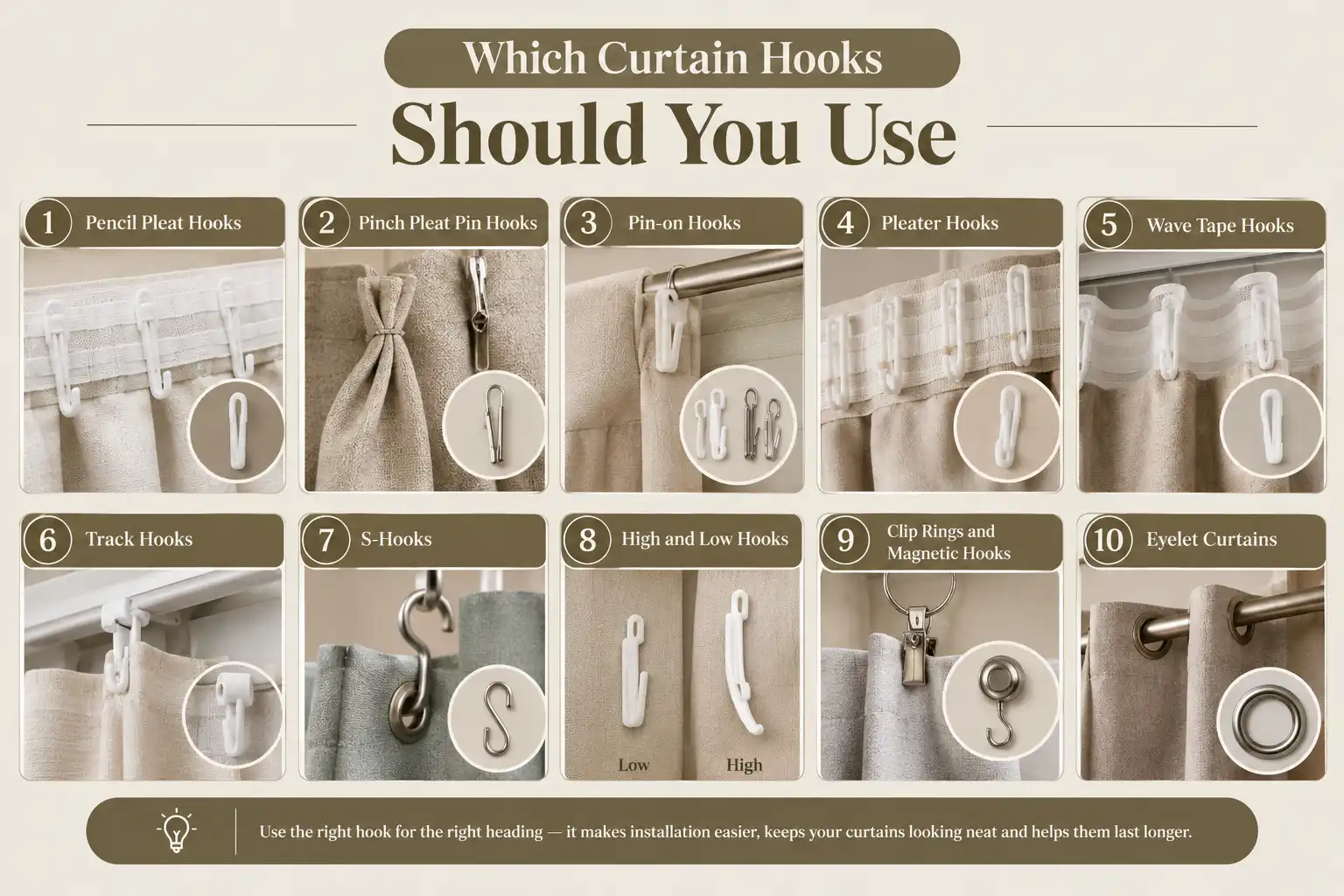
The right hook depends on the heading and on what the curtain hangs from, with each style designed for a specific setup. While pencil pleat headers rely on standard plastic slides, pinch pleats require specialty pin hooks, and heavier fabrics often need durable metal hardware.
Pencil pleat hooks
These slide into the pockets of the heading tape. Push them in with the tail pointing down. Hook into the pockets only, never into the pull cords.
Pinch pleat pin hooks
These have a sharp pin. The pin goes up behind the stitching of a pleat until only the hook end shows. They give a formal, tailored look.
Pin-on hooks
These pierce the back layer of a rod pocket or flat header. The curved end drops into a ring eyelet. They let plain panels hang like curtains on rings. Pin hooks come in a few shapes. Round pin hooks suit rings and traverse rods. Pointed top pin hooks suit pinch pleats. Long-neck pin hooks suit thick curtains and deep headers.
Pleater hooks
These have prongs that slide into pleating tape or loops on the back of a curtain. They grip firmly, so they suit thick or heavy fabric.
Wave tape hooks
Wave tape has set hook positions. The hooks sit at fixed distances on evenly spaced carriers, so the folds come out even without measuring.
Track hooks
Track hooks connect the curtain to the runner or glider that moves along a track. They stay hidden behind the fabric when the curtains are closed.
S-hooks
S-hooks link a grommet or a sewn loop to a ring. They suit light curtains and are easy to attach and remove.
High and low hooks
A low hook lets the curtain hang lower. A high hook lifts the curtain top. On a ceiling track, low hooks help the curtain cover the track. On a pole with rings, high hooks are the usual choice. If the track is very shallow, high hooks can work better.
Clip rings and magnetic hooks
Clip rings are not true hooks, but many people use them as a no-sew option. They suit light, flat panels. Clips can mark delicate fabrics such as silk and velvet, and they may not hold very heavy curtains. Magnetic hooks work on metal window frames where a rod cannot go.
Eyelet curtains
Eyelet curtains have metal rings sewn in. The pole passes through them, so you do not need hooks.
Use pencil pleat hooks for tape headings, pin hooks for pinch pleats, pin-on hooks for rod pockets, and wave tape hooks for wave curtains. Eyelet curtains need no hooks.
Which heading styles need hooks?
Each heading style has its own way of holding the curtain. This table shows the match.
| Heading style | Hook needed | Hangs from | Look |
| Pencil pleat | Pencil pleat hook | Rings or gliders | Even, gathered pleats |
| Pinch pleat | Pin hook | Rings or gliders | Formal, spaced pleats |
| Goblet pleat | Pin hook | Rings or gliders | Full, cup shaped pleats |
| Wave (S fold or ripple fold) | Wave tape hook | Gliders | Soft, even S folds |
| Rod pocket | Pin-on hook (optional) | Pole | Gathered, relaxed |
| Back tab | Pin-on hook (optional) | Rings or pole | Clean front, hidden tabs |
| Tab top | None or pin-on hook | Pole | Casual |
| Eyelet | None | Pole | Straight, modern folds |
A rod pocket curtain hangs straight on a pole without hooks, while hooks and rings alter how the fabric slides and how its folds cascade. Selectingpinch pleat curtains creates structured double or triple folds, whereas opting for wave curtains forms uniform, continuous S-shaped folds. Ultimately, the heading style dictates the required hardware—tape, pleated, and wave headers rely on specific hooks, whereas eyelet and tab top styles slide directly onto the pole.
Curtain poles, rings and tracks
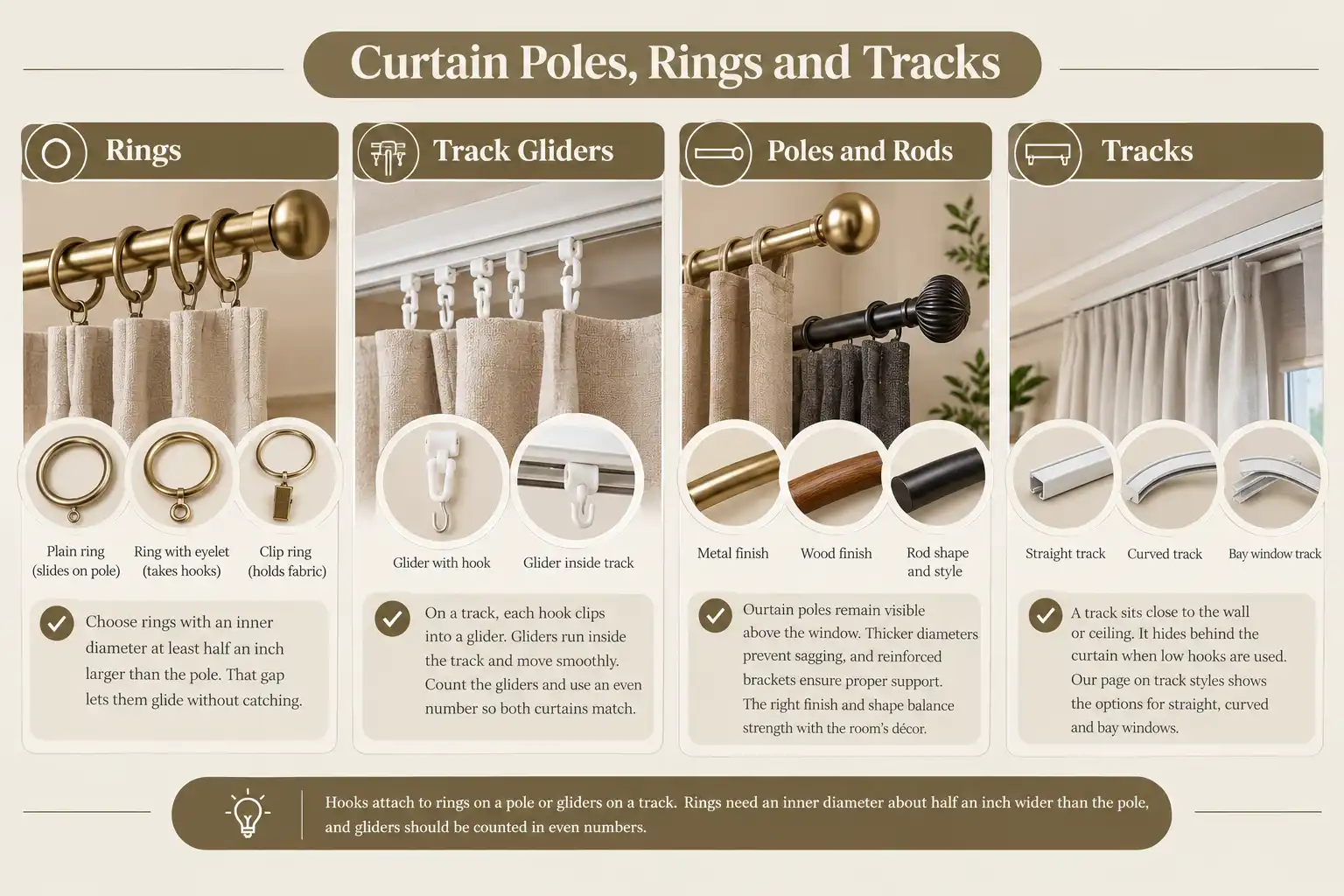
The hook is only one part of the system. It links the curtain to the ring or glider, so those parts must match.
Rings
Rings slide on the pole. Choose rings with an inner diameter at least half an inch larger than the pole. That gap lets them glide without catching. Rings with eyelets take hooks. Clip rings hold the fabric without a hook.
Track gliders
On a track, each hook clips into a glider. Gliders run inside the track and move smoothly. Count the gliders and use an even number so both curtains match. Privacy curtains inhealthcare rooms work the same way, with runners on a ceiling track.
Poles and rods
Curtain poles remain visible above the window, making the choice of metal or wooden finish key to matching room décor. Thicker diameters prevent sagging under heavy drapes, while curtain rods with reinforced brackets ensure proper support across wider spans. Selecting the right rod shape and finish balances structural weight capacity with the overall aesthetic of the space.
Tracks
A track sits close to the wall or ceiling. It hides behind the curtain when low hooks are used. Our page ontrack styles shows the options for straight, curved and bay windows.
Hooks attach to rings on a pole or gliders on a track. Rings need an inner diameter about half an inch wider than the pole, and gliders should be counted in even numbers.
How do you measure before you hang?
Good measuring makes hanging easier. Do it before you touch a hook.
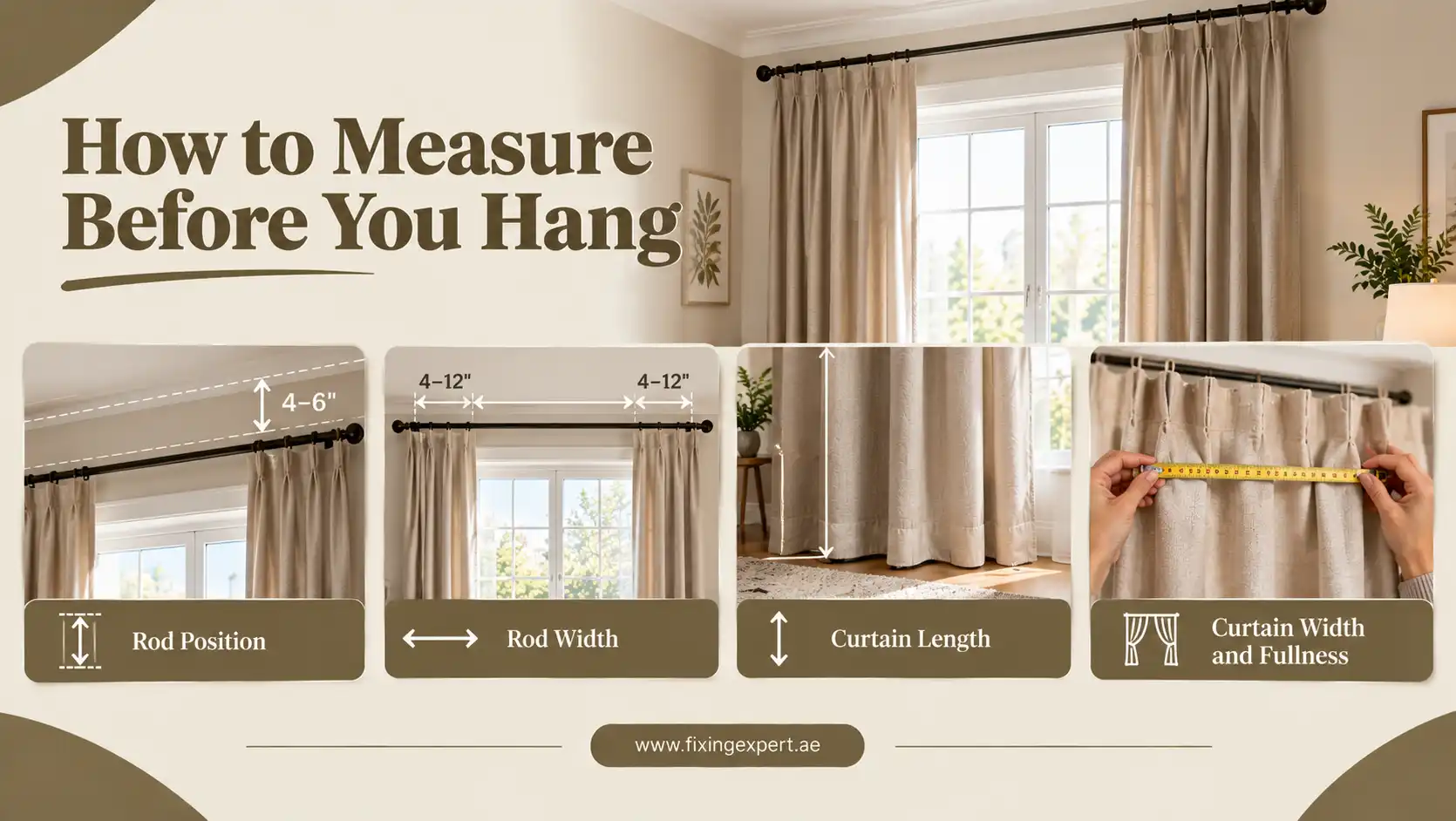
Rod position
Set the pole halfway to two thirds of the way up between the window frame and the ceiling. Many designers also suggest mounting it 4 to 6 inches above the frame. A higher pole makes the window and the ceiling look taller. If the room has moulding, adjust to suit it.
Rod width
A pole about 4 to 6 inches wider than the window frame on each side is a common guide. Some designers go up to 12 inches. Wider poles let the curtains rest on the wall when open, so the window gets full light.
Curtain length
Decide where the hem should land. Common choices are just above the floor, touching the floor, or with a small pool of fabric. Remember that the hook and ring add height. Measure from the top of the pole, not from the top of the ring. If the length is off, book a curtain alteration service .
Curtain width and fullness
Full curtains look better. Pleated headings are usually made about two to two and a half times the track width. A pencil pleat can shrink to half its width when pulled up. Once you pull the tape cords, you cannot return it to the original size. Check the fit before you pull.
Set the pole halfway to two thirds up toward the ceiling, make it 4 to 12 inches wider than the frame on each side, and measure the drop from the top of the pole. Check the width before you pull any heading tape.
How do you hang pencil pleat curtains with hooks?
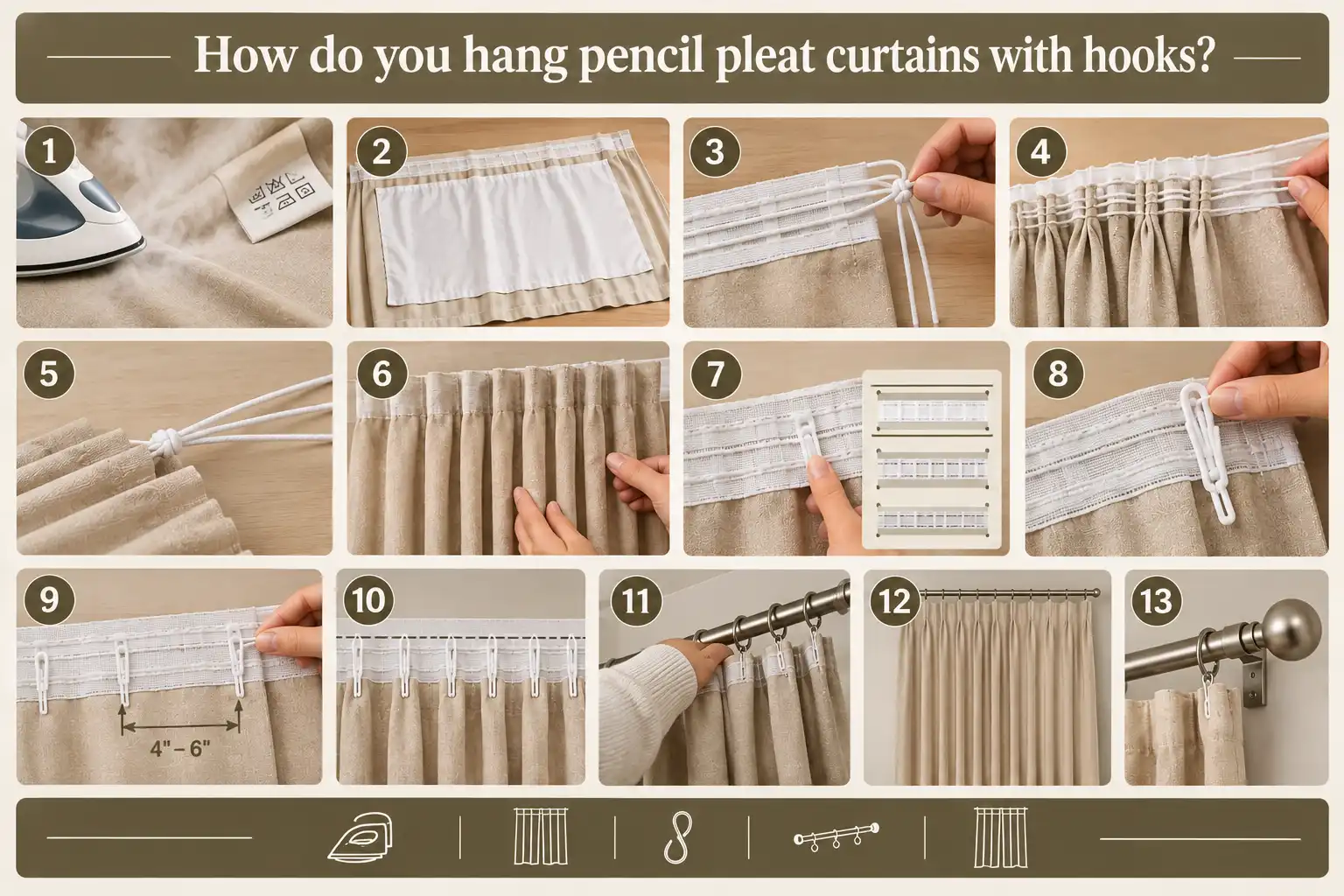
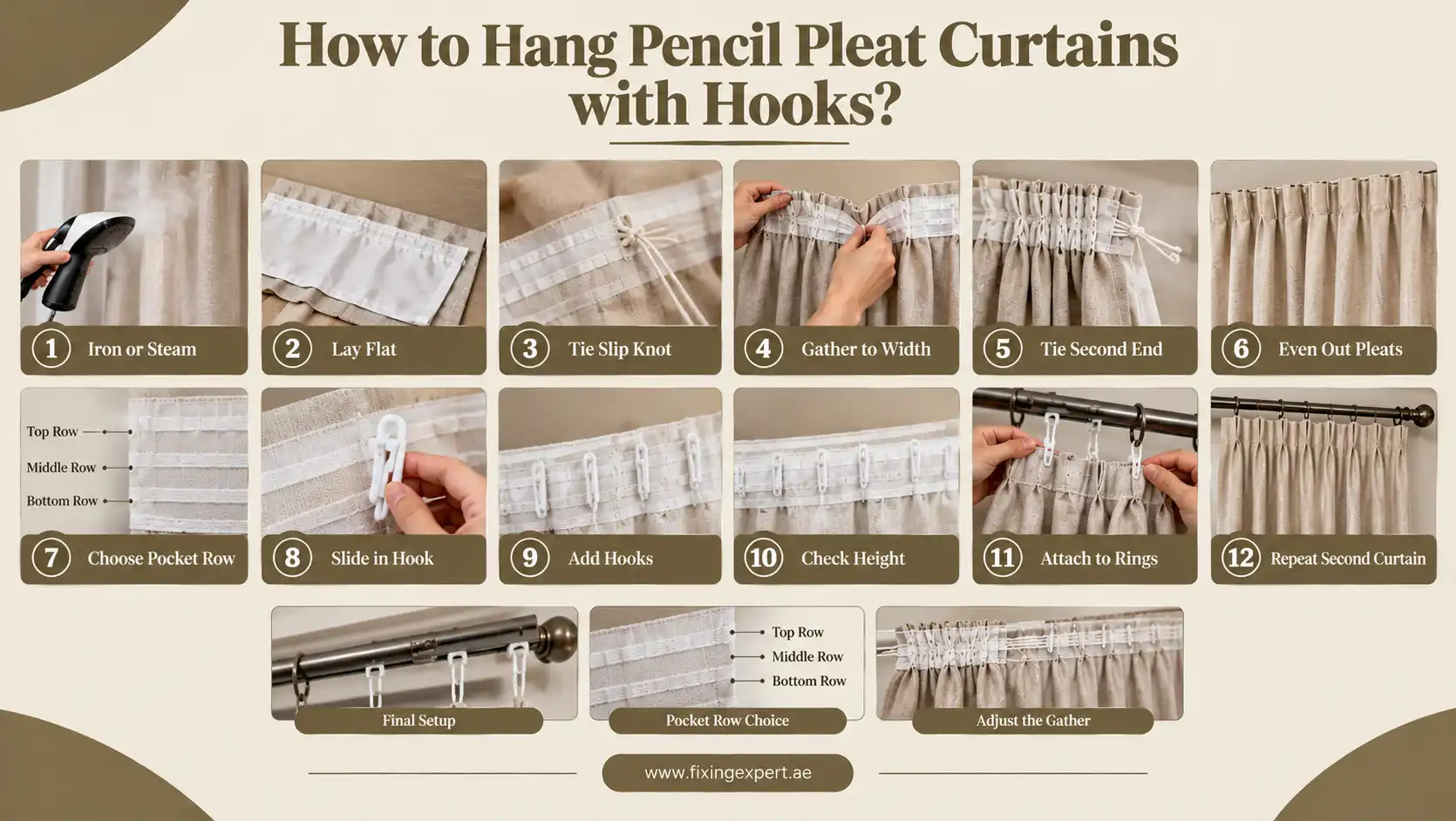
Pencil pleat is the most common heading that uses hooks. The tape at the back has three rows of pockets and three cords. Follow these steps.
Step by step
- Iron or steam the curtain to remove creases. Check the care label for heat settings.
- Lay the curtain flat with the lining facing you.
- Find the three cords on the tape. Tie them in a slip knot at one end. Tuck the knot away. Do not cut the cords.
- Hold the loose cords at the other end. Push the curtain along the cords until it gathers to the width you want.
- Tie the cords at the second end and tuck them away.
- Even out the pleats. Each pleat should be the same width and shape.
- Choose a pocket row. The top or middle row shows the pole or track. The bottom row hides it.
- Slide a hook into a pocket at the outer edge. Point the tail down.
- Add hooks along the tape. Place one hook every 4th to 6th pocket.
- Check that all hooks sit at the same height.
- Drape the curtain over your arm. Attach the hooks to the rings or gliders.
- Repeat with the second curtain.
- Slide the last ring on each side to sit between the bracket and the finial.
Pocket row choice
The pocket row sets the curtain length. The top row lifts the curtain and shows more of the pole. The bottom row lowers it and hides the pole. Try one hook in each row first if you are not sure.
Adjusting the gather
Loosen the cords a little if the curtain looks too tight. A tight gathering makes stiff, narrow folds. A loose gathering looks flat. Aim for even folds with soft depth.
To hang pencil pleat curtains, gather the tape cords, tie them off, place a hook in the chosen pocket row every 4th to 6th pocket, and clip the hooks into rings or gliders.
How do you hang pinch pleat curtains with hooks?
Pinch pleat curtains have pleats sewn in. The pleats are spaced further apart than on pencil pleat tape. They need pin hooks rather than tape hooks.
Step by step
- Iron the curtain.
- Count the pleats. This tells you how many pins you need and how far apart they sit.
- Add three extra pins. One goes at each outer edge and one goes at the centre where the two curtains meet.
- With the lining facing you, slide the pin up under the stitches at the back of a pleat.
- Push it until the sharp tip is hidden and only the hook end shows.
- Place a pin in every pleat.
- Set each pin as close to the top as you can while keeping it hidden. The curtain should hang below the pole or track.
- Check the length after a few pins before you continue.
- Add a pin at the outer edge of each curtain.
- Add a pin at the inner edge of one curtain only. Leave the inner edge of the other curtain free so it overlaps and closes the gap.
- Support the curtain on your forearm. Start from the middle and work outward, hooking each pin into its ring or glider.
- Place the last ring between the finial and the bracket.
Why the overlap matters
The free inner edge lets one curtain sit over the other. This stops light from showing at the centre when the curtains are closed.
For pinch pleats, place a pin in every pleat, add one at each outer edge and one at the centre of one curtain, and hook them from the middle outward.
How do you hang rod pocket curtains with pin-on hooks?
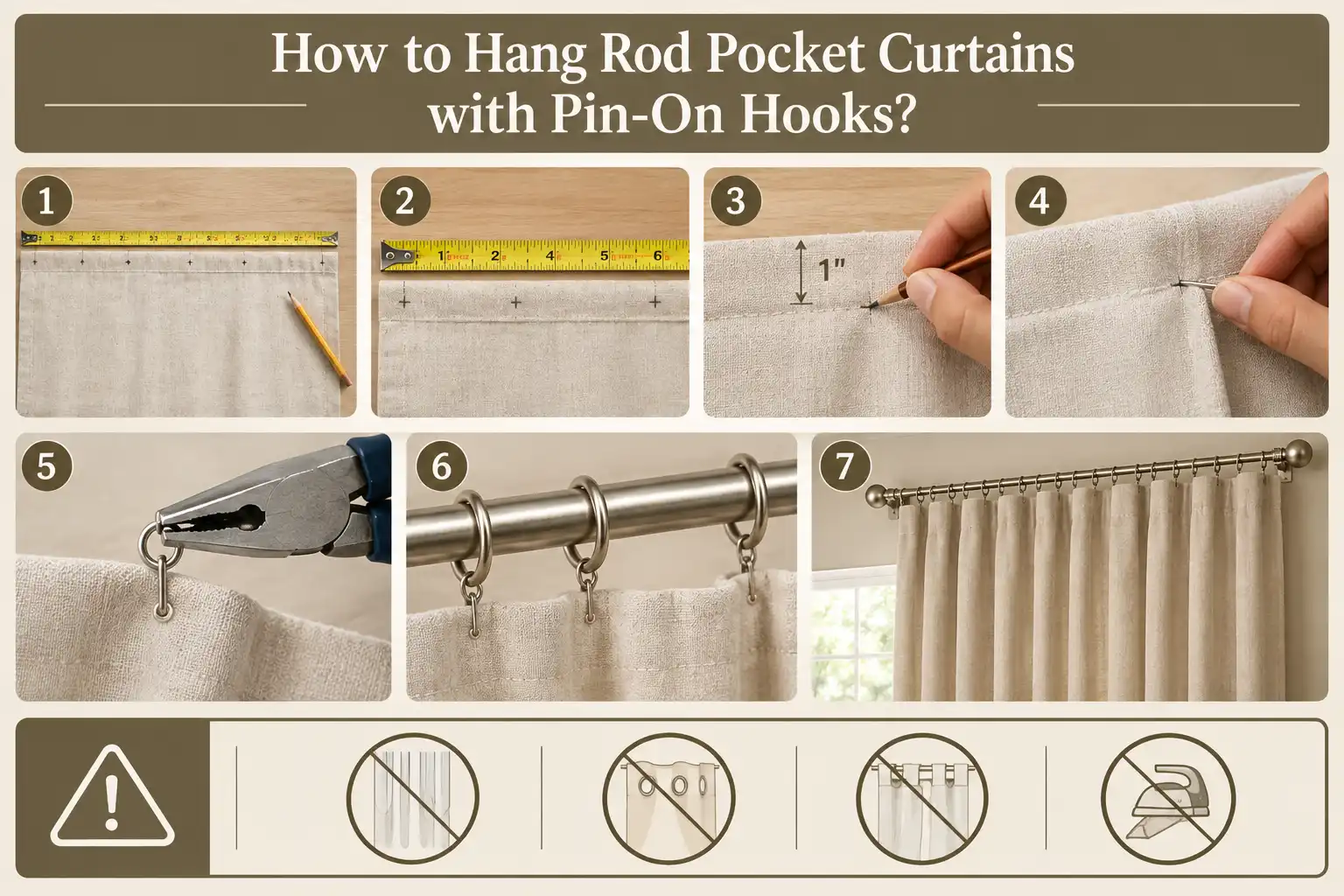
This method gives plain rod pocket panels the elevated look of ring-slung drapery. Because the pin needs multiple fabric layers to remain completely hidden, it performs best with thick, sturdy materials. Hanging rod pocket curtains with pin hooks secures the panel evenly to rings for a smoother glide, while the essential steps below outline the basic process.
Quick steps
- Lay the panel flat and mark hook spots 4 to 6 inches apart.
- Place the two end marks about 1 to 2 inches in from the edges.
- Mark the pin height. For a standard pocket, about one inch below the top edge works. Adjust for deeper or shallower pockets.
- Push each pin through the back layer of the pocket only. No pin should show on the front.
- Close the ring eyelets a little with pliers so the pins cannot slip out.
- Thread each pin hook through a ring eyelet and hang the rings on the pole.
- Leave the last ring on each side outside the bracket.
When this method is not suitable
Avoid it on thin sheer fabric. The pins can tear it. Grommet tops and curtains without a pocket or tabs also do not work, because the pin has nothing to hide behind. For sheer fabric, iron-on pleating tape or reinforcing fabric behind the pocket can help.
Pin-on hooks give rod pocket curtains a ringed look. Mark spacing 4 to 6 inches apart, push each pin through the back layer only, and close ring eyelets so the pins cannot slip out.
Hanging wave curtains on a track
Wave curtains use a special tape with fixed hook spots. This makes the folds even and easy to set. The style is also known as S fold or ripple fold.
Steps
- Look at the tape. The hook spots are set at equal distances.
- Place a wave hook in each marked spot.
- Clip each hook into a glider on the track.
- Move the curtain along the track to check the folds.
- Adjust any hook that sits out of line.
The set spacing removes the guesswork. Do not add or remove hooks from the tape positions. Changing the spacing breaks the wave pattern. Wave panels also work well withmotorised curtains, since the track already carries the load.
Wave curtains hang from gliders using the hook spots on the tape. Fill every spot and keep the spacing as made.
How many hooks do you need per curtain?
Hook count changes how the curtain hangs. Too few hooks let the fabric sag between them. Too many make it stiff.
The basic rule
Place one hook every 4th to 6th pocket on pencil pleat tape. For pin-on hooks, keep 4 to 6 inches between them. Count one at each end.
The formula
Take the gathered width of the curtain in inches. Divide by your spacing. Add one for the end hook.
Example: a panel gathered to 50 inches with 5 inch spacing needs 50 divided by 5, which is 10, plus 1. That gives 11 hooks.
Adjusting for weight
Heavy curtains such as lined blackout or thick velvet need closer spacing, near 4 inches. Light fabric can go nearer 6 inches. Match the count to the rings or gliders too. Each hook needs one.
Divide the gathered width by the spacing and add one. A 50 inch panel with 5 inch spacing needs 11 hooks, and heavy fabric needs closer spacing.
How do you get neat, even folds?
Hooks set the top of the curtain. The folds need a little time to settle.
Shape the folds by hand
Once the curtain is up, run your fingers down the fabric. Guide each fold into place from top to bottom.
Tie the folds
Tie soft fabric strips around the curtain at the top, middle and bottom. Keep the ties loose. Leave them for at least 24 hours. Thick or stubborn fabric may need up to three days.
Steam if needed
If creases remain, use a steamer. Steam the curtain while it hangs. Keep the steamer moving so the fabric does not get wet in one spot.
Check the hem
Stand back and check that the hem is level. If one side is longer, check the hooks on that side. A hook set a quarter inch lower shows as a slant.
Shape the folds by hand, tie them loosely at the top, middle and bottom, and leave the ties on for 24 hours or more. Check that the hem is level.
How do you hang heavy, sheer and outdoor curtains with hooks?
Fabric weight changes the hook, the hardware and the spacing.
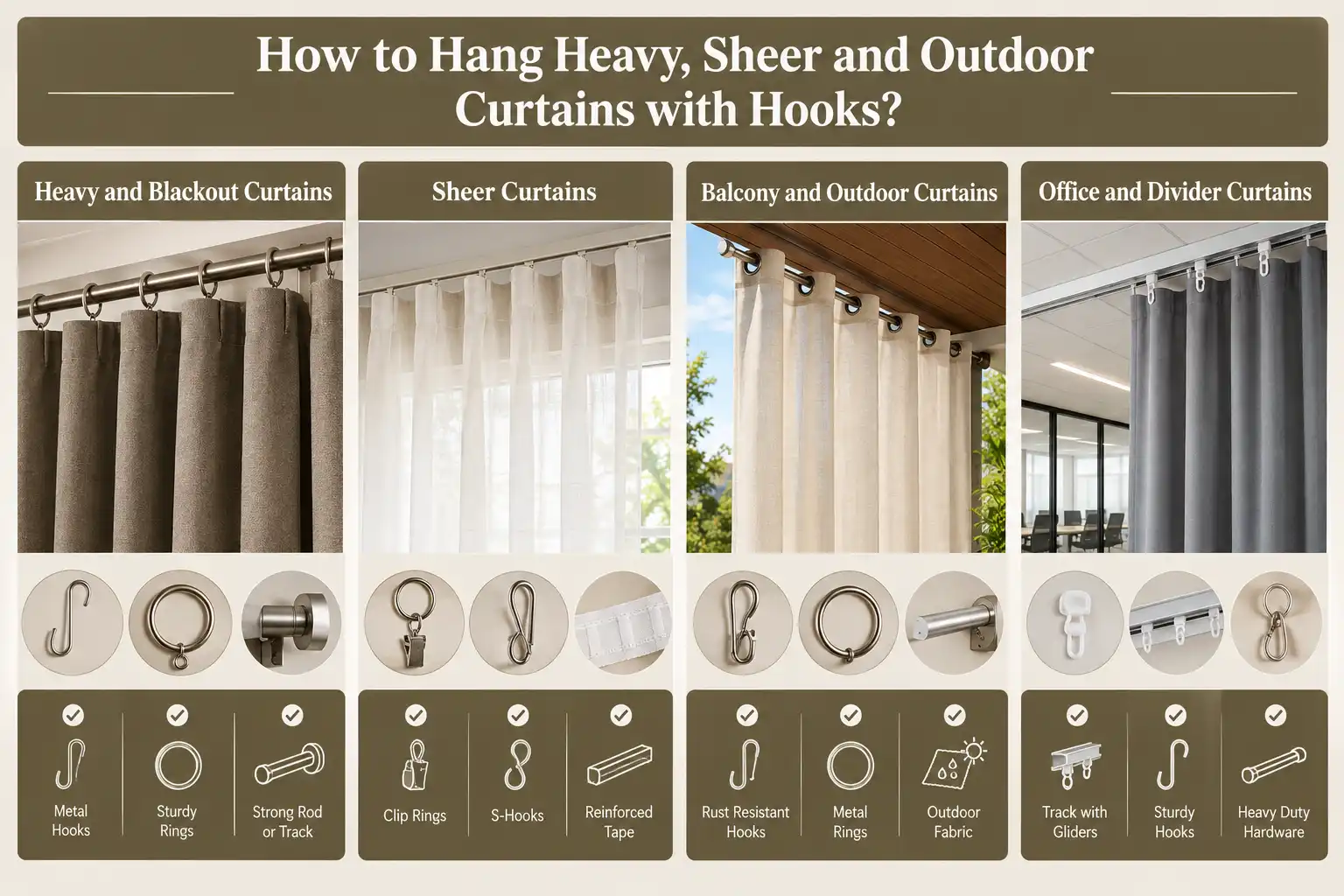
Heavy and blackout curtains
Lined blackout curtains and dense soundproof curtains are heavy. Use metal hooks, sturdy rings and a strong pole or track. Heavy duty metal tracks and rods handle the load better than thin ones. Keep hook spacing near 4 inches.
Sheer curtains
Light fabric tears easily at the pin. Use clip rings, S-hooks or hooks on reinforced tape, and space them a little closer. Layering a sheer panel behind a heavier one is common, and our notes on hanging sheer curtains in different styles show how. You can also browse our sheer curtains range.
Balcony and outdoor curtains
Outdoor curtains face sun, wind and moisture. Choose rust resistant metal hooks and rings. Indoor fabric does not suit outdoor use, so pick a fabric made for it. See ourbalcony curtains page for suitable options.
Office and divider curtains
Offices often use tracks with gliders for wide runs and partitions. Hooks should be sturdy, since these curtains open and close often.
Use metal hooks and closer spacing for heavy curtains, reinforced hooks or clips for sheers, and rust resistant hardware outdoors.
Can you hang curtains with hooks and no rod?
Yes, in some cases. This is the route when drilling is not allowed. The word hooks can mean wall hooks as well as curtain hooks, so it helps to know the limits.
Adhesive wall hooks
Adhesive hooks stick to a clean, dry wall. They suit light to medium curtains. Space several hooks across the window to spread the weight. Check the weight limit on the pack.
Tension rods
A tension rod fits inside the window frame by pressure. It needs no hooks or screws. It works for light curtains in narrow openings.
Other no-drill options
Magnetic hooks work on metal frames. Curtain wire systems, velcro strips and removable ceiling hooks can also carry light curtains. These methods are useful when you need to hang curtains without a rod, particularly in situations where drilling is not practical. In rental properties, hanging curtains in a rental can also be done with removable fittings that avoid permanent holes or other damage.
Safety points
- Read the weight rating before you buy.
- Wipe the wall clean before sticking anything on it.
- Do not use adhesive hooks for heavy blackout or lined curtains.
- Test with the curtain lightly before you trust the setup.
Wall hooks and tension rods can hold light curtains without drilling, but they have low weight limits. Heavy curtains need a fixed pole or track.
Metal or plastic hooks
Hook material affects strength and lifespan.
Metal hooks
Metal hooks handle weight and last longer. Choose them for heavy, lined or blackout curtains. Brass and zinc plated hooks resist rust. They are less likely to bend or snap.
Plastic hooks
Plastic hooks are light and cheap. They work for light curtains and many tracks. They can crack under heavy loads or with age.
Finish
Metal hooks come in finishes such as brushed nickel, brass or matte black. When the hook shows on a pole with rings, match the finish to the ring and pole.
Use metal hooks for heavy curtains and plastic for light ones. Pick a finish that matches the pole if the hook will be visible.
What mistakes should you avoid?
These errors cause most hanging problems.
- Hooks at uneven heights, which tilts the hem
- Hooks placed in the pull cords instead of the pockets
- Too few hooks on a wide or heavy curtain
- Pulling the tape before checking the width
- Using clip rings on velvet, silk or heavy panels
- Leaving the last ring inside the bracket
- Rings too small for the pole
- Skipping the folding and setting step
Avoid uneven hook height, hooking the cords, too few hooks and clip rings on heavy fabric. Check the width before pulling the tape.
How do you fix common hanging problems?
Most problems have a simple fix.
| Problem | Likely cause | Fix |
| Curtain sags between hooks | Hooks too far apart | Add hooks so spacing is 4 to 6 inches |
| Hem looks slanted | Hooks at different heights | Move hooks to match on both sides |
| Hooks slip out of the tape | Hook opening too wide | Squeeze the hook bottom slightly with pliers |
| Rings catch on the pole | Joint on an extendable rod | Rub clear wax on the seam |
| Pleats look flat | Folds have not set | Shape by hand and tie for 24 hours or more |
| Pin shows on the front | Pin set too high or through both layers | Move it lower and through the back layer only |
| Curtain too short | Hooks in the bottom pocket row | Move to the top or middle row |
| Curtain touches the floor too much | Hooks in the top pocket row | Move to the bottom row |
| Gap at the centre | Both inner edges pinned | Leave one inner edge free to overlap |
If the rod is the problem
Hold a level against the rod. If it is not straight, fix the brackets before you touch the hooks. A crooked rod makes even hooks look wrong.
Match the fix to the cause. Space hooks at 4 to 6 inches, level the hooks and rod, and move hooks between pocket rows to change the length.
Care and maintenance
A little care keeps the hooks and curtains working well.
Before washing
Take a photo of the hook positions on your phone. The photo shows you where each hook goes when you put the curtain back up.
Removing and refitting
Unhook the curtain and lay it flat. Take out the hooks before washing, as metal hooks can mark fabric in the drum. Refit using your photo.
Cleaning hardware
- Wipe metal rings and hooks with a dry microfibre cloth.
- Use a damp cloth with mild soap for deeper cleaning, then dry fully.
- Dust wooden rings dry. Water can swell the wood.
- Wipe plastic parts with a damp cloth.
Safety checks
Check the brackets every so often. Make sure they are firm in the wall and that the pole does not wobble. A loose pole can fall. This matters most in rooms where children or pets play.
Photograph hook positions before washing, remove the hooks first, clean the hardware by material and check that brackets stay firm.
When should you get a professional to hang curtains?
Hanging curtains with hooks is a task most people can do. Some jobs are better left to a fitter.

Heavy or wide curtains
Very wide windows and heavy lined panels put more load on the pole and brackets. A poor fixing can pull out of the wall. Plan the fixing before you order heavy fabric.
High ceilings and awkward spots
Fixing above a tall window needs a safe ladder or tower. A fitter has the gear to do this safely.
Tracks, curves and bays
Curved and bay windows need bent tracks and careful placement. Help from a professional gives cleaner lines.
Motorised systems
Motorised tracks need power and correct wiring. If you are considering motorised curtains, plan the fixing first.
Made to measure
Curtains cut to size tend to hang better because the width, drop and heading are matched to the window.Custom made curtains allow the fabric to sit more evenly across the opening, whilebedroom curtains can be selected around the room’s layout, light levels and overall style.Professional curtain fitting covers the installation of poles, tracks and curtain hanging, particularly where the window is wide, the ceiling is high or the system is motorised.
Heavy curtains, wide windows, bay windows and high-level installations may also require more precise fitting. With the correct measurements and installation, made to measure curtains generally give a cleaner and more balanced finish.
Wrap up
Hanging curtains with hooks is simple when you follow the order. Check the heading, pick the matching hook, space the hooks evenly, keep them level and let the folds set. Most faults trace back to spacing or height, and both are easy to fix.
Pick the hook to suit the heading, keep spacing at 4 to 6 inches, hang at equal height, and set the folds for 24 hours or more.
Frequently asked questions
How do you hang curtains with hooks step by step?
Fit hooks into the heading, clip them to rings or gliders, and hang the curtain on the pole or track.
The steps are:
- Iron the curtain, gather the tape if it has one,
- Place hooks at equal spacing,
- Hook them into the rings or gliders
- Hang the curtain.
For example, on a pencil pleat panel gathered to 50 inches, place 11 hooks at 5 inch spacing, all at the same pocket row.
How far apart should curtain hooks be?
Place hooks 4 to 6 inches apart, or every 4th to 6th pocket on pencil pleat tape.
Closer spacing suits heavy fabric and gives a firmer hang. Wider spacing suits light fabric. A common case is a thick lined panel where hooks at 6 inches leave visible sag, and moving to 4 inches fixes it.
Which curtain hooks are best?
Pin hooks suit pinch pleats, tape hooks suit pencil pleats, and wave hooks suit wave tape.
There is no single best hook, because the heading decides it. A pinch pleat curtain fitted with a tape hook will not hold its pleats. Match hook to heading first, then choose metal for heavy fabric.
Do you need hooks for all curtains?
No. Eyelet curtains and some tab top curtains hang directly on a pole.
Eyelet curtains have rings sewn in, so the pole threads through. Rod pocket curtains also slide on a pole without hooks. Hooks are needed for tape headings, pleats and wave curtains. If you want ringed rod pocket curtains, add pin-on hooks and rings.
How do you hang curtains on a track with hooks?
Place the hooks in the heading and clip each one into a glider.
Count the gliders first and use an even number so both curtains match. Use low hooks if you want the curtain to cover the track. For example, a ceiling track with low hooks lets the curtain fall to the top edge and hide the track.
How many hooks do I need for a curtain?
Divide the gathered width by the hook spacing and add one.
A panel gathered to 60 inches with 5 inch spacing needs 13 hooks. Buy a spare pack, since packs sometimes fall short and running out halfway up the ladder wastes time.
Why are my curtains sagging between the hooks?
The hooks are too far apart or the fabric is heavy for the hook type.
Add hooks until spacing is 4 to 6 inches. Switch to metal hooks if plastic ones are bending. A wide heavy panel often needs two or three extra hooks to remove sag.
Why do my curtain hooks keep falling out?
The hook opening is too wide, or the hooks are in the wrong place.
Squeeze the bottom of the hook lightly with pliers to narrow the gap. Check that pencil pleat hooks sit in the pockets and not on the cords. Pin hooks should sit behind the pleat stitching.
Can I hang curtains without drilling?
Yes, for light curtains. Use adhesive hooks, a tension rod or magnetic hooks.
These have low weight limits. Thin sheers can work. Heavy lined curtains need a fixed pole or track. Always check the weight rating and clean the surface first.
How long should I leave ties on the curtain folds?
Leave them on for at least 24 hours.
Thick or stiff fabric can need up to three days. After that, the fabric holds the folds when you open and close the curtains.
Can I use clip rings on pleated curtains?
You can, but pin hooks work better.
Clips can flatten pleats and mark the header. They suit light, flat panels. For pinch pleats or heavy fabric, pin hooks give a stronger hold and keep the pleats sharp.
Where should the last ring sit on the pole?
Place the last ring between the bracket and the finial.
This holds the curtain in place at the edge and stops it from sliding toward the middle. It also frames the window neatly.